Friday, November 30, 2018

Mónica de la Torre: Newly Segmented 2018 KWH Reading

In January of this year, multitalented poet, translator, editor, and scholar Mónica de la Torre stopped by our own Kelly Writers House to give a reading as part of the ongoing Visiting Poet-Scholar Series. Thanks to PennSound staffer Luisa Healey, we're able to showcase newly-segmented MP3s from that event with our listeners.

The evening began with introductions by both Al Filreis and Davy Knittle, followed by de la Torre's opening comments on the place of serial poems within her collected body of work. Her reading highlights works in this mode, with selections coming from throughout her long literary career. Four is represented by several poems — "Photos While U Wait," "On Neuroticism and Cutting Fabric," "Songs that Changed Your Life," and "Happy New Years" — and she dips into Public Domain for "Cease to Stutter Sing-Song." The majority of the reading, however, is dedicated to her latest publication, The Happy End / All Welcome, and her current work-in-progress, Discontinued Repetition. From the former, we hear "Positions Available," "Table #20," "View from an Aeron Chair," "View from a Dodo Chair," "Table #17," and "Human Intelligence Tasks." As for Discontinued Repetition, de la Torre explains that the book is "mainly all translations of the same poem," "Equivalencias," which was originally written in Spanish about two decades ago. Some of the iterations she reads include "The Poem Is Titled Equivalences," "Self-Mastery," "Hola Mi Amor," "Same As It Ever Was," "Latin Lover," and "The Most Mimetic of All." de la Torre concludes the set with a Q&A session, and her responses are broken up thematically, including talk about writing in two languages, poetry produced by algorithm, and philosophies of translation.

You can listen to and watch de la Torre's 2018 KWH reading here, and be sure to scroll down for a wide array of readings spanning fifteen years.

Wednesday, November 28, 2018

David Bromige: Two Newly Segmented Readings

In a recent Jacket2 commentary post, PennSound co-director Al Filreis highlighted a pair of vintage recordings of David Bromige that had recently been segmented by PennSound staff editor Luisa Healey.

The first of these, dating from May 23, 1989, is an appearance by Bromige on A.L. Nielsen's radio program, Incognito Lounge, which aired biweekly on San José's KSJS-FM. The twenty-two minute program starts with a few introductory comments before Bromige starts reading, with selections including "You," "Sounds Like Something I Would Make," "Lines," and the complete twelve-part poem, "It to Experience."

We also have segmented Bromige's seventeen-minute set from a November 1990 tribute reading to Robert Duncan — which also aired on Incognito Lounge that same month. This reading starts with a lengthy introduction, followed by "The Swiss," "Let Me Put This Another Way," "On a Hundred Block Walk from A Cast of Tens," and two untitled poems identified by their first lines: "I am a brainwashed Sudanese poet…" and "I have five minutes to read it…"

You can listen to both of these readings, and many, many more, on PennSound's David Bromige author page, which showcases a vast array of recordings from the mid-60s through to the late-90s, along with a number of posthumous tribute readings.

Monday, November 26, 2018

Three New Belladonna* Readings, 2018

Today we're following up on a recent post announcing new additions to our Belladonna* Reading Series homepage, with three new readings from the last few months.

The earliest of these, from September 19th, is another launch event for Pamela Sneed's new book, Sweet Dreams, this one being held at the St. Mark's Poetry Project. For this event, which was introduced by Kyle Dacuyen and Rachel Levitsky, Snead was joined by guest readers Roya Marsh, Shelley Marlow, and Tracie Morris.

Next, from October 11th, we have a Belladonna* Roll Call Reading Series event, held at Spoonbill and Sugartown's Montrose Avenue location. This special evening featured Patricia Spears Jones presenting Serena Fox and Rachel Blau DuPlessis presenting Orchid Tierney.

Finally, from October 16th, there's quite an impressive reading co-sponsored by Belladonna*, The Operating System, and Ugly Duckling Presse at McNally Jackson Books in Williamsburg. Elae (Lynne DeSilva-Johnson) served as master of ceremonies for the evening, which featured a line-up of Margaret Randall, Urayoán Noel, Lila Zemborain, María Vázquez Valdez, and Elizabeth Zuba.

Now approaching its twentieth year, Belladonna* continues to be as vital a force as ever in our contemporary poetry scene. On our Belladonna* reading series homepage, you'll find an astounding array of audio and video documentation of the organization's ambitious work promoting "the work of women writers who are adventurous, experimental, politically involved, multi-form, multicultural, multi-gendered, impossible to define, delicious to talk about, unpredictable, and dangerous with language," going back to its very origins. Click here to start browsing, or click any of the individual dates above to visit that specific reading.


Wednesday, November 21, 2018

PennSound Presents Poems of Thanks and Thanksgiving

With the US celebrating Thanksgiving tomorrow, I thought it might be worthwhile to resurrect a PennSound Daily feature from way back in 2010: a mini-mix of poems of thanks and thanksgiving — some old, some new — taken from the PennSound archives.

In a classic recording of "Thanksgiving" [MP3] from the St. Mark's Poetry Project, Joe Brainard wonders "what, if anything Thanksgiving Day really means to me." Emptying his mind of thoughts, he comes up with these free associations: "first is turkey, second is cranberry sauce and third is pilgrims."

"I want to give my thanks to everyone for everything," John Giorno tells us in "Thanks 4 Nothing" [MP3], "and as a token of my appreciation, / I want to offer back to you all my good and bad habits / as magnificent priceless jewels, / wish-fulfilling gems satisfying everything you need and want, / thank you, thank you, thank you, / thanks." The rolicking poem that ensues offers both genuine sensory delights ("may all the chocolate I've ever eaten / come back rushing through your bloodstream / and make you feel happy.") and sarcastic praise ("America, thanks for the neglect, / I did it without you, / let us celebrate poetic justice, / you and I never were, / never tried to do anything, / and never succeeded").

"Can beauty save us?" wonders Maggie Nelson in "Thanksgiving" [MP3], a standout poem from her marvelous collection, Something Bright, Then Holes, which revels in the holiday's darker edges and simplest truths: "After dinner / I sit the cutest little boy on my knee / and read him a book about the history of cod // absentmindedly explaining overfishing, / the slave trade. People for rum? he asks, / incredulously. Yes, I nod. People for rum."

Yusef Komunyakaa gratefully recounts a number of near-misses in Vietnam — "the tree / between me & a sniper's bullet [...] the dud / hand grenade tossed at my feet / outside Chu Lai" — in "Thanks" [MP3], from a 1998 reading at the Kelly Writers House.

Finally, we turn our attention to the suite of poems that concludes Mark Van Doren's Folkways album, Collected and New Poems — "When The World Ends" / "Epitaph" / "Farewell and Thanksgiving" [MP3] — the last of which offers gratitude to the muse for her constant indulgence.

To keep you in the Thanksgiving spirit, don't forget this 2009 PennSound Podcast (assembled by Al Filreis and Jenny Lesser) which offers "marvelous expressions of gratitude, due honor, personal appreciation [and] friendship" from the likes of Amiri Baraka, Ted Berrigan, Robert Creeley, Jerome Rothenberg, Louis Zukofsky and William Carlos Williams.

Monday, November 19, 2018

PoemTalk #130: Gwendolyn Brooks' "Riot"

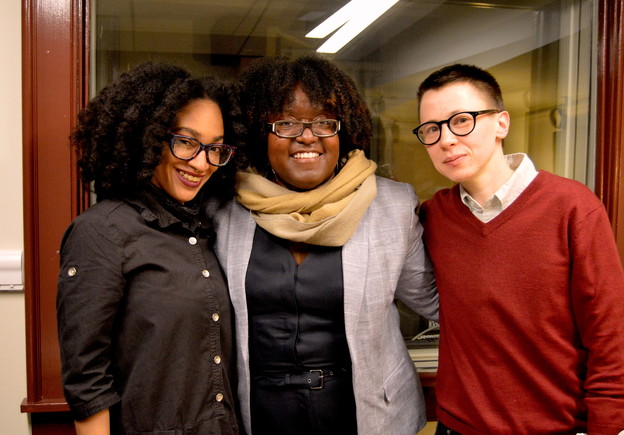
Today we released the latest episode in the PoemTalk Podcast Series (that's #130 if you're keeping track), and it's a very exciting one indeed, focusing on Gwendolyn Brooks' landmark 1969 poem, "Riot." For this show, host Al Filreis convened a panel of (from left to right) Amber Rose Johnson, Tonya Foster, Davy Knittle.

As Filreis explains in his post announcing the new episode on the PoemTalk Blog, "'Riot' is the title poem in the (now rare) chapbook published by Dudley  Randall's Detroit-based Broadside Press in 1969" — he provides a link to a PDF copy at the marvelous Eclipse archive — "and has been collected variously, including in the book Blacks (1994)." He also reprints the chapbook's epigraph, a quote by Henry Miller's Sunday After the War, "It would be a terrible thing for Chicago if this black fountain of life should suddenly erupt. My friend assures me there's no danger of that. I don't feel so sure about it. Maybe he's right. Maybe the Negro will always be our friend, no matter what we do to him."

From there, he moves on to the poem's cadence and typography, starting with a comment by Amber Rose Johnson, "There's so much punctuation working in the poem as she performs it," then he observes, "Stops are emphatic. Lists of things deliberately compile." He continues, "Later Amber Rose hears both riot and collapse in the very voice of the poet, and at the end of the discussion all agree that this poem, especially in performance, is an example of what powerful, memorable poems can do: they find ways to do what they say." 

You'll find the full text of Brooks' poem, and much more discussion of the program here. The full archive of PoemTalk podcasts is available here for your listening pleasure, and Filreis makes a rare recommendation of an earlier PoemTalk episode, "in which Herman Beavers, Tracie Morris, and Jo Park discuss Brooks' poem 'Truth' and Etheridge Knight’s poem-response to it, 'The Sun Came,'" as a fine complement to this program.

Wednesday, November 14, 2018

Donato Mancini: Two Recent Readings

Just a few weeks ago, we highlighted Canadian poet Donato Mancini's recent Wexler Studio Recording Session. Today, we have two more recent additions to announce. The first of these, dating from October 20th of this year, is a Baltimore reading from the "fatrasies" of Philippe de Beaumanoir and the "fatras" of Watriquet de Couvin. That's joined by an October 3, 2017 reading at Simon Fraser University, where Mancini reads "A Flea the Size of Paris: The Fatras," with Ted Byrne and guests Danielle LaFrance and Jacqueline Turner.

Our Donato Mancini author page is home to many more recordings of the poet from over the past five years, including two separate Wexler Studio sessions, readings from Washington, D.C.'s venerable Bridge Street Books, Johns Hopkins University, The Kootenay School of Writing, and Vancouver, BC. You'll also find two recordings from Mancini's residency at University of Windsor, a 2016 home-recorded session of poems from his earlier collections, Buffet World (2011) and Loitersack (2014), and a 2016 appearance on the inaugural episode of Short Range Poetic Device, entitled "Poetry and Poetics Streaming Against the Totality." Click here to start exploring all of the recordings mentioned here.

Friday, November 9, 2018

Divya Victor: New Author Page

Over the past year and a half it's been an amazing experience working with Jacket2 guest editor Divya Victor. She has a keen eye for content, offers effortlessly incisive commentary, and has shaken up and challenged our tight-knit editorial team in the best ways imaginable. If you don't already know this side of Divya, you will soon enough, when we unveil the "Extreme Texts" feature she's been working on for the past year.

One thing Divya is well-known as, however, is a talented and innovative poet, and that's what makes her recently-created PennSound author page a cause for celebration. There, you'll find an archive of work spanning nine years, starting with a 2009 Emergency Series reading at our own Kelly Writers House. That's followed by a 2010 reading of Hellocast Feral Cat Attack (with participant-collaborators) for Les Figues Press, a 2012 St. Mark's Poetry Project reading with Vanessa Place, 2014 readings at Videofag and Counterpath, and "Cicadas in the Mouth," her Leslie Scalapino Memorial Lecture in Innovative Poetics (which you can read as well as watch). Jumping forward to 2017, theres video of her reading "W is for Walt Whitman's Soul" at BookThug, and then a trio of readings from this year: a Wexler Studio Recording Session and a Kelly Writers House conversation with Laynie Browne, both recorded on April 20th, along with a July reading with Cat Tyc for Living Poetry at the Hudson Area Library. Click here to start exploring this treasure trove of recordings.

Wednesday, November 7, 2018

George Quasha reads "Verbal Paradise," 2018

Over the past several years, one of the many herculean tasks Chris Funkhouser has set for himself is recording the work of fellow poet George Quasha. Today we're highlighting a recent addition from that project: audio of Quasha reading his book Verbal Paradise in its entirety. This session took place in Barrytown, New York on July 3rd of this year.

On his author website, Quasha has this to say about Verbal Paradise, which is the first of six projected books in his "preverbs" series: 

The work of preverbs, of which this is the first book to enjoy publication, resists introductory or explanatory remarks, even as it makes them inevitable in the context of poetry. Preverbs precede themselves, so to speak, with hidden trapdoors; but this rather elusive distinction regarding a radical of composition is not like premeditation or conceptualization. One instance has to do with the relationship of preverbs to poetry in any pre-existing sense. The question “is this poetry?” has to remain open; if preverbs have a program it’s an openness regarding their own nature, especially in relation to the big consensual distinctions (poetry, even language). (Preverbially: poetry is what still exists on the other side of the distinction.) The escape-hatch approach to definition-qualification is not a defensive act by which, say, preverbs would ward off all conceptual framing or aesthetic theory (which they quite willingly play with); rather, it’s an expression of their nature to promote mind-degradable utterance. Thinking, unthinking, further thinking; saying, unsaying, further saying.

You can read more about the book here, and listen to it here. Funkhouser's complete Quasha recordings can be found here.

Monday, November 5, 2018

Philly Small Presses Dinner Panel, 1999

Here is a true slice of vintage Kelly Writers House programming, dating all the way back to March 26, 1999. If you were around then, you could've enjoyed a full day of wonderful programming billed as "A Celebration of Philadelphia Writers," which was sponsored by the Humanities Forum.

The day started early with breakfast at the White Dog Cafe and a talk entitled, "So, You Want to Get Published?" That was followed by "Communities and Writers," a lunchtime event on "Writing in Philly," "Philadelphia in Film," and an exhibition opening and book signing that went straight on through to 5:30. For evening plans, you had your choice of The Chosen at the Arden Theatre or a busy night at the Clef Club that started with a talk on "Interplay of Philadelphia Jazz and Poetry," followed by an open-mic poetry jam hosted by KWH.

The keystone event of the day, however — and the one that we're highlighting — is the Philadelphia Small Presses Dinner, held at the Writers House. As the program blurb announces, "Philadelphia is experiencing a literary renaissance, thanks to the many dedicated poets and writers who run reading series, publish literary journals, and run small presses here in Philadelphia. Join some of Philadelphia's literary innovators at the Kelly Writers House for a roundtable conversation about Philadelphia's lively publishing scene." The line-up for the event is quite formidable, including Chris and Jenn McCreary (of Ixnay Press), Dave Deifer (of Xconnect), Michael Magee (of Combo), Heather Thomas and Alicia Askenase (representing 6ix), Gil Ott (of the Philadelphia Publishing Project and Singing Horse Press), Louis Cabri (of PhillyTalks), Kristen Gallagher (of Handwritten Press), and Jena Osman (of Chain). You can listen to this historic discussion here.

Friday, November 2, 2018

Steve McCaffery, "Wot We Wokkers Want" b/w "One Step to the Next"

We close out this week with an interesting artifact from Steve McCaffery"Wot We Wokkers Want" b/w "One Step to the Next" was released on LP and cassette in 1980 by the Underwhich Audio Collective, a small Canadian independent label (based in Toronto, Ontario and Saskatoon, Saskatchewan) that also issued small run releases (usually about 100 copies) by the likes of Owen Sound, the Four Horsemen, Paul DuttonBob Cobbing, Susan Frykberg, Larry Wendt, and DUCT, among others.

Better known by its full title, The Kommunist Manifesto or Wot We Wukkerz Want Bi Charley Marx un Fred Engels, the leadoff track is McCaffery's translation of The Communist Manifesto into the dialect of West Riding of Yorkshire, or, as he puts it, "Redacted un traduced intuht’ dialect uht’ west riding er Yorkshuh bi Steve McCaffery, eh son of that shire. Transcribed in Calgary 25 November to 3 December 1977 un dedicated entirely to Messoors Robert Filliou and George Brecht uv wooz original idea this is a reullizayshun." You can read the piece in its entirety here as part of the PECP Library. Side A also includes "Mid●night Peace" ("a nostalgic translation of the Dadaphony of hell") and "A Hundred And One Zero S One Ng," which is McCaffery's translation of Brecht's translation of the closing section of Robert Filliou's 14 Chansons et Charade.

Side B starts with "One Step Next to the Next," co-created with Clive Robertson, which centers around turntable manipulations of a National Geographic flexi-disc on the Apollo space flights. The closing track, Emesin which "a phrase is intercepted, reversed, synthesized, and obsessively repeated as a stolen micro-unit." As the liner notes explain, "it represents McCaffery's first theft from himself." Listen in to all of these tracks here.