Friday, July 31, 2020

Erín Moure: Kelly Writers House Fellows Program, 2020

One of the biggest highlights of each academic year is the annual Kelly Writers House Fellows program, which brings a fascinating and diverse roster of creators to UPenn for a trio of events each spring. While novelist Saidiya Hartman was able to make it to campus for her visit in February, our March and April events, featuring poet Erín Moure and journalists Jenna Wortham and Wesley Morris respectively, were reconfigured as scaled-down virtual events. Today, we're happy to share video of Moure's reading and conversation, which was hosted by Julia Bloch on March 30th.

After Bloch's introduction, and her own welcome, Moure starts with a request from the audience, reading two poems from her translation of Alberto Caeiro and Fernando Pessoa's O Guardador de Rebanhos: "What Me Guard Sheep?" and "Some Woman Out There Has a Piano." Next she moves on to her 2002 collection, O Cidadán, reading "document30 (viable risk)," "document31 (la república)," "document32 (inviolable)," and "Hazard Non." Moure then explains how she first encountered the work of Chus Pato and reads from her translations of Pato's m-Talá and Charenton. Moure then moves back to her own poetry, reading selections from her latest book, 2019's The Elements. She concludes with "Birthday," a much-requested poem from her latest publication, a translation of Uxio Novoneyra's The Uplands: Book of the Courel and other poems. Bloch and Lily Applebaum then rejoined the livestream to facilitate a half-hour Q&A session with the virtual audience.

You can watch Moure's complete KWH Fellows program by clicking here. On PennSound's Erín Moure author page, you'll find four more readings recorded between 1986 and 2017, along with appearances on PoemTalk, Close Listening, and the PennSound Podcast Series.

Tuesday, July 28, 2020

Happy 93rd Birthday to John Ashbery

July 28th would have been the 93rd birthday of John Ashbery, who passed away in September 2017. Certainly, Ashbery's place in poetry's pantheon is well-established, and you get a sense of this by trying to take in the immense scale of PennSound's Ashbery author page, which is home to nearly a thousand individual MP3 files, along with countless videos and other resources that run the gamut from a 1951 student presentation of his play Everyman in Cambridge to home recordings made not long before his death. While the breadth and depth of our archive pays tribute to Ashbery's talents, I also like to think that it serves as an indication of his (and his spouse, David Kermani's) dedication to the PennSound project, and I truly believe that their support helped shape the development of our site in immeasurable ways. 

We first got permission to share Ashbery's work in October 2007, not long after I came on as PennSound's managing editor, and just as PennSound Daily was starting. The site looked a little different then than it does now, just like we all did. That Ashbery and Kermani would take an interest in what we were doing isn't necessarily surprising — our collection of recordings serves as an extension of the excellent work that the Flowchart Foundation's Ashbery Resource Center has done cataloguing and sharing the poet's work, and of course Kermani famously went so far as earning a master's degree in library science to properly archive his husband's papers —but I don't think any of us would have guessed just how fervent their support would be. Our Ashbery page started with a shopping bag of cassettes, and a few recordings we already had on hand, and there would be many more shopping bags over the years. Charles or Al would be in New York and run into John and David and another dozen or so tapes would be handed off. Some were high quality studio recordings of iconic poems, and some were amazingly ephemeral: readings at obscure venues, radio conversations, discussions of artists or composers, etc. Kermani's curator's eye and forethought ensured that the much-in-demand poet secured rights to share recordings through our site. In one case, he went so far as negotiating that a big podcast appearance — via The New Yorker or The New York Review of Books, I believe — be embargoed for just one week before it went up on our site.

We're tremendously grateful for that enthusiasm, because it helped us assemble a big, beautiful archive for a beloved and influential poet, but also because it opened doors for us that otherwise might have remained locked. In 2007, PennSound was two years old (or four, if you start counting from our soft launch), and while we already had some venerable names in our author index — Stein, Williams, Pound, Olson, and Oppen, for example — Ashbery was one of the bigger contemporary voices at that early stage in our development, and back then, when discussions with poets and/or their estates often began with a lengthy layperson's explanation of how the site worked, his presence on the site seemed to help reassure the skeptical that their recordings would be safe with us. While it might seem inconsequential in the face of a thousand MP3 files, the respect rightly afforded Ashbery and its effects upon our fledgling archive can't be overstated, and when I was reminded today that it was the late, great poet's birthday my first thought, even after all these years, was to be grateful. 

If you'd like to browse some of those aforementioned recordings, here's the place to start.


Monday, July 27, 2020

PoemTalk #150: Two by Terrance Hayes

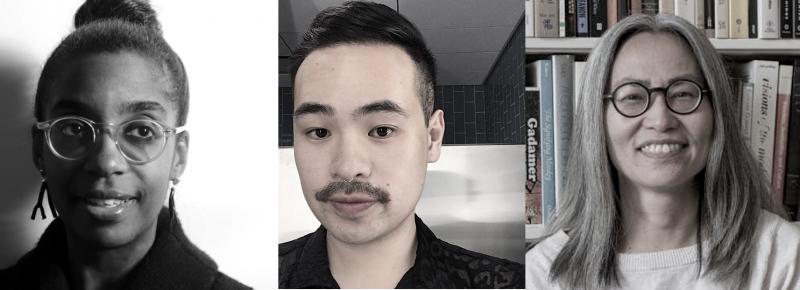
Today the PoemTalk Podcast series issued its landmark 150th episode, which focuses on two connected poems from Terrace Hayes's 2006 collection, Wind in a Box: "MJ Fan Letter" and "RSVP." For this program, host Al Filreis was joined by a panel that included Simone White, Dixon Li, and Jo Park (shown left to right).

Filreis starts his PoemTalk blog post by making explicit the connections between the two poems: "The first begins with an address to Michael Jackson ('Dear K.O.P,' or King of Pop) and the second begins 'Dear Michael,' although the opening of that versified fan letter is crossed out — single-line excising that makes it easy nonetheless to see and read what is meant to be excluded or second-guessed. And when the cross-outs finish in that passage of the second poem, the writing starts again with 'Dear K.O.P.' We hear layerings of speaker, addressed figure, voices, subjective imaginings, and fantastic substitutions." He continues, discussing this complexity and its effects upon the panelists: "Any time taken to sort though the several shifting modes of address surely will be rewarded. Listen for this: toward the end of the discussion you will hear in the PoemTalkers' own voices the thrill of people who are realizing yet again that poetry — well, at least this poetry — is a form of art and of critical inquiry well suited to convey the complex effects of a person as entangled and fraught as MJ." Filreis concludes, "In a sense these poems are a dense chronicle of that huge influence, and the group discusses several such lasting effects."

You can read more about this latest show and find the complete text of both poems here. The full PoemTalk archives, spanning more than a decade, can be found here.


Wednesday, July 22, 2020

Six Poets Each Teach One Short Poem to High-School Students

Here's a blast from the Kelly Writers House's past that's emblematic of its spirit of outreach to diverse audiences and an interesting precursor, of sorts, to ModPo. "Six Poets Each Teach One Short Poem to High-School Students," was a special event first held in May 2009 that brought together students from Liza Ewen's poetry course at Friends Central School and a half-dozen poets from the Philadelphia community, who discussed favorite poems "that would somehow convey something significant about themselves as a poet." It was such a great success that a second event was organized by Al Filreis and Ewen in May 2010.

In a blog post not long after the 2010 event, Filreis gave this rundown of the participants and their choices:
Rivka Fogel taught "This Room" by John Ashbery, a beautiful indirect memorial to Pierre Martory and non-narrative meditation on absence as presence. Sarah Dowling then came in and taught a section of "A Frame of the Book" by Erin Moure. Jessica Lowenthal then taught Harryette Mullen's "Trimmings." Randall Couch taught a very early poem by John Keats before revealing that it was Keats. John Timpane taught an Yvor Winters poem about the emotional complication of saying farewell to an adult child at an airport; Wintersean restraint and emotional distance abound here and strike one (strike me, at least) as a refreshing sort of illiberalism in an age of gobs of conventionally sentimental parent-child verse. Tom Devaney may have taken the pedagogical prize on this day, presenting William Carlos Williams' "The Last Words of My English Grandmother" — a seemingly easy poem for h.s. students to grasp. Yet it also does everything a modern poem does, and makes a remarkably good scene of instruction.
Video and audio of both events can be found here, along with PDF copies of the poems under discussion. You'll find much more programming like this, from KWH and elsewhere, on PennSound's Anthologies / Collections / Group Readings page.


Monday, July 20, 2020

M.C. Richards on PennSound

We might all aspire to lead lives as rich as that of M.C. Richards, the poet, potter, and translator whose eighty-five years included a stint teaching at the fabled Black Mountain College (where she also participated in the first happening), an early experiment in communal living at Stony Point's "the Land" (along with John Cage, David Tudor and others), and friendships with Jackson Mac LowCharles Olson, Paul Williams, Robert Rauschenberg and Franz Kline. Her vivacity undimmed by the passage of time, she devoted her later years to working with the developmentally disabled at the Camphill Village in Kimberton, PA.

On PennSound's M.C. Richards author page you'll find a 1997 recording made at Indre Studios in Philadelphia, which comes to us courtesy of a close friend, Jasper Brinton, who provided us with a little background to the session. "She made this tape essentially under some strain: she did not live to see it published to any degree; but understood its importance for her legacy," he notes. "The quality of the recording is excellent. Her voice strong. Earlier in 1991 Station Hill Press published Imagine Inventing Yellow: New and Collected Poems of M.C. Richards. The tape includes a few of these poems but also later work she saw fit to preserve."

We're very glad to be a part of that preservation process. You can listen to the seventy-five minute recording, consisting of nearly two dozen poems — including "March," "Strawberry," "Imagine Inventing Yellow," "Morning Prayer," "How to Rake Water," "Sweet Corn," and "For John Cage on His 75th Birthday" — along with plentiful fascinating asides and remarks by the author, by clicking here.


Friday, July 17, 2020

Five Poems by Grzegorz Wroblewski, 2020

Here's a short but sweet video clip to close out the week that brings together content from both PennSound and Jacket2five poems by Grzegorz Wroblewski, translated by Piotr Gwiazda and read by Marcus Slease, with complementary visuals in the form of Wroblewski's paintings. The clip was assembled this month, but the Jacket2 connection — which goes back five years — is that these translations first appeared in Marit MacArthur and Kacper Bartczak's wonderful J2 feature "(Polish) Poetry after Różewicz," published in November 2015.

You can read Gwiazda's translations of the five poems showcased — "Decline," "The Reading Room in Christianshavn," "A Conspiracy," "Ostrich Farm," and "Light in the Cathedral" — by clicking here. Readers might also be interested in Gwiazda's short essay, "Grzegorz Wróblewski and Różewicz," part of the same feature, in which the translator traces the lines of influence that link Wroblewski to the senior poet:
In many of his poems Wróblewski adopts an austere and straightforward style. He shuns literary ornamentation and traditional forms (even though, unlike his predecessor, he usually follows the rules of punctuation and capitalization.) In terms of philosophical outlook, he gravitates toward existentialism that verges on nihilism. He writes about alienation, anxiety, failure of communication, loss of identity. Although he lacks Różewicz's firsthand experience of war, he often records the violence and cruelty of the modern world. In this respect, we can consider him a reluctantly moral poet.
You can watch this new collaborative video by clicking here. On PennSound's Grzegorz Wroblewski author page, you'll find one complete reading that focuses on the poet's collections Kopenhaga (2013) and Zero Visibility (2017), recorded in 2016 at the Baltic Centre for Writers and Translators in Visby, Sweden. There are also several shorter clips recorded in London and Copenhagen that go back as early as 2012.


Wednesday, July 15, 2020

Fred Moten and Simone White, NYC 2017

Here's a very exciting reading to keep the week going strong: a 2017 reading and discussion featuring Fred Moten and Simone White, held as part of the Belladonna* And/With series at New York's Abrons Art Center. Recorded on October 9th of that year, this event was curated by Ana Paula and Asiya Wadud, along with guest curator Marcella Durand, who also provided introductions for the readers. Each poet's set runs approximately thirty minutes, with a final half-hour set aside for conversation and questions from the audience. You'll find each poet's set along with the joint session on Moten and White's individual PennSound author pages, along with our Belladonna series page.


Monday, July 13, 2020

Anya Lewin: 'How to Be European,' 2007


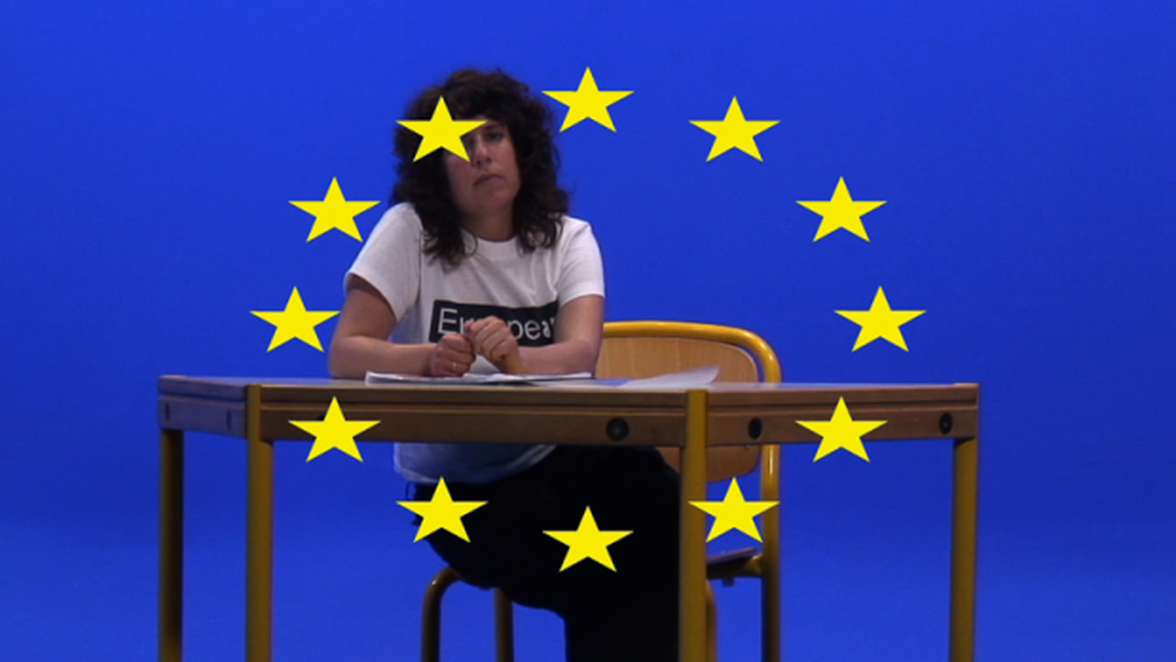
We're taking another deep dive into the PennSound archives today to rediscover Anya Lewin's short film How to Be European, which we added to the site in 2011.

Created during a three-month residency at InterSpace in Sofia, Bulgaria (as part of 2007's At Home in Europe Project, which also included artists' residencies in Norway, Latvia, and the UK), How to Be European was inspired by Lewin's lessons in Bulgarian with Boris Angelov. "The lessons question who learns and who teaches and whether European identity exists for anyone but Americans?," she explains. "The work uses a mixed methodology of pre-written Socratic dialogues, bad acting, experimental visual techniques, educational television, obscure references and poetic news reading and covers concepts such as time, language, economics, flow and mobility, dog watching, and cultural presentation."

Lewin then considers the broader implications of these ideas: "Imagine a school where one learns how to be European in a changing Europe. Migration flows from East to West to East again. The EU is growing, yet doesn't include every 'European' country. It is getting more and more complicated to understand what European is and most importantly how to act European? In 1974 the sociologist Erving Goffman published his book Frame Analysis, which examined the way behaviour changes depending on the context. In a classroom we know how to act as teacher and student; can we extend this idea to Europe? When countries enter the frame of the EU do they become European?"

You can watch How to Be European on Lewin's PennSound author page, where you'll also find a number of supplemental links, including her homepage, where more of her work is on display.


Friday, July 10, 2020

Revisiting the EPC@20 Celebration

I figured we'd stay with our sister site, the Electronic Poetry Center, for today's PennSound Daily. Specifically, I thought it might be worthwhile to revisit the celebration held at SUNY-Buffalo in the fall of 2014 to celebrate the archive's twentieth anniversary. Spanning two days, EPC@20 featured readings, talks, and performances by poets who've had a close affiliation with the site over its lifespan. 

Thursday, September 11th began with an afternoon session that included talks by Steve McCaffery, Danny Snelson, Laura Shackelford, cris cheek, Elizabeth Willis, and Loss Pequeño Glazier. Evening performances followed in two sets: the first featuring Tammy McGovern, Snelson, and Wooden Cities with Ethan Hayden; the second with Joan Retallack, cheek, and Tony Conrad.

Friday, September 12th began with afternoon readings and talks by Myung Mi Kim, Retallack, Charles Bernstein, and a panel talk featuring Bernstein, Glazier, Jack Krick, Shackelford, and Snelson. The celebration concluded with evening performances from Glazier, Willis, and Bernstein.

Video and audio recordings of the proceedings are available here. The program for the celebration can be found here.


Wednesday, July 8, 2020

New at the EPC: Silliman's Blog Archive (2002–2020)

I have never thought of myself as an experimental writer, but this project is clearly a step into un- (or at least under-)charted territory. My idea is to write briefly from time to time mostly about my writing and whatever I might be thinking about poetry at the moment. Other subjects (music, politics, etc.) may enter in, as they do in life.
Blogs have been around for awhile now, but to date I haven't seen a genuinely good one devoted to contemporary poetry, so it may prove that there is no audience for such an endeavor. But this project isn't about audience. The fact that the blog has the potential to carry forward the best elements of a journal and seems inherently prone to digressive, if not absolutely plotless, prose gives me hope that this form might prove amenable to critical thinking.
With these words, Ron Silliman began the inaugural post on Silliman's Blog back in August 2002. Nearly two decades later, he is still posting content, though certainly at a less rabid clip than during the blog's heyday, and his perspectives are every bit as insightful and controversial as they've always been. This week, the Electronic Poetry Center announced its latest project: an expansive archive of Silliman's Blog, from its inception up to the present. Organized by PennSound Senior Editor Steve McLaughlin, the complete contents are browsable chronologically, searchable, and navigable via keyword.

Much like the Buffalo Poetics Listserv (1994–2014) and Jacket Magazine (1997–2010), Silliman's Blog is an indispensable document — for both better and worse — of how the world of contemporary poetry adapted to and exploited new technological advances, not dissimilar from how previous generations had made use of word processors, the IBM Selectric, Xerox photocopiers, mimeograph machines, and answering machines to spread both poetry and discussion thereof. While it traces the gradual evolution of that discourse over two tumultuous decades, there's a definite sense that plus ça change, plus c'est la même chose here as well, both in terms of the toxic political milieu of those early years of the blog and the controversies (both aesthetic and social) that emerge along the way. That said, my only regret regarding this archival endeavor is that the comments have not been preserved along with Silliman's posts since they provide a vital extension of the discourse in all its beauty and ugliness.

While this will serve as an excellent resource for future scholars, it's also a fascinating and worthwhile read in the present, and skipping around haphazardly through the posts, I am very happily reminded of why we all kept an eye out for the latest updates on our XML feed aggregator: Silliman is a genuine polymath with passionate perspectives on poetry, but also baseball, film, politics, and much, much more. In particular, I remember loving what he had to say about the Philadelphia Phillies and Project Runway, both of which were a lot better a decade ago than they are now, and revisiting those posts brings a pang over lost time as well as a lovely sense of shared appreciation. You can take your own little nostalgia trip by clicking here.


Monday, July 6, 2020

Four New Belladonna* Events, 2020

This week starts with a quartet of newly-added recordings from the Belladonna* reading series, which also serves as a fascinating snapshot of how the venerable and long-running series adapted to the COVID-19 crisis this spring.

Our first event, held on January 17th at New York's Bureau of General Services – Queer Division, featured sets by Jasmine Gibson and S. Brook Corfman with introductions provided by Alma Valdez-García by James Loop. Next, from February 21st, we have a launch event for the journal Matters of Feminist Practice, held at Printed Matter NYC. Introductions for this event were provided by Karla Kelsey and Poupeh Missagh, while the readers included Alexis Almeida, Lida Nosrati, ELÆ [Lynne DeSilva-Johnson], Megan Madden, Teresa Carmody, and Madhu H. Kaza. Then, from March 7th, we head to the Brooklyn Museum for a reading by Jessie Rice-Evans, S*an D. Henry-Smith, and Giannina Braschi, with James Loop once again providing intros for the readers. Finally, from May 19th, we have a second event celebrating Matters of Feminist Practice, held via Zoom. This time around, Poupeh Missaghi served as host, while participants included Kat Savino, Mary-Kim Arnold, and Petra Kuppers, along with Julie Patton, whose contribution unfortunately went unrecorded.

Now in its twenty-first year, Belladonna* is "a reading series and independent press that promotes the work of women writers who are adventurous, experimental, politically involved, multi-form, multicultural, multi-gendered, impossible to define, delicious to talk about, unpredictable, and dangerous with language." You can listen to these latest additions by clicking here, and there are countless amazing recordings spanning the series' complete history waiting for you to discover on PennSound's Belladonna* series page.


Friday, July 3, 2020

Congratulations to CLMP Firecracker Award Winners Osman and Moriarty

This week brought wonderful news for Jena Osman and Laura Moriarty, joint winners of the Firecracker Award in Poetry from Community of Literary Magazines and Presses. CLMP's annual award "celebrate[s] books and magazines that make a significant contribution to our literary culture and the publishers that strive to introduce important voices to readers far and wide."

Osman's winning collection is Motion Studies, published by Ugly Duckling Presse, which "defies categorization, combining science writing, dystopian (science) fiction, popular journalism, critical theory, and lyricism." On her PennSound author page, you can hear her read from the book as part of a session recorded at our own Kelly Writers House last June. That, along with an interview with Chris Mustazza recorded at the same time, are the most recent recording you'll find there, as part of a diverse array of recordings going all the way back to 1990.

Moriarty's prize-winning volume is Personal Volcano, released by Nightboat Books. In their citation, the judges hailed the book for embodying the "tension between the 'social' and the 'deep ecological' — encompassing of something larger and more powerful than the anthropocentric could ever admit." While we don't have any recordings from Personal Volcano on Moriarty's author page, you will find an engaging collection of recordings made between 1997 and 2013, where the poet's talents are on full display.

This year's poetry awards were selected by a panel of Thom Donovan, Celina Su, and Simone White, and the long-list of finalists included books by Mary Ruefle, Cyrée Jarelle Johnson, Raquel Salas Rivera, and Knox Gardner. You can read more about CLMP and the Fireworks Awards here. Once again we congratulate Osman, Moriarty, and all the finalists for this honor.


Thursday, July 2, 2020

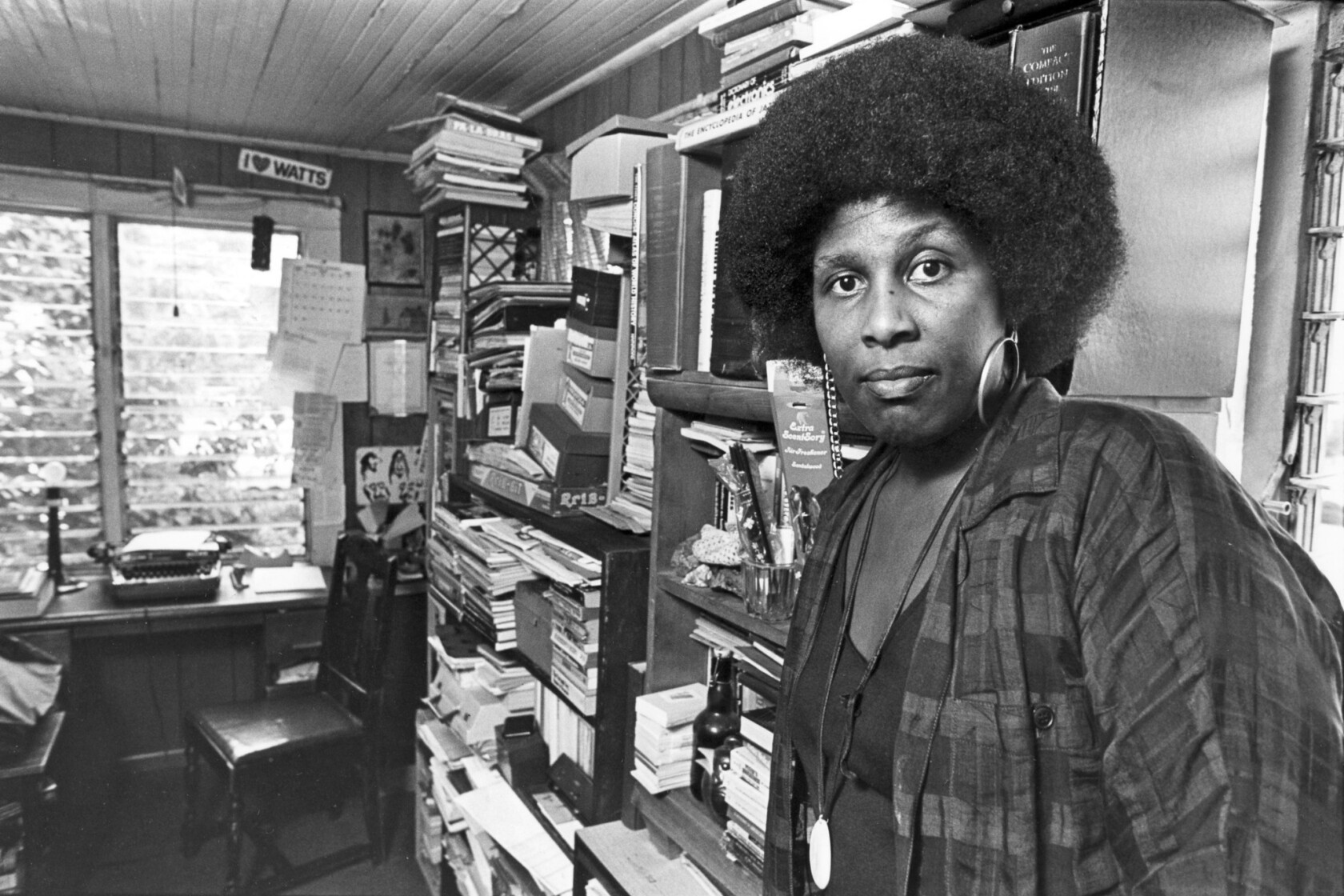
Wanda Coleman on PennSound

When Wanda Coleman passed away at the age of 67 in 2013, the headline of her Los Angeles Times obituary remembered her as that city's "unofficial poet laureate." In that same tribute, Richard Modiano of Beyond Baroque recalled that Coleman "wrote not just about the black experience in Los Angeles but the whole configuration of Los Angeles in terms of its politics, its social life," and poet and actress Amber Tamblyn, in a memorial for the Poetry Foundation, echoed those sentiments: 
Wanda was not just a Los Angeles treasure, she was a trove of it. She was the original performance poet, someone who could blow the hair off of any audience’s scalp, who read complex poems of race, suffering, sexual desire, music and love with the same power with which she wrote them. She was the person I refereed to when some shithead from New York wanted to tell me that no one cool or kind or genuine ever came out of Los Angeles. "Maybe you should stop trying to meet your wife at the Chateau, then, and go see Wanda Coleman read instead."
Modiano concurs. In his estimation, she was "a world-class poet. The range of her poetry and the voice she writes in is accessible to all sorts of people."

For those reasons and many more, we're very glad that Coleman is a part of our archives. On her PennSound author page, you'll find a modest but vital collection of recordings that make clear the breadth of her immense talents.  The most recent material you'll find there is a fifteen-minute set from a 2008 benefit for poet Will Alexander in Los Angeles, and we also have a few poetic selections from albums released by Coleman — Our Souls Have Grown Deep Like the Rivers (Rhino, 2000) and Jazzspeak: A World Collection (New Alliance Records, 1991) — along with the 1988 New Alliance LP Black Angeles in its entirety. Finally, thanks to David Buuck, we have recordings from the conference Expanding the Repertoire: Continuity and Change in African-American Writing, held at Small Press Traffic in April 2000.

Speaking in 2001, Coleman acknowledged that "Others often use the word 'uncompromising' to describe my work," before noting, "I find that quite pleasing." You can see for yourself by clicking here.