Wednesday, November 27, 2019

PennSound Presents Poems of Thanks and Thanksgiving

With the US celebrating Thanksgiving tomorrow, it's time to revisit a perennial PennSound Daily tradition that started way back in 2010: a mini-mix of poems of thanks and thanksgiving — some old, some new — taken from the PennSound archives.

In a classic recording of "Thanksgiving" [MP3] from the St. Mark's Poetry Project, Joe Brainard wonders "what, if anything Thanksgiving Day really means to me." Emptying his mind of thoughts, he comes up with these free associations: "first is turkey, second is cranberry sauce and third is pilgrims."

"I want to give my thanks to everyone for everything," the late John Giorno tells us in "Thanx 4 Nothing" [MP3], "and as a token of my appreciation, / I want to offer back to you all my good and bad habits / as magnificent priceless jewels, / wish-fulfilling gems satisfying everything you need and want, / thank you, thank you, thank you, / thanks." The rolicking poem that ensues offers both genuine sensory delights ("may all the chocolate I've ever eaten / come back rushing through your bloodstream / and make you feel happy.") and sarcastic praise ("America, thanks for the neglect, / I did it without you, / let us celebrate poetic justice, / you and I never were, / never tried to do anything, / and never succeeded").

"Can beauty save us?" wonders Maggie Nelson in "Thanksgiving" [MP3], a standout poem from her marvelous collection, Something Bright, Then Holes, which revels in the holiday's darker edges and simplest truths: "After dinner / I sit the cutest little boy on my knee / and read him a book about the history of cod // absentmindedly explaining overfishing, / the slave trade. People for rum? he asks, / incredulously. Yes, I nod. People for rum."

Yusef Komunyakaa gratefully recounts a number of near-misses in Vietnam — "the tree / between me & a sniper's bullet [...] the dud / hand grenade tossed at my feet / outside Chu Lai" — in "Thanks" [MP3], from a 1998 reading at the Kelly Writers House.

Finally, we turn our attention to the suite of poems that concludes Mark Van Doren's Folkways album, Collected and New Poems — "When The World Ends" / "Epitaph" / "Farewell and Thanksgiving" [MP3] — the last of which offers gratitude to the muse for her constant indulgence.

To keep you in the Thanksgiving spirit, don't forget this 2009 PennSound Podcast (assembled by Al Filreis and Jenny Lesser) which offers "marvelous expressions of gratitude, due honor, personal appreciation [and] friendship" from the likes of Amiri BarakaTed BerriganRobert CreeleyJerome RothenbergLouis Zukofsky and William Carlos Williams.

Monday, November 25, 2019

Phill Niblock on PennSound

We were very proud to be able to host work by composer and Experimental Intermedia Foundation director Phill Niblock for practically as long as our site has been in existence. Today, we're highlighting the three films by Niblock available on PennSound, all of which were upgraded with higher-resolution video files when we created a proper Niblock author page in 2013.

The latest addition is Evidence, starring Erica Hunt. Shot in 1983, the eighteen-minute relishes negative space, beginning with stark white Helvetica lettering on a black background that persists for more than a minute before fading in the film's sole visual: the poet's face, silhouetted to near-featurelessness by a white television screen. Seen in profile, Hunt's speaking gestures are heightened — subtle shudders and nods, along with the frenetic moirĂ© of her mouth — serving as an apt accompaniment to the narrative.

This one-third/two-third profile motif also appears in Niblock's mid-70s portrait of Hannah Weiner, where the poet's speedy delivery of her clairvoyant writings weaves in and out of live reading segments juxtaposed with domestic scenes. Meanwhile, in Niblock's 1973 portrait of Armand Schwerner, the poet contends with the wind as he reads (or more accurately, preaches) from his Tablets pacing back and forth in a bright orange jacket on a hilltop, the Verrazano-Narrows bridge behind him.

You'll find all three of these marvelous poetic portraits on our Phill Niblock page, and don't forget to check out PennSound Cinema, home to a stunning array of essential filmic materials.


Friday, November 22, 2019

PoemTalk #142: on Charles Bernstein's "As If the Trees by Their Very Roots Had Hold of Us"

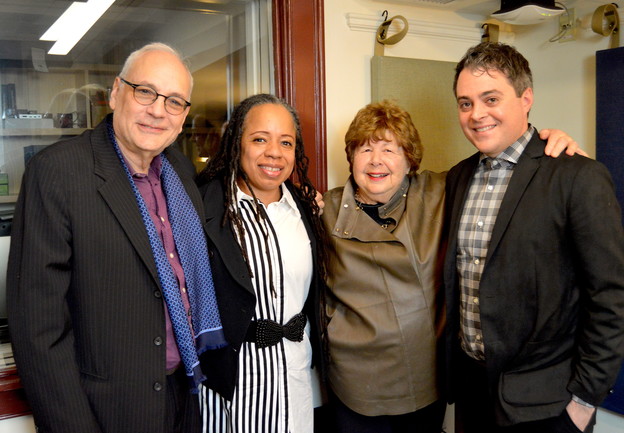
Today, we release episode #142 in the PoemTalk Podcast Series, a very special episode on Charles Bernstein's early poem, "As If the Trees by Their Very Roots Had Hold of Us," recorded as part of a Kelly Writers House celebration of Bernstein's retirement from teaching last April. Host Al Filreis convened a panel that included (shown from left to right) Tracie Morris, Marjorie Perloff, and Danny Snelson, and Bernstein makes a cameo at the end, popping into the Wexler Studio to share a poem during the concluding Gathering Paradise segment.

As Filreis explains in his PoemTalk blog post on this episode, the poem "originally appeared in Senses of Responsibility (1979) and in 2010 was chosen by Bernstein to be included in All the Whiskey in Heaven: Selected Poems. We know the writing of the poem dates at least to 1977, which is when he performed it at a reading at the Place Center in New York (on December 18); he read that day with Kathy Acker." He continues, offering this preliminary summary of the program's discussion: "Our group observes that the poem is uncharacteristic, especially of writing in that early period with its intensely disruptive, disjunctive style at the level of the phrase. Yet the poem's satire — a mock of 'poet voice' and of the centrality of concepts like poetic 'presence' dominant in that era — looks forward to Bernstein's stance and tone of recent years." You can read more about the program, find the complete text of Bernstein's poem, read more about the Bernstein celebration, and listen to or watch video of this episode by clicking here. The full PoemTalk archives, spanning more than a decade, can be found here.

Wednesday, November 20, 2019

In Memoriam: Sean Bonney (1969–2019)

Today brings the sad news of English poet Sean Bonney's passing. His sister, Mel Bonney-Kane, shared this message on social media: "We are devastated to let people know that my beloved brother Sean Bonney died in a tragic accident last week in Berlin. We are in the process of seeking to bring him home and will let people know of the funeral arrangements when we are clearer. He will live on in his words and poetry."

We couldn't agree more, which is why we humbly direct our listeners to our Sean Bonney author page. There, you'll find a modest collection of recordings made between 2009 and 2012. The earliest reading, presented in two videos, is an August 2009 reading at Manchester's The Other Room that includes selections from The Commons, Document: Poems, Diagrams, Manifestos, and Tracts and Commentaries. Next there's a 2011 reading from The Commons at London's Birkbeck College, and a trio of readings from Happiness: Poems After Rimbaud at the University of Cambridge's Lady Mitchell Hall in November 2011, and unknown London venue in 2011, and at the Poetry and Revolution Conference, X-ing the Line, at London's The Apple Tree in May 2012. Our last two recordings are "Notes on Militant Poetics" from the aforementioned Poetry and Revolution Conference, and a home recording from the Letters on Harmony series made in the summer of 2012. 

These documents of Bonney's work are nicely complemented by PoemTalk Episode #122, where Bonney's "Happiness" is discussed by a panel including Al Filreis, Anna Strong Safford, Chris Martin, Stephen Willey, and Luke Roberts. You can listen to everything mentioned above by clicking here. We send our condolences to Bonney's family, friends, colleagues, and fans as this devastating news spreads throughout the poetry community.


Monday, November 18, 2019

Ted Enslin: New Author Page

Our latest PennSound author page is for Ted Enslin (1925–2011), the avant-garde poet long associated with the Maine wilderness. 

Our collection starts well into his writing life, with a February 1985 reading at the legendary Woodland Pattern Book Center, followed by a January 1986 interview and reading on WMCS-AM and a reading of the single poem "Antiphony" at Bowling Green State University's Kobacker Hall in April 1989. We have another Woodland Pattern reading from February 1990, a March 1992 reading at Granary Books and another set from the same month at Wendell's, both in New York City. Then there are readings in Las Cruces in February 1997, the University of Maine in February 2000, and a recording of Enslin and Ben Friedlander reading at an unknown location in April 2000. Finally, from Jonathan Skinner's Steel Bar Reading Series, we have Enslin's last reading, close to home at Bates College in November 2009.

You can browse the aforementioned readings by clicking here.


Friday, November 15, 2019

Happy Birthday, Ted Berrigan!

November 15th would have been the 85th birthday of Ted Berrigan, a poet of capacious talents and appetites whose life and work continues to resonate decades after his premature death. We honor him today by taking a tour of his PennSound author page, which has grown exponentially over the course of our history.

Our earliest recording comes from a 1968 visit to SUNY-Buffalo, where Robert Creeley provided an introduction to a set that includes a number of iconic early poems like "Words for Love," "Living with Chris," "For You," and "Things to Do in New York City," along with a generous selections from The Sonnets. That's followed by a May 1971 reading with Anne Waldman of their co-authored poem "Memorial Day" in its entirety, and while we now know that this isn't the sole surviving copy of this historic reading, that makes it no less breathtaking. Next, there's an August 1971 reading a San Francisco's Intersection for the Arts, whose setlist draws heavily from poems that would eventually be published in 1975's Red Wagon, including "Wishes," "Ophelia," "Wrong Train," "Frank O'Hara," "Crystal" and "Three Sonnets and a Coda for Tom Clark," along with "People Who Died" (from 1970's In the Early Morning Rain), "Southampton Business" (published in 1977's Nothing for You) and the as-yet-unpublished "Things To Do in Bolinas." The true standout tracks, however, are of some of Berrigan's most-beloved works from the period — "Words for Love," "What I'd Like for Christmas, 1970," "Today in Ann Arbor" and "Things To Do in Providence" — performed with their full emotional weight and playful hilarity, by a young writer at the peak of his poetic abilities.

Moving forward in time, we have a trio of recordings from a March 28, 1973 reading at the St. Mark's Poetry Project that were released on the 1980 album, the World Record: Readings at the St. Mark's Poetry Project, 1969-1980 — "Things to Do in New York City," "Landscape with Figures (Southampton)" and "Frank O'Hara" — followed by an August 1977 appearance on on Public Access Poetry with Harris Schiff, where Berrigan read a handful of mid-70s poems like "A Little American Feedback," "Carrying a Torch," "Erasable Picabia," and "From A List of the Delusions of the Insane, What They Are Afraid Of." From August 1978, we have Berrigan's appearance on In the American Tree, hosted by Lyn Hejinian and Kit Robinson. In this 35 minute program, the poet reads from Red Wagon and his Easter Monday manuscript, and discusses his compositional techniques, including his novel, Clear the Range. Highlights include "Whitman in Black," "Buddha on the Bounty," "Personal Poem #9," "Crystal," "Three Pages" and "Remembered Poem." From December of the same year, we have a Jim Brodey-organized recording of The Sonnets that starts with an intro from Ron Padgett and singing by Shelley Kraut, which unfortunately suffers from audio quality issues for a roughly twenty-minute span towards the beginning. 

Next we have a handful of audio and video recordings from Naropa University made during 1979 and 1980, followed by the heart of our Berrigan author page (and one of the very first recordings to be added to PennSound) is a historic and controversial June 1981 reading of his masterpiece, The Sonnets, in its entirety as part of a residency at San Francisco's New Langton Arts Center. Berrigan had been preparing the manuscript for a new edition of The Sonnets to be published the following year by United Artists, and therefore this reading includes a number of poems left out of the 1966 Grove Press edition, making this (until the revised 2000 Penguin Poets edition) the most complete record of his debut collection. Equally important is the poet's lengthy introduction, running nearly ten minutes, in which he describes in great detail the origins of the methods employed in The Sonnets, his life story in the years surrounding its composition and his early correspondences with poets who'd go on to become some of his closest friends (including Robert Creeley, Frank O'Hara and Philip Whalen).

Our last complete reading is a 1982 set at Bard College that covers Berrigan's A Certain Slant of Sunlight-era output, including the title poem, "Red Shift," "A Poets Tribute to Philip Guston," "Blue Galahad," "The School Windows Song," and "Sleeping Alone." There are also a few scattered tracks, including "Red Shift" from the Peter Gizzi-edited Exact Change Yearbook #1 and an excerpt from "Memorial Day" from Waldman's 2001 album, Alchemical Energy. Last, but by no means least, is PoemTalk #5, which addresses Berrigan's "3 Pages (for Jack Collom)." You can listen to all of the recordings mentioned above on PennSound's Ted Berrigan author page — clicking on the title above will take you directly there.

Wednesday, November 13, 2019

Haroldo de Campos on PennSound

Today we're highlighting our author page for poesia concreta pioneer, Haroldo de Campos, which is anchored by a 2002 video from the Guggenheim Museum celebrating his life and work. Presented in conjunction with the exhibition Brazil: Body and Soul, this January 12, 2002 event featured both performances and discussion of de Campos' work by a wide variety of poets, translators and critics.

The video begins with introductory comments by Pablo Helguera and organizer Sergio Bessa, who are followed by a staging of de Campos' 1950 poem/play "Auto do Possesso (Act of the Possessed)," translated by Odile Cisneros and directed by Cynthia Croot. Craig Dworkin is next, reading his translation of "Signantia quasi coelum / signĂ¢ncia quase cĂ©u," follwed by a brief set by Cisneros, who reads her translations. The performances conclude with Marjorie Perloff and Charles Bernstein reading Bessa's translation of "Finismundo," after which Perloff and Bernstein take part in a panel discussion moderated by Bessa.

Next, from 2005's Rattapallax we have a single track, "Calcas Cor de Abobora." Finally, we have a 2017 video of our own Charles Bernstein performing at New York's Hauser and Wirth Gallery with Sergio Bessa on September 28, 2017. This event, co-sponsored by the Poetry Society of America and held in conjunction with an exhibit by Mira Schendel at the gallery, included Bessa speaking about de Campos and Bernstein reading his translations of Drummond, Cabral, Cruz e Sousa, Leminksi, and Bonvicino.

On our Haroldo de Campos author page, you'll also find a link to Bernstein's 2003 essay "De Campos Thou Art Translated (Knot)", first published in the Poetry Society of America's Crosscurrents.

Monday, November 11, 2019

Jackson Mac Low and Tom Leonard, Sound and Syntax Festival, 1978

Here's a fascinating recent addition to our archives: a 1978 video of Jackson Mac Low and Tom Leonard reading at the Sound and Syntax International Festival of Sound Poetry. Bob Cobbing provides introductions to both poets.

The first performer is Jackson Mac Low. His set begins with the "First Milarepa Gatha," the syntax of which, he explains, is taken from the mantra of Milarepa, "the bodhisattva who looks as if he's listening to a transistor radio." He follows that performance with a brief explanation of the techniques involved in the piece's composition. Next is a series of eleven poems, "Phone," which starts with an improvised piece that is then processed into various variations that complete the set. His next piece, "1st Sharon Belle Mattlin Vocabulary Crossword Gatha" returns to the techniques of his first text, but adds an added delight for listeners: live accompaniment on piano, as dictated by the very complex set of performance instructions Mac Low typically provides with his gatha pieces. Then we have a "Simultaneity" taken from his recently-published book, 21 Matched Asymmetries, which is nothing short of stunning, with Mac Low joined on stage by a quartet of friends and collaborators — bpNichol, Steve McCaffery, Jerome Rothenberg, and David Toop — for a five-voice performance. Mac Low concludes with "Let It Go," starting with William Empson's poem of the same name, which inspired his own "Words nd Ends" revision of that piece, which follows. 

Tom Leonard's set is next, starting with "A Short History of Marianism" — a recorded piece during which Leonard presents an altar of sorts with a box of Flash detergent set between two candles, dances for the audience, and holds up signs (which unfortunately are not completely legible in the video). That's followed by "The Rainbow Of," a piece built upon repetitions of short phonemes and words. He next reads a few pieces from his 1975 book Bunnit Husslin that are "not sound poems but reflect Glasgow patois," including the prefatory poem, "Poetry." The recording concludes with a then-recent tape composition, "Either/Or," based on Kierkegaard's work of the same name, during which Leonard sits on stage, smoking thoughtfully.

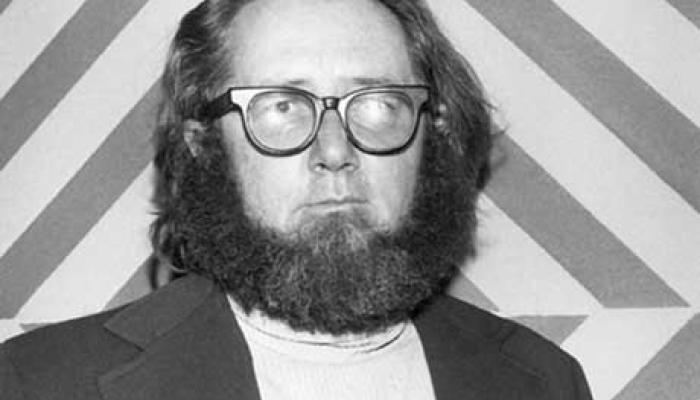
As would befit both of these artists and their interest in chance operations, the video is handheld and grainy, producing lovely visual distortions throughout (as is visible in the photo above). You can start watching by clicking here.


Friday, November 8, 2019

Mei-mei Berssenbrugge: 2019 KWH Fellows Program

We recently announced the exciting roster of Kelly Writers House Fellows that will be joining us in 2020 — including Canadian poet and translator ErĂ­n Moure — which gives us something to look forward to in the cold winter months to come. Today we're looking backwards to our visit from one of this year's fellows, poet Mei-mei Berssenbrugge, who joined us this past March 25–26.

Berssenbrugge's visit began with a reading on the evening of the 25th that included a number of longer readings, including "Irises," "Concordance," "Hello, the Roses," "Star Beings," "Lux," and "Chaco and Olivia." She returned on the 26th for a brunch conversation with Al Filreis, which has been segmented thematically. Some of those sections include their discussion of aphorisms, syntax and line structure, Berssenbrugge's poetic influences, classical literature, photography, and the definition of time.

Audio and video versions of both of these programs are available for your listening and viewing pleasure here. Our PennSound author page for Berssenbrugge houses more than two dozen individual recordings going back as far as 1986, including interviews, radio programs, and many, many readings. Click here to start browsing.

Wednesday, November 6, 2019

Congratulations to 2019 Latner Writers’ Trust Poetry Prize Winner Stephen Collis

Today brought the exciting news that poet Stephen Collis had been awarded the 2019 Latner Writers’ Trust Poetry Prize, which is "given to a mid-career poet in recognition of a remarkable body of work, and in anticipation of future contributions to Canadian poetry." The jurors' citation, signed by Hoa Nguyen and Margo Wheaton, states:
Through six collections of poems, Stephen Collis has achieved something remarkable: an invigorating body of work that convincingly addresses both the urgency of the present moment and the long echoes of our historical and lyrical past. 
In disrupted language simultaneously unsettled and musical, Collis passionately investigates subjects as diverse as the Trans Mountain pipeline expansion, John Clare and the English countryside, the increasing disappearance of public space, and, in a hauntingly beautiful sequence, the death of his sister from cancer. The depth and scope of Collis' vision is startling and impressive; so are the courage, precision, and care he brings to the poems he creates. 
In Collis, we find a poet ferociously hitting his stride. We're looking forward with eagerness to what comes next.
We congratulate Collis for this astounding honor and happily direct our listeners to his PennSound author page where they can sample his award-winning work. There you'll find a modest yet broad array of recordings made between 2005 and 2014, including readings, panel discussions, and an interview on Leonard Schwartz's radio program Cross-Cultural Poetics. Among many great resources, I'd especially like to highlight Collis' contributions to North of Invention, the two-day festival we hosted at the Kelly Writers House in January 2011, along with Short Range Poetic Device, a four-part radio show organized and hosted by Collis and Roger Farr during the 2010 Vancouver Winter Olympics. As the program notes explain, "Each show hosted a number of Vancouver poets, nearly all of whom were involved in anti-Olympic activities of one sort or another. The poets read from their work and discussed the role of poetry in contemporary struggles, the politics of poetic form, protest genres and both political and literary 'tactics.'" Click here to start listening.

Monday, November 4, 2019

Joseph Ceravolo on PennSound

We're starting this week by highlighting our holdings from beloved New York School poet Joseph Ceravolo (1934–1988), which we're very proud to be able to present through the generosity of his widow, Rosemarie.

Our earliest recording was made at the poet's home in the spring of 1968 and largely consists of poems from Wild Flowers Out of Gas (published the previous year) including "A Song of Autumn," "Drunken Winter," "Skies," "Happiness in the Trees," "White Fish in Reeds," and "Dangers of the Journey to the Happy Land." That's followed by "Poems and Background" from the 1969 album Tape Poems (ed. Eduardo Costa and John Perreault) and another set of home recordings from 1971. Running a little more than half an hour, this set also includes selections from Wild Flowers Out of Gas, plus "Ho Ho Ho Caribou" (here divided into its ten sections), the first three sections of "The Hellgate," and "Where Abstract Starts." 

Up next is a lengthy set of forty-nine poems recorded at the University of Chicago on May 11, 1976. Some titles included in this set: "Winds of the Comet," "Sleeping Outside My Mind," "The Spirit Mercury," "Interior of the Poem," "Kyrie Eleison," and "Good Friday." As Rosemary Ceravolo notes, there are some differences in titles between these recordings and the table of contents of 2012's Collected Poems since "Joe must have changed or added titles after he did the readings." Our last recording is Ceravolo's October 21, 1978 set at the Ear Inn that contains a number of poems-in-progress from the collection Mad Angels, often represented by a first line rather than its finished title, including "Tongues" and "Night Ride," along with a selection of early poems published in 1979's Transmigration Solo: "Sleep in Park," "Descending the Slope," "Romance of Awakening," and "Migratory Noon."

Along with these original recordings, we offer our listeners two marvelous complements. First, there's the September 2013 celebration of Ceravolo's work at the Kelly Writers House, organized by CAConrad, along with "The Lyrical Personal of Joe Ceravolo," an ambitious 2013 Jacket2 feature organized by Vincent Katz. Click here to listen to everything mentioned above.

Friday, November 1, 2019

Tuli Kupferberg's "No Deposit, No Return" (1966)


We're closing out this week with one of my favorite recordings from our archives and one I'm very proud that we can share with our listeners: Tuli Kupferberg's 1966 ESP-Disk release, No Deposit, No Return. While many know the late Kupferberg for his inimitable contributions to poetry-rock mavericks, the Fugs, this ambitious solo album is far more obscure, though not without its dedicated fans.

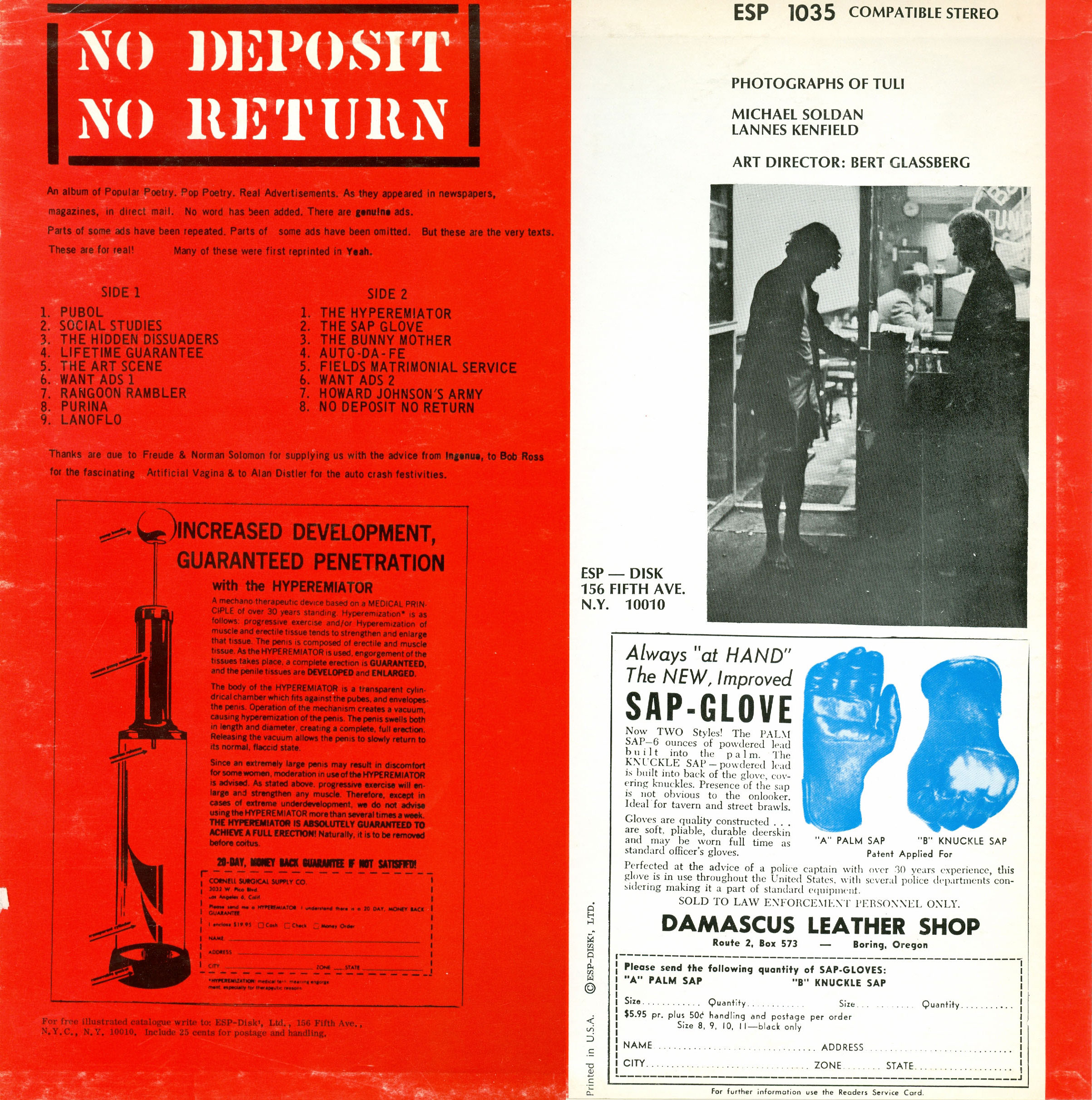
Subtitled "an evening of pop poetry" on the record sleeve, which devolves into "a nightmare of popular poetry" in Kupferberg's opening track, No Deposit, No Return is comprised exclusively of found texts performed with musical accompaniment "by Gary Elton on the various": "Real Advertisements," as the back cover explains, "As they appeared in newspapers, magazines, in direct mail. No word has been added. There are genuine ads. Parts of some ads have been repeated. Parts of some ads have been omitted. But these are the very texts. These are for real!" The end result is quite poetic, yet also drifts into the realm of pure comedy — albeit a comedy rooted in social critique — along with the golden age of radio, thanks to Elton's musical backings and sound effects. The invocation of sixties pop sensibilities and appropriative aesthetic also adds an element of the visual arts, creating a truly hybrid electric form that neatly parallels the contemporaneous sound poetry of John Giorno in building upon the foundational work of Charles Reznikoff.

"Everyone I suppose has always wanted to write his own commercial." Kupferberg notes in the introductory track, explaining the album's origins. "I have resisted this temptation strenuously, especially for this album, but when a certain well-known shampoo company came to the Fugs last summer, proposing that we do our own commercial for their new summer product, I countered with my own suggestion for a new product" — namely, Pubol, a pubic hair shampoo — and thus the project was born.

Aside from consumerism and America's culture of violence, No Deposit, No Return's major preoccupation is sex and sexuality, as Kupferberg performs advertisements for timid swingers, not-so-timid swingers, fetish photos, an erotic novel (Violations of the Child Marilyn Monroe, attributed to "Her Psychiatrist Friend") and a scary-looking penis pump,"the Hyperemiator," whose ad is one of two reproduced on the record's back cover. In a Foucauldian sense, particularly in the midst of a period of revolutionary sexual exploration, the poet reminds us that societal curiosity about sex and atypical sexual interest are nothing new. Regardless, there's a startling difference between the hidden, repressed and clinical nature of the poems on No Deposit, No Return, and the joyous and liberated carnality celebrated in Fugs' songs like "Supergirl" and "Coca Cola Douche." Thus, the album serves as both a strident cross-generational critique and a statement of shared beliefs, targeted at young audiences through one of their most popular media. In a fashion not dissimilar from what Kupferberg parodies in tracks like the heartbreaking "Social Studies," or the Fugs' "Kill for Peace," No Deposit, No Return is very effective propaganda.

We're grateful to Kupferberg's daughter, Samara, for her permission to share this groundbreaking record, which you can listen to in its entirety here. By clicking on the thumbnail images you can view large-format scans of the album covers and liner notes as well.