Monday, November 29, 2021

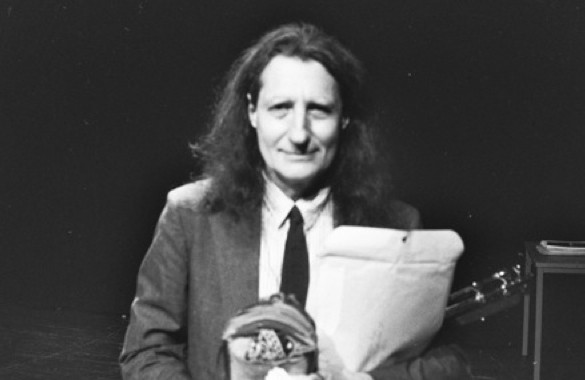
Jackson Mac Low at Naropa University, 1975

We're starting this week off with a new addition to the PennSound author page for Jackson Mac Low: an August 1975 recording made at Naropa University's Jack Kerouac School of Disembodied poetics. The timing of this recording — likely coming during the Kerouac School's first summer session (Allen Ginsberg and Anne Waldman started the program in 1974) — gives us interesting perspective on who was invited or just generally willing to help the fledgling program get off the ground.

While unsegmented, this recording has been split in half, corresponding to the two sides of the cassette tape housing it. Side A includes the titles "The Mantra of Chain Resese," "A Vocabulary for PI Moore," "36th Light Poem," "For and From John Cage," "Donna Rita Joseph Conrad," and "42nd Light Poem" for Paul Goodman. Side B starts with "Gloria" and continues with "Print Out from the 14 PDP3 Poem" and "Green Tara Mantra. " You can listen to these poems by clicking here. Listeners might also want to check out another Naropa set from the same month, which we added to the site in 2015, which includes renditions of several of the same poems, with a complete set list of "The Peter Innisfree Moore Poems" "36th Light Poem," "Phoeneme Dance for John Cage," "Joseph Conrad Poem," "42nd Light Poem," and "Du-fie."

Of course these two Naropa recordings are just a small fraction of the considerable archive you'll find on our Jackson Mac Low author page. Click here to start browsing our complete holdings.

Friday, November 26, 2021

PoemTalk #166: on Cecilia Vicuña's "Colliding and not colliding at the same time"

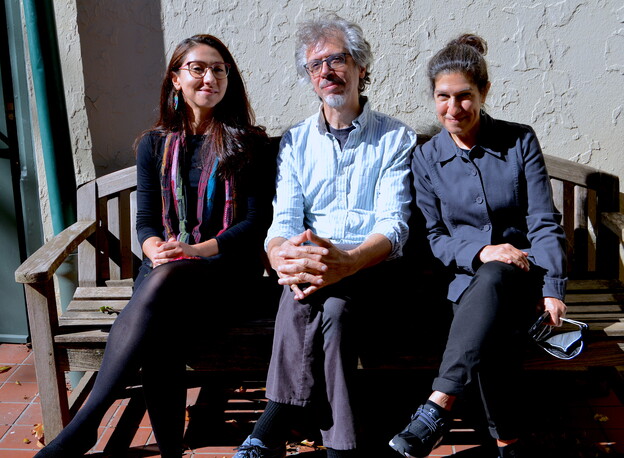
Earlier this week we released episode #166 in the PoemTalk Podcast series, which addresses Cecilia Vicuña's performance of "Colliding and not colliding at the same time," taken from "a ninety-minute presentation titled 'An Illustrated Conversation' that took place ... at the Writers House in February of 2017." Joining host Al Filreis for this program are panelists (from left to right) Huda Fakhreddine, Edwin Torres, and Jena Osman.

Filreis' Jacket2 blog post announcing the new episode offers up some useful contextual information on the performance under consideration: "The segment begins as the audience, having been encouraged to ask questions about an art video that had just been screened, went momentarily silent. No questions were being asked, so Vicuña began improvisationally to fill the room with words and sounds, exploring a convergence or collision of topics: the then-recent election of Donald Trump, 'the millionaires' coup;' in Brazil, the 'mystery of what is happening at this moment in the earth,' the collective thought of the people in the room, and the room itself." He continues, "Vicuña has an unusual talent for reading you in the room. 'I feel read' and 'She is accurately reading me' are typical responses of members of her audiences," before asking, "From what does she derive the various seemingly incidental topics of her improvisation?"

You can listen to this latest program and read more about the show here. PoemTalk is a joint production of PennSound and the Poetry Foundation, aided by the generous support of Nathan and Elizabeth Leight. You can browse the full PoemTalk archives, spanning more than a decade, by clicking here.

Wednesday, November 24, 2021

PennSound Presents Poems of Thanks and Thanksgiving

With the US celebrating Thanksgiving this week, it's time to revisit a perennial PennSound Daily tradition that started way back in 2010: a mini-mix of poems of thanks and thanksgiving — some old, some new — taken from the PennSound archives.

In a classic recording of "Thanksgiving" [MP3] from the St. Mark's Poetry Project, Joe Brainard wonders "what, if anything Thanksgiving Day really means to me." Emptying his mind of thoughts, he comes up with these free associations: "first is turkey, second is cranberry sauce and third is pilgrims."

"I want to give my thanks to everyone for everything," the late John Giorno tells us in "Thanx 4 Nothing" [MP3], "and as a token of my appreciation, / I want to offer back to you all my good and bad habits / as magnificent priceless jewels, / wish-fulfilling gems satisfying everything you need and want, / thank you, thank you, thank you, / thanks." The rolicking poem that ensues offers both genuine sensory delights ("may all the chocolate I've ever eaten / come back rushing through your bloodstream / and make you feel happy.") and sarcastic praise ("America, thanks for the neglect, / I did it without you, / let us celebrate poetic justice, / you and I never were, / never tried to do anything, / and never succeeded").

"Can beauty save us?" wonders Maggie Nelson in "Thanksgiving" [MP3], a standout poem from her marvelous collection, Something Bright, Then Holes, which revels in the holiday's darker edges and simplest truths: "After dinner / I sit the cutest little boy on my knee / and read him a book about the history of cod // absentmindedly explaining overfishing, / the slave trade. People for rum? he asks, / incredulously. Yes, I nod. People for rum."

Yusef Komunyakaa gratefully recounts a number of near-misses in Vietnam — "the tree / between me & a sniper's bullet [...] the dud / hand grenade tossed at my feet / outside Chu Lai" — in "Thanks" [MP3], from a 1998 reading at the Kelly Writers House.

Finally, we turn our attention to the suite of poems that concludes Mark Van Doren's Folkways album, Collected and New Poems — "When The World Ends" / "Epitaph" / "Farewell and Thanksgiving" [MP3] — the last of which offers gratitude to the muse for her constant indulgence.

To keep you in the Thanksgiving spirit, don't forget this 2009 PennSound Podcast (assembled by Al Filreis and Jenny Lesser) which offers "marvelous expressions of gratitude, due honor, personal appreciation [and] friendship" from the likes of Amiri BarakaTed BerriganRobert CreeleyJerome RothenbergLouis Zukofsky and William Carlos Williams.

Monday, November 22, 2021

Régis Bonvicino: In His Own Words

Charles Bernstein's latest Jacket2 commentary post showcases a recent interview with Brazilian poet Régis Bonvicino, conducted by Indian poet Runa Bandyopadhyay with Aurora Fornoni Bernardini, which was organized by Ekhon Bangla Kobitar Kagaj. Both the script of the exchange and a video are available, along with a recent review in Rialta by Ricardo Alberto Pérez of Bonvicino's latest, Deus devolve o revólver.

Here's an excerpt from a brief biographical statement by Bonvicino that starts off the conversation:

I started very young to write what I called poetry. My first book is composed of fifteen poems (Bicho Papel, 1975), the second Régis Hotel (20 poems, 1978). I didn't see myself as a poet then. In 1983 I published Sósia da Cópia and then I started to see myself more as an author. When I was 14 years old Frei Tito (tortured by the dictatorship, he killed himself in France in 1974) was my teacher. If I said that Bicho Papel was related to him, I exaggerated. I am agnostic. But the military dictatorship here was from 1964 to 1985 and marked us all. I believe that art without a critical spirit is a decorative art. Poetry now that is not questioning itself is not exactly poetry, as I see it.  Life is becoming more vulnerable: this is very much present in my poems. 

You can read or watch the full interview by clicking here. Check out the recordings housed on PennSound's Régis Bonvicino author page by clicking here.

Friday, November 19, 2021

Dawn Lundy Martin on PennSound

Today we're showcasing the recordings available on our Dawn Lundy Martin author page, which offers listeners the opportunity to check out readings and talks from 2006 to 2016.

The earliest pair of recordings come from an April 2006 visit to New York City, which yielded sets for both Belladonna* and the Segue Series; Martin would return for another Segue reading at the Bowery Poetry Club in December 2008. Our first recording from A. L. Nielsen's Heatstrings Theory archives is an October 2009 reading at Penn State University, and Nielsen was also kind enough to share a March 2016 appearance by the poet as part of a reading celebrating What I Say: Innovative Poetry by Black Writers in America, held in Brooklyn for that year's National Black Writers Conference at AWP. Then, from Andrew Kenower's A Voice Box archives, we have a pair of Bay Area readings: a 2010 reading at David Buuck's house and a 2013 reading at Tender Oracle held as part of the East Bay Poetry Summit. Finally, we have "On Discomfort and Creativity," the 2016 Leslie Scalapino Lecture in Innovative Poetics, held at Naropa University’s Jack Kerouac School of Disembodied Poetics. Video of that event is available, along with a link to the text in Something on Paper.

Four of the earlier readings mentioned above have been segmented into individual MP3s, providing listeners the unique opportunity to listen to multiple iterations of the same poems — including "The Undress," "The Morning Hour," "Bearer of Arms 1775-1783," and "The Symbolic Nature of Chaos" — read at separate events. Taken together, they also provide an interesting document of Martin's evolving style from her first publications up to just before her most recent collection, Good Stock, Strange Blood (Coffee House Press, 2017), which earned Martin the Kingsley Tufts Poetry Award in 2019 for "creating 'fascinating, mysterious, formidable, and sublime' explorations of the meaning of identity, the body, and the burdens of history along with one’s own private traumas." You can experience Dawn Lundy Martin's formidable voice by clicking here.


Wednesday, November 17, 2021

Bob Perelman on William Carlos Williams' "The Sea-Elephant"

It's entirely possible that you missed out on English Studies in Canada's special issue "On Discreetness: Event and Sound in Poetry," coedited by Louis Cabri and Peter Quartermain, which came out in the summer of 2009. Today, we're highlighting one of that issue's most exciting pieces — Bob Perelman's "A Williams Soundscript: Listening to 'The Sea-Elephant'" — which was subsequently republished in Jacket2 in 2013.

I first met Bob at John Ashbery's reading at Haverford College in February 2008, not long after I started working here at PennSound, and one of the first topics we discussed was his piece for the forthcoming ESC special issue and his desire for the essay to be accompanied by a number of brief excerpts and composite tracks from William Carlos Williams' two readings of "The Sea-Elephant." Eventually, I'd step in at the last minute as sound editor for the issue and put together a CD of tracks to complement the various articles, but even with footnote-esque prompts in the text to indicate when readers should listen to a particular track, this was not the ideal presentation we'd imagined. That's why, jumping forward four years, we're very glad that the essay can finally be read as it was originally intended. The Jacket2 reprint includes 50 embedded streamable MP3s, which allow readers to hear illustrative snippets of Williams without having to leave the document. It's a truly marvelous piece, and even more so when made available in this fashion, so head on over to Jacket2 right now (by clicking here) to start reading and listening.

Monday, November 15, 2021

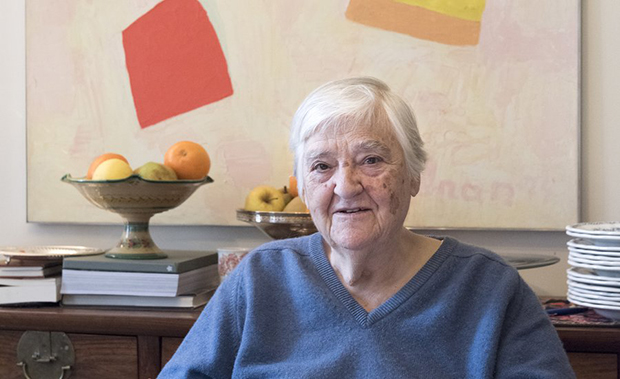
In Memoriam: Etel Adnan (1925–2021)

We start this week out with devastating news for the world of contemporary poetry: Lebanese-American poet and painter Etel Adnan has passed away at the age of 96 in Paris.

Our own Charles Bernstein posted a tribute to Adnan on Jacket2, hailing her as "a beacon of thought in a dirempt world." He continues, "In her writing I sense her hovering just beyond, in view but ungraspable, yet grounding me in ever-changing realizations. Luminous company, trusted guide, necessary source of immediate information, Adnan is a visionary of the meteoric and diasporic. Oscillating between the ecstatic and the unbearable, she finds home in the evasive emplacements of each moment."

PennSound's Etel Adnan author page is home to a modest archive of recordings that nevertheless give a sense of her diverse talents. That collection begins with Adnan's 2006 appearance on episode #118 of Leonard Schwartz's program, Cross-Cultural Poetics, titled "Forms of Violence." Via phone from Paris, she "reads from her book In the Heart of A Heart Of Another Country (City Lights), and meditates on her mother city of Beirut and American violence, inner and outer."

From 2010, we have a Serpentine Gallery reading showcasing The Arab Apocalypse and a 2012 reading commemorating the release of Homage to Etel Adnan (Post-Apollo), which was held at The Green Arcade Books Ideas Goods and co-sponsored by The Poetry Center and Small Press Traffic. Adnan returned to the Serpentine Sackler Gallery in London for a conversation with poet Robert Grenier a few weeks later. This chat between two hybrid artists was the inaugural event for the exhibition, "Etel Adnan: the Weight of the World."

Next we have a marvelous longform discussion with Jennifer Scappettone, recorded September 23–24, 2017, which has been segmented into individual tracks by theme, including "Home Life and School in Beirut," "Education in Philosophy and Beginnings in Painting," "English-Language Poetry and US Politics from the Vietnam War through Today," and "Cultural Identity, Multilingualism, and Translation." Finally, from December 2020, we have a reading and conversation with Bernstein hosted by the Brooklyn Rail’s New Social Environment, which also featured Sarah Riggs, Omar Berrada, and Susan Bee.

We're grateful to be able to share Adnan's work with our audience, and likewise send our thanks to those who've shared resources with us. You can listen to any of the aforementioned recordings by clicking here.

Friday, November 12, 2021

David Antin Discusses Kathy Acker, 2002

Here's another stunning vintage recording from our archives to bring our week to a close: a half-hour video of David Antin discussing Kathy Acker — who he calls "a dazzlingly charming and funny and brilliantly powerful writer, whose work I've always felt very close to" — as part of a symposium on her work held at New York University on November 8, 2002.

"Let me point out I knew Kathy before she was the Kathy Acker you all know," Antin begins, discussing his first meeting her at UC San Diego in 1968, when she was working as a teaching assistant and associating with other "refugees from Brandeis," along with her husband Robert (nominally a student of Marcuse). He goes on to discuss "the climate in which Kathy came to be a poet" — specifically "the proclaimed sexual revolution" and "the year of the assassinations" (Antin's arrival in the city coincided with Robert Kennedy's murder and Valerie Solanas' shooting of Andy Warhol) — then recalls the guidance that he provided to young and aspiring writers like Acker, Mel Freilicher, and others from their social circle, the conceptual art projects he worked closely with (including a Fluxus retrospective), and associations with figures like his wife, Eleanor, Jerry and Diane Rothenberg, Lenny Neufeld, George Quasha, et al., all of which proved to be very influential. "She was exposed to all of these people in various ways that were useful to her," he observes. 

He goes on to talk about her compositional use of constraint ("Her engagement was with so many things but she had to restrain herself to not be all over the place all at once."), her means of getting her work out to wider audiences, and the qualities that made her a singular talent: "Kathy had both intelligence and energy, and she had desire [...] It was the intensity of her desire for life." It's a gossipy, raucous recollection that also reveals deeper truths about how Acker came into her own. You can watch it here.

Wednesday, November 10, 2021

A New Disability Poetics Symposium, 2018

Today we're highlighting A New Disability Poetics Symposium, which was recorded at the LGBT Center at UPenn on October 18, 2018. This ambitious, multi-part gathering was organized by Jennifer Bartlett, Ariel Resnikoff, Adam Sax, and Orchid Tierney, in collaboration with Knar Gavin, Declan Gould, Davy Knittle, and Michael Northen.

The proceedings began with the panel "Larry Eigner's Disability Poetics," moderated by Charles Bernstein, with talks by George Hart, Michael Davidson, and Jennifer Bartlett. That's followed by "Disability and Performance," moderated by Declan Gould, with contributions by torin a. greathouse and Camisha Jones; and "Poetic Experiment and Disability," moderated by Orchid Tierney, with panelists Sharon Mesmer and Gaia Thomas.

These talks are complemented by a number of readings, the first taking place as part of the symposium itself, with sets by Bartlett, Jim Ferris, Ona Gritz, Anne Kaier, Dan Simpson, and Brian Teare. There's a second set recorded at our own Wexler Studios with Kaier, Simpson, Ferris, Gritz, and Michael Northen reading their work. Finally, poet Kathi Wolfe was unable to take part in the symposium, but made home recordings of the pieces she would have read at the event, which we've made available to listeners as well.

Given both the significance of Disability Studies and the growing attention it's receiving from more mainstream audiences, this is a particularly important event, and one that we are very proud to be able to share with a wider audience. To start listening, click here.

Monday, November 8, 2021

Susan Howe and David Grubbs: "Frolic Architecture," 2011

Over the years, we've been able to bring you a wide variety of audio and video from the fruitful and long-running collaboration of poet Susan Howe and musician/composer David Grubbs (Squirrel Bait, Bastro, Gastr del Sol) and today we're happy to present footage of a recent performance of their piece, Frolic Architecture, recorded at Harvard University on November 1, 2011.

The stunning center section of Howe's 2010 book, That This (New Directions), Frolic Architecture was "inspired by Susan Howe's experience of viewing various manuscripts, sermon notebooks, books, and pamphlets of the eighteenth century American Calvinist theologian Jonathan Edwards in the vast collection of Edwards family papers at the Beinecke Rare Book and Manuscript Library in New Haven, Connecticut. Especially by the folder in Box 24 titled 'Wetmore, Hannah Edwards, 1713–1773, Diary, 1736–39, copy in the hand of Lucy Wetmore Whittelsey, with commentary/n.d.'" The texts were composed "using multi-purpose copy paper, scissors, 'invisible' scotch tape, and a Canon copier PC170 [to] collage fragments of this 'private writing' with a mix of sources from other conductors and revealers in the thick of things — before." Howe and Grubbs released a studio version of Frolic Architecture on Drag City subsidiary Blue Chopsticks (home to their previous albums, 2008's Souls of the Labadie Tract and 2005's Theifth) in 2011, which further develops the collaborative nature of the piece — aside from Howe's appropriation of Hannah Edwards Wetmore's diary, Frolic Architecture was originally published as a limited-edition artist's book by Grenfell Press, featuring ten photograms by James Welling (also reproduced in That This).

Working in a similar mode to their earlier collaborations, Grubbs creates an airy and haunting bed of sound, consisting of laptop manipulations of Howe's pre-recorded voice — rhythmic and chaotically scattered phonemes that mimic the poem's collaged scraps and flutter around the poet's live performance — wed to modulated Hammond organ drones. Much like Souls of the Labadie Tract, the two artists' interaction on Frolic Architecture began at a very early and unpublished stage in the text's development, and as Howe acknowledges in the Q&A session that follows the performance, her association with Grubbs has shaped her approach to writing and language in general. While, at first, she deemed Frolic Arcitecture to be an "unperformable poem," Grubbs' efforts to "match [his] fragmentation to [her] fragmentation" yield fantastic results once again.

Friday, November 5, 2021

Short Films by Ken Jacobs on PennSound

We're closing out this week by highlighting a number of stunning short films by Ken Jacobs that we're proud to include as part of our PennSound Cinema collection. They include a half-dozen silent micro-films, each the length of a television commercial, created in 2016: Writhing Cities, Central Park, Snow in Headlights I, Window Cleaner, Dead Leaves, and Deader Leaves. These silent meditations serve as an amuse-bouche to unfamiliar viewers, introducing them to Jacob's use of the Pulfrich effect — an early film theory based on the notion that a projected image reaches each eye at a slightly different time (those interested in learning more can read a wonderfully-detailed explanation by Miriam Ruth Ross here) — built upon looped images that rapidly alternate from positive to negative. The resulting films effect a visual equivalent to the Shepard scale, seeming simultaneously static and in-motion, and creating a lush, immersive three-dimensional image.

This is probably a good point to warn readers that due to this intense flickering effect we recommend that those with epilepsy and similar conditions triggered by light avoid watching these films. They can be challenging even for those without seizure disorders: I started to get a headache after about a half hour with the films, but it was a worthwhile tradeoff for the viewing experience.

After the super-brief clips, we have a trio of longer films: Capitalism: Child Labor (2006), Another Occupation (2011), and Seeking the Monkey King (2012). On the small scale, these films operate much like the aforementioned shorts in terms of their flickering using the Pulfrich effect, however the images are further embellished with color washes, inset details, and other distortions, and evolve over time rather than fixating on one image. They're also scored, with Rick Reed providing music for the first two — which showcase tremoloed drones that shift from peaceful bell-tones to harsh metallic squeals — while J.G. Thirwell's soundbed for the last blends dramatic blockbuster pomp with calmer passages. In Capitalism we meditate on a haunting Lewis Hine-like image of young textile workers, while Another Occupation recycles and degrades found footage of Bangkok, and in Seeking the Monkey King we explore dazzling jewel-like landscapes of crumpled tinfoil while pondering occasional intertitles that rail against the titular monarch.

You can view all of these films, and listen to a three-part 2009 Close Listening program with the filmmaker on our Ken Jacobs author page.

Wednesday, November 3, 2021

Happy Birthday to Tom Weatherly

November 3rd was the birthday of poet Tom Weatherly, which makes it an excellent opportunity to revisit David Grundy's mindblowing Jacket2 feature, "A Short History of Tom Weatherly."  Here's a brief excerpt from his introductory note:
We're familiar by now with the designation of neglected writers as "poets' poets" — essentially, an excuse for their continuing neglect. And we are, or should be, even more familiar with the neglect heaped on African American innovative writers, especially those who refuse to be easily pigeonholed into secure ideological or formal categories. Thomas Elias Weatherly (1942–2014) fits both categories. Since his death, on July 15, 2014, his work has continued to occupy the cracks, lost in the shadows, just another one of the ghosts of American poetry. It shouldn't be this way. Born in Scottsboro, Alabama, in 1942, Weatherly turned to poetry at the age of eight after seeing a vision of Homer, who instructed him to become a "wekwom teks," or "weaver of words." This experience inspired his first poem: "It did seem / That he said / Sing until dead." Weatherly would heed this call throughout his life. 
What follows an unstinting, encyclopedic justification of his estimation of Weatherly's importance. Grundy has gathered, very nearly, everything written about or by Weatherly over his thirty-five year writing life. That includes the complete text of his long out-of-print books Maumau American Cantos (Corinth Books, 1970) and Thumbprint (Telegraph Books, 1971), along with his joint publication with Ken Bluford, Climate/Stream  (Middle Earth Books, 1972), selections from the still in-print Short History of the Saxophone (Groundwater Press, 2006), and a lavish selection of uncollected poetry from his earliest mature poems to what's likely the last poem written before his death in 2014. A selection of critical writings is included as well, most notably his introduction to Natural Process (Hill and Wang, 1970) — an important anthology of African American poetry co-edited with Ted Wilentz — and "Black Oral Poetry in America: An Open Letter," published in Alcheringa in 1971. In fact, our Jacket2 Reissues copy of that issue of Alcheringa was missing one page, naturally in the midst of Weatherly's essay, and Grundy was able to get us a scan to complete our archive.

All of the aforementioned materials would be, in and of themselves, would be more than a worthy tribute to Weatherly's talents and a delight for readers. They are, however, merely one part of the overall feature. Once again, I'll let Grundy explain:
Forming a companion to this work by Weatherly is a series of longer critical essays and shorter tributes. Burt Kimmelman's essay on Weatherly, "The Blues, Tom Weatherly, and the American Canon," shows Weatherly as a blues poet par excellence, carefully tracing his emergence in the New York poetry scene, the importance of his Southern background, and the technical innovations of his work. Ken Bluford's "Essay with Tom Weatherly in It," first published alongside Weatherly's work in Lip magazine in 1970, further points out how Weatherly's use of Southern vernacular traditions both sets him alongside and contrasts him to better-known poets of the Black Arts Movement. My own essay focuses on Weatherly's first book, the Maumau American Cantos, concentrating on Weatherly's writing of the American South and his figurations of sexuality. The piece by Evelyn Hoard Roberts reprinted from the Dictionary of Literary Biography provides a detailed and invaluable biographical overview of Weatherly's early career. 
The shorter tributes he mentions are part of a third sub-section containing all sorts of fascinating ephemera: " fond reminiscences, poems, and obituaries from Akua Lezli Hope, Eugene Richie, Janet Rosen, Aram Saroyan, M. G. Stephens, Rosanne Wasserman, and the late John Ashbery," along with contemporaneous reviews of his work, examples of the poets own "illuminated manuscripts," and a whole slew of audio-visual materials. That includes a newly-unearthed 1968 reading at the St. Mark's Poetry Project that, along with a 1971 reading in Grand Valley, Michigan, can be found on PennSound's Tom Weatherly author page. When we first added the 1971 recording, not long after Weatherly's death, Charles Bernstein offered this summation of its contents: "Weatherly reads the complete serial poem 'Mau Mau American Cantos' for the first ten minutes of the reading ... after that he reads various poems, including 'Lady Fox' from Thumprint but nothing else from that book or Mau Mau." He also hailed Weatherly's work as "powerful, brilliant, often volatile (and distressingly unacknowledged)." Well, now you certainly have the opportunity to evaluate his judgment. 

Monday, November 1, 2021

Eugene Ostashevsky: Scalapino-Hejinian Lecture in Innovative Poetics, 2021

We kick off this new week with video footage of Eugene Ostashevsky delivering his Scalapino-Hejinian Lecture in Innovative Poetics, "Translingualism: A Poetics between Cultures, Nations, and Languages." Originally scheduled for March 17, 2020, Ostashevsky's talk was an early victim of the Covid-19 pandemic, rescheduled until this past September of this year, where it was delivered via Zoom.

This excerpt from the original announcement for the canceled 2020 event seems especially pertinent to the topic of Ostashevsky's talk:

Writing in LARB, Boris Dralyuk calls The Pirate a "raucous modern-day Anatomy of Melancholy, a seriocomic linguistic performance the likes of which we rarely see, in any tongue. It is a beautiful song, broadcast by an outcast whose language is all his own." The Italian newspaper Il Manifesto speaks of The Pirate's "poetics of immigration." The German edition of the book, translated by Uljana Wolf and Monika Rinck, was awarded the International Poetry Prize from the City of Münster, with the jury praising the original's "polyphonic and polyglot verbal acrobatics" and linguistic multiplicity. For the Süddeutsche Zeitung, Ostashevsky's work "argues that one must have distance from language, and also an awareness that no language is only 'mine'; it is rather many languages of different times and speakers that collide or coalesce under the name 'English.' Every language is, in a sense, a parrot language." For another German reviewer, The Pirate "deconstructs the strategies of linguistic exclusion concealed by such concepts as 'indigenous,' 'refugee,' and 'native language.'" 

Originally the Scalapino Lecture in Innovative Poetics, the Scalapino-Hejinian Lectures in Innovative Poetics started in 2011, the year after Leslie Scalapino's death. As amorphous as its namesake's poetry, the series has had events at a variety of locations over the past decade, including the Pratt Institute, Small Press Traffic, Naropa University, and UC Berkeley. You can browse our complete archive of recordings from the series here; Ostashevsky's lecture can be found here.