Friday, December 31, 2021

PoemTalk #167: on Myung Mi Kim's "And Sing We"

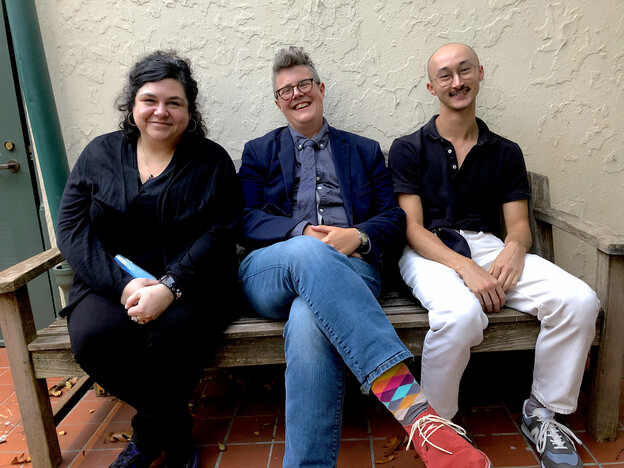
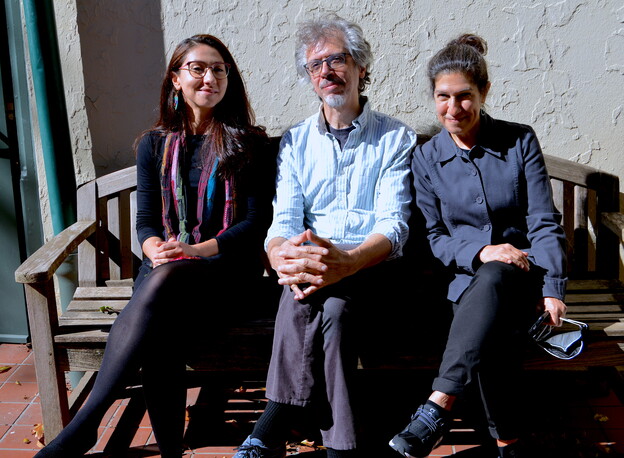
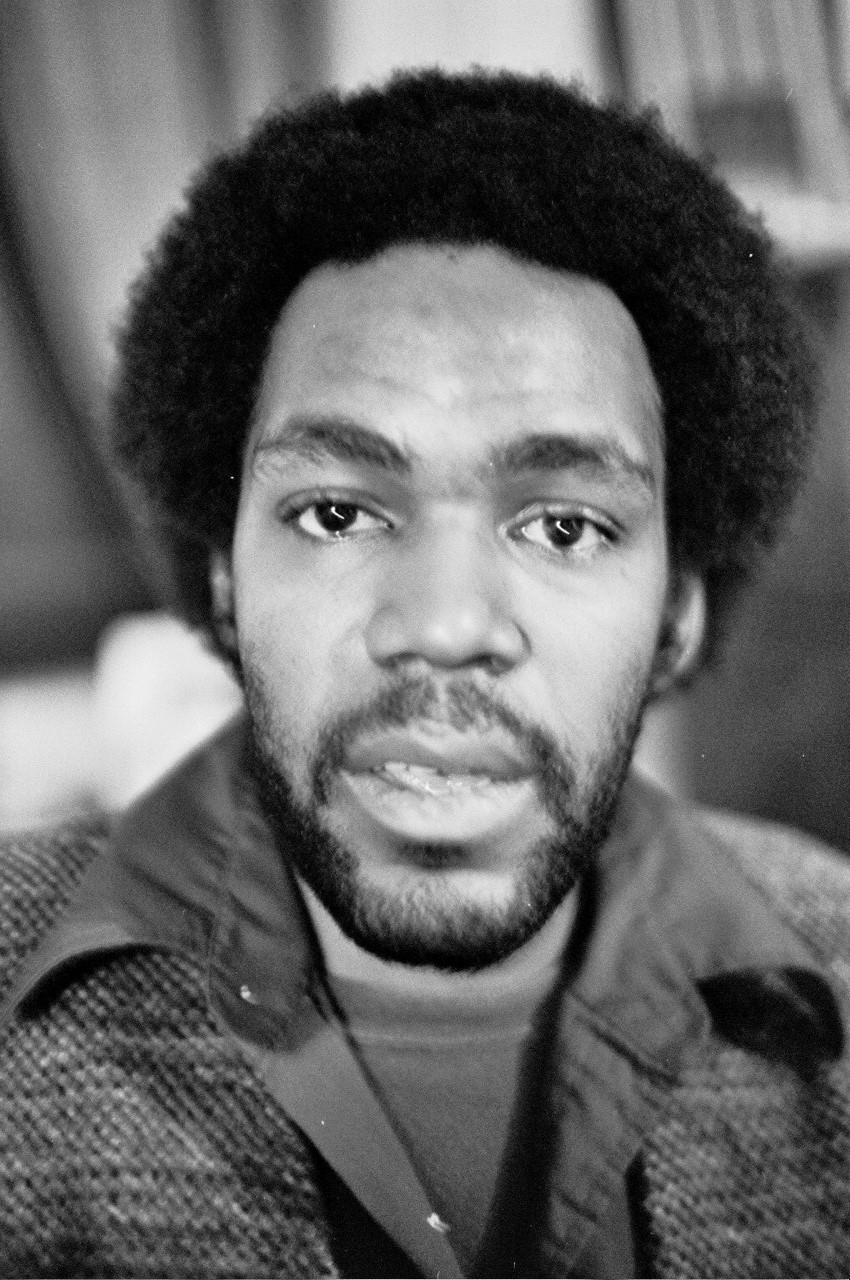
We close out this week and the year as a whole with the latest episode in the PoemTalk Podcast series, its 167th in total, which was released last week. For this program, host Al Filreis was joined by a panel consisting of (from left to right) erica kaufman, Jack Giesking, and Jonathan Dick to discuss Myung Mi Kim's "And Sing We," the opening poem from her 1991 Kelsey Street Press release, Under Flag.

"In this poem, memory is presence rather than absence. It is constructed partly of a series of childhood recollections, some more explicit than others," Filreis states in his Jacket2 blog post announcing the new episode. "We seem to see an immigrant family's kitchen scene. Then there's the school performance led by the first grade teacher, with its officially optimistic and aurally as well as thematically allegiant 'Um-pah, um-pah sensibility.'" He continues, "The proem's title has already conveyed the national anthem, and other idioms suggest the Pledge of Allegiance (as well as the book's titular idea with its strong preposition 'under'), and so 'um-pah, um-pah' strikes us as so insistently regular as to be threatening, ominous. Sousa-like insistence upon celebration," before concluding "But the writing of the poem, with its discordant and post-traumatic haltings and its scene-switching, resists the forceful, socializing sounds to be learned in and from US culture." 

You can listen to this latest program and read more about the show here. PoemTalk is a joint production of PennSound and the Poetry Foundation, aided by the generous support of Nathan and Elizabeth Leight. You can browse the full PoemTalk archives, spanning more than a decade, by clicking here.


Wednesday, December 29, 2021

Yusef Komunyakaa on PennSound

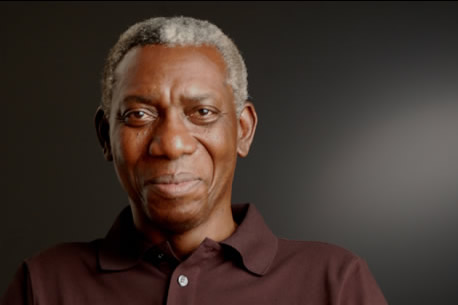
Today we're taking a closer look at PennSound's author page for Yusef Komunyakaa, which was created not long after our official launch in 2005. While it houses a modest set of recordings, it nevertheless has many of this much-anthologized poet's most iconic work.

The heart of our Komunyakaa page is a March 1998 reading at our own Kelly Writers House. This  segmented recording consists of twenty-four in total, including favorite poems like "Facing It," "The Smokehouse," "Ode to the Maggot," "The God of Land Mines," "You and I Are Disappearing," and "Ode to a Drum," along with "Rhythm Method," "Letter to Bob Kaufman," "Camouflage in the Chimera," "We Never Know," and "Thanks," which has been a cherished part of PennSound's "Poems of Thanks and Thanksgiving" playlist for more than a decade. There's also a July 1999 appearance with Deborah Garrison on BBC Radio 3's Contemporary American Poetry Program, and the single poem "Slam, Dunk & Hook," published as part of the 2005 anthology Rattapallax.

We're grateful and proud to have Yusef Komunyakaa as part of the diverse array of voices found within PennSound's vast archives. You can listen to all of the poems mentioned above my clicking here.


Monday, December 27, 2021

Haroldo de Campos on PennSound

Today we're highlighting our author page for poesia concreta pioneer, Haroldo de Campos, which is anchored by a 2002 video from the Guggenheim Museum celebrating his life and work. Presented in conjunction with the exhibition Brazil: Body and Soul, this January 12, 2002 event featured both performances and discussion of de Campos' work by a wide variety of poets, translators and critics.

The video begins with introductory comments by Pablo Helguera and organizer Sergio Bessa, who are followed by a staging of de Campos' 1950 poem/play "Auto do Possesso (Act of the Possessed)," translated by Odile Cisneros and directed by Cynthia Croot. Craig Dworkin is next, reading his translation of "Signantia quasi coelum / signância quase céu," follwed by a brief set by Cisneros, who reads her translations. The performances conclude with Marjorie Perloff and Charles Bernstein reading Bessa's translation of "Finismundo," after which Perloff and Bernstein take part in a panel discussion moderated by Bessa.

Next, from 2005's Rattapallax we have a single track, "Calcas Cor de Abobora." Finally, we have a 2017 video of our own Charles Bernstein performing at New York's Hauser and Wirth Gallery with Sergio Bessa on September 28, 2017. This event, co-sponsored by the Poetry Society of America and held in conjunction with an exhibit by Mira Schendel at the gallery, included Bessa speaking about de Campos and Bernstein reading his translations of Drummond, Cabral, Cruz e Sousa, Leminksi, and Bonvicino.

On our Haroldo de Campos author page, you'll also find a link to Bernstein's 2003 essay "De Campos Thou Art Translated (Knot)", first published in the Poetry Society of America's Crosscurrents.

Thursday, December 23, 2021

John Richetti reads "A Visit from St. Nicholas"

As we close out the year, we have one more gift to pass along to our listeners from our friend John Richetti: a recording of Clement Clarke Moore's beloved Christmas poem, "A Visit from St. Nicholas," made specially last December to be added to his growing anthology, "119 Favorite Poems, Good for Memorizing."

More frequently known by its opening phrase, "'Twas the night before Christmas ...," "A Visit from St. Nicholas" was first published in Troy, New York's Sentinel on this day in 1823 with no attribution. It became wildly popular, reprinted far and wide, and its author — a professor of literature and divinity at New York City's General Theological Seminary of the Episcopal Church, who initially sought to downplay his connection to the poem — would finally be credited in 1837, with Moore including it in a collection of his verse in 1844.

Click here to listen to Richetti's performance of the poem. You can read along on the Poetry Foundation's copy of the poem here. Many more recordings made by Richetti form the backbone of our PennSound Classics page, which is organized by author name. To start browsing, click here.


Tuesday, December 21, 2021

Welcoming Winter with Bernadette Mayer

At 10:58AM EST, we officially make the transition from autumn into winter, and the day that lies ahead of us will be the year's darkest. The winter solstice has long been a source of cultural inspiration and poetic inspiration as well, with one of the most notable recent manifestations being Bernadette Mayer's iconic Midwinter Day, which celebrates its forty-third birthday this year. While not published until 1982, Mayer famously wrote the book — hailed by Alice Notley as "an epic poem about a daily routine ... sedate, mundane, yet marvelous" — in its entirety while marking the the winter solstice at 100 Main Street in Lennox, Massachusetts on December 22, 1978. 

While celebrating Mayer and Midwinter Day today is an annual PennSound tradition, it takes on special significance after yet another challenging pandemic year. As Megan Burns notes in her Jacket Magazine essay on the book: "A long held tradition on Midwinter's Day was to let the hearth fire burn all night, literally keeping a light alive through the longest night of winter as a source of both heat and a symbol of inspiration to come out the other side of the long night closer to spring and rebirth. It is fitting that a poem about surviving death and the intimacy of the family would be centered around this particular day that traditionally has focused on both. The hearth is the center of the home where the family gathers, where the food is cooked and where warmth is provided. Metaphorically, the poem Midwinter Day stands in for the hearth gathering the family into its folds, detailing the preparation of food and sleep and taking care of the family's memories and dreams."

Mayer read a lengthy excerpt from the book at a Segue Series reading at the Ear Inn on May 26th of the following year, which you can listen to on her PennSound author page along with a wide array of audio and video recordings from the late 1960s to the present. 

Friday, December 17, 2021

"Poetry Is for Breathing," 2019

Organized by Orchid Tierney,  "Poetry Is for Breathing: A Reading Against Islamophobia" took place at our own Kelly Writers House on April 17, 2019, with sets by Aditya Bahl (poet, translator, and a current Johns Hopkins Ph.D. candidate), Husnaa Hashim (2017-2018 Youth Poet Laureate of Philadelphia), and Fatemeh Shams (shown at right, a poet and UPenn professor of Persian literature). 

The announcement for this event situates it as a direct response to both recent tragedy and and long-simmering prejudices: "On March 15, 2019, a white supremacist murdered fifty people at the Al Noor Mosque and Linwood Islamic Centre in Christchurch, Aotearoa-New Zealand. Please join us for a special lunchtime poetry reading in support of the survivors and victims of this terrorist attack. Invited poets will read their works, and we encourage the audience to share their thoughts as we collectively examine the intersections of white supremacy in Christchurch and Philadelphia."

You can experience this very special reading via streaming video or MP3 format by clicking here. More recordings by both Tierney and Shams are available on their respective PennSound author pages.

Wednesday, December 15, 2021

Congrats to MLA Scaglione Translation Prize Winners, incl. Nakayasu

Last week saw announcements of this year's MLA prizes handed out, including one for PennSound poet Sawako Nakayasu. Along with Jack Jung, Don Mee Choi, and Joyelle McSweeney, Nakayasu was awarded the 2021 Aldo and Jeanne Scaglione Prize for a Translation of a Literary Work for their work on Yi Sang: Selected Works (Wave Books, 2020). The committee's citation begins "Yi Sang was a bilingual (Korean and Japanese) avant-garde poet who died in obscurity, at twenty-seven, in 1937. His writing combines fable, fantasy, satire, parody, Dadaism, concrete poetry, and quasi-translation and presents a steep challenge to translation." It continues: 
But Jack Jung, Sawako Nakayasu, Don Mee Choi, and Joyelle McSweeney — themselves experienced practitioners of experimental poetry — took the job to heart and have recreated in English Yi Sang's terse, polyglot, self-undermining, dreamlike parables and essays, first published in Korean and Japanese and then subjected to the hazards of war and neglect. With its evocation of alien typographies, its professed decadence, and its indifference to hierarchy, Yi Sang's writing fits on neither side of the colonial relationship that defined Korea and Japan. The elegant format and plural translating voices make this book a suitable monument to this intriguing figure.
We send our heartiest congratulations to all four translators, including Nakayasu, and we welcome you to check out her PennSound author page, which includes readings and interviews, including a 2007 Cross Cultural Poetics appearance that highlights her work as a translator. 

Monday, December 13, 2021

Ted Enslin: 2000 Recording Newly Segmented

We recently segmented Ted Enslin's February 16, 2000 reading at the University of Maine. This forty-five minute set included twenty-three titles in total, including "A Little Night Music," "Tangeré," "Apple Tree Study," "To See One Thing Among the Shapes," "Sound Pattern," "Uprooting," "Botany," "Not Yet, Not So," "Benediction," "Variations on a Thing," "Forgotten Seed," "How Should We Listen," "The Road Around Jenkins," and "Sea Change." Click here to start listening.

On PennSound's Ted Enslin author page you'll find a total of ten readings from the late poet, starting with a 1985 reading at the legendary Woodland Pattern bookstore and ending with a 2009 set as part of Jonathan Skinner's Steel Bar series at Bates College. In-between there are sets from the Wendell's in New York City, Granary Books, Bowling Green State University, a radio appearance from WMCS Malchias and more. Click here to start browsing.

Friday, December 10, 2021

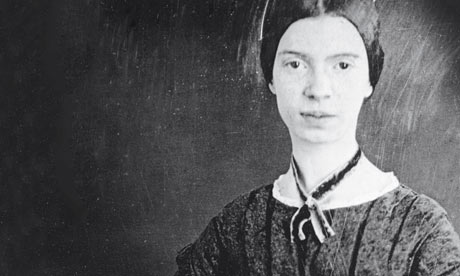
Happy Birthday to Emily Dickinson

Today would have been the 190th birthday of Emily Dickinson. For many years, a treasure trove of Dickinson materials was scattered throughout our site, but a few years ago we pulled together a proper PennSound author page for the poet, gathering selected resources from throughout our archives.

It should come as no surprise that Susan Howe would be prominent featured, and here you'll find complete talks on the poet from 1984 (from the New York Talk series) and 1990 (from SUNY-Buffalo) in addition to several smaller excerpts from larger talks pertaining to the poet. There's also a link to PoemTalk #32, which discusses Howe's interpretation of Dickinson's "My Life had stood - a Loaded Gun."

Full series of lectures on Dickinson are also available from Robert Duncan and Robert Creeley, both at the New College and dating from 1981 and 1985, respectively. Among other substantial contributions, there's also the 1979 Dickinson Birthday Celebration at the St. Mark's Poetry Project (featuring Jan Heller Levi, Charles Bernstein, Susan Leites, Charles Doria, Virginia Terrace, Barbara Guest, Madeleine Keller and Vicki Hudspith, Armand Schwerner, Karen Edwards, Jackson Mac Low, Maureen Owen, and Howe) and Rae Armantrout's 2000 presentation on Dickinson from "Nine Contemporary Poets Read Themselves Through Modernism."

You'll also find performances of individual Dickinson poems from John Richetti and Jeffery Robinson as well as brief excerpts of radio interviews — with John Ashbery, Guest, and Elizabeth Bishop — pertaining to the poet.

Our hope is that this page, which brings together disparate resources already available in our archives, will be a useful tool for teachers, students, and casual readers, as well as serious scholars. Click here to start exploring.

Wednesday, December 8, 2021

Remembering Jackson Mac Low

Today is the 17th anniversary of the passing of polymath poet Jackson Mac Low, which is a wonderful reason as any to revisit some of the many recordings housed on his PennSound author page.

There you'll find a wide array of audio and video spanning four decades, from the 1970s up till just a few months before his death in December 2004. In addition to numerous readings — including seven Segue Series sets, recordings from the St. Mark's Poetry Project, the Living Theater, the Line Reading Series, PhillyTalks, the Radio Reading Project, the Orono 40s conference, the Sound & Syntax International Festival of Sound Poetry, and more — along with talks from the St. Mark's Talks series, SUNY-Buffalo, the New Langton Arts Center, and LINEbreak, videos from Public Access Poetry and Mac Low's 75th birthday festschrift, and numerous complete album releases (often with Anne Tardos). A few recent additions include his 1975 reading at Naropa University and  a 1978 video of Jackson Mac Low and Tom Leonard reading at the Sound and Syntax International Festival of Sound Poetry.

If this embarrassment of riches seems a little overwhelming, or if you're new to Mac Low's prodigious career, it might be helpful to start with the 2008 book launch event for Thing of Beauty: New and Selected Works, which features Tardos, Charles Bernstein, Mei-mei Berssenbrugge, Drew Gardner, Joan Retallack, Chris Mason, or PoemTalk #46 on Mac Low's "Words nd Ends from Ez."


Monday, December 6, 2021

Join Us for a Live PoemTalk Taping on Wednesday 12/8

We'd like to extend an invitation to anyone in the Philadelphia area to join us this Wednesday afternoon for a live, in-person recording session for an upcoming PoemTalk podcast. This episode will focus on two poems, or "pre-verbs," by poet George Quasha, and will feature a panel including Anthony Elms, Charles Bernstein, and Laynie Browne in addition to host Al Filreis.

We will be recording the episode in the Kelly Writers House's Arts Cafe beginning at 4 PM. If you's like to attend, please email Al at afilreis@writing.upenn.edu. We hope to see you there!

Friday, December 3, 2021

John Richetti Reads Love Poems, 2021

While Valentine's Day is more than three months away we're here to help you pitch a little woo with a new collection of love poetry recorded by our dear friend John Richetti. This latest body of work is a passive collaboration of sorts, with Richetti's selections taken from Jon Stallworthy's 1973 anthology, A Book of Love Poetry, which he recently revisited. Here's his full introduction to these new recordings:

Love has always been a recurring theme in poetic expression over the centuries. The speaker is almost always a man addressing a woman to praise her beauty or to declare his desire for her or even to berate her for refusing his advances, and often enough warning her that her beauty won’t last. Love, of course, is a vague notion. The word can signify sexual desire or something less intense such as fondness and fellow-feeling for friends and relatives or indeed for the rest of the world, fellow humans and animals. I have been browsing lately in an anthology, A Book of Love Poetry, edited by Jon Stallworthy (Oxford University Press, 1973), and I have encountered many familiar poems and also many I did not know, including about a dozen by women. So here in this section I have chosen to record a number of love poems, including many that most readers like me will not be familiar with. As Stallworthy remarks in his introduction, “there are almost as many definitions of love as there are poets,” and in “a high proportion of cases, what they have to say is said better, more freshly, than anything on any other subject.”

Richetti's selections are generous, to say the least, with a whopping seventy tracks spanning several centuries. Iconic names like Tennyson, Marvell, Rossetti, Marlowe, Poe, Pound, Donne, Berryman, Swift, Byron, Neruda, Frost, Shakespeare, Auden, Whitman, and Yeats, among many others. Particularly as the semester is winding down for many of us, it's a great time to relax and immerse ourselves in some classic literature. Click here to start browsing this new, impressive body of material.

Wednesday, December 1, 2021

Tomorrow at KWH: A Celebration of Al Filreis' '1960'


We invite you to join us tomorrow night, December 2nd, at 6:00 PM EST for a live-streamed celebration of our own Al Filreis' newest book, 1960: When Art and Literature Confronted the Memory of World War II and Remade the Modern. This special event will be co-hosted by Charles Bernstein and Laynie Browne and can be watched here. Here's the full announcement:
We're delighted to invite you to join us Thursday, December 2, at 6:00 PM (ET), to celebrate the release of the newest book by Kelly Writers House Faculty Director Al Filreis, 1960: When Art and Literature Confronted the Memory of World War II and Remade the Modern. In his latest work, Filreis recasts 1960 as a turning point to offer a groundbreaking account of postwar culture. He examines an eclectic group of artistic, literary, and intellectual figures who strove to create a new language to reckon with the trauma of World War II and to imagine a new world. Laynie Browne and Charles Bernstein will lead a conversation with Filreis on his writing and process. We hope to see you there! Registration is required to attend this event in person. Please fill out the PennOpen Pass daily symptom checker the day of the event and be ready to display your Green Pass.

In addition, here is a sampling of some advance praise that 1960 has garnered:

Tightly focused on work done within the year of its title, 1960 offers a compelling account of how artists processing the memory of mass trauma in World War II turned to innovation and reinvention as a means of recovery. Al Filreis has managed a rare accomplishment―writing a profound work of historical analysis that has deep implications for ideas shaping our lives today. — Johanna Drucker, author of Iliazd: Meta-Biography of a Modernist

1960 offers a provocative and vivid intellectual history from a literary perspective. Reading works as diverse as John Coltrane’s My Favorite Things and Jackson Mac Low’s aleatory poetry as part of the belated processing of World War II traumas, it asks us to reconsider the origins, references, and trajectories of the postwar avant-gardes. — Craig Dworkin, author of Dictionary Poetics: Toward a Radical Lexicography

This brilliantly syncretic book confronts the repression of World War II in American culture, circa 1960. Filreis thinks through a constellation of songs, literature, poetry, and films, each pierced by the war. His linked essays show how great art is not only ethically necessary but also a source of endless pleasure. 1960 is a tour de force of critical intelligence. — Charles Bernstein, author of Pitch of Poetry

We hope you'll join us for this very special event.


Monday, November 29, 2021

Jackson Mac Low at Naropa University, 1975

We're starting this week off with a new addition to the PennSound author page for Jackson Mac Low: an August 1975 recording made at Naropa University's Jack Kerouac School of Disembodied poetics. The timing of this recording — likely coming during the Kerouac School's first summer session (Allen Ginsberg and Anne Waldman started the program in 1974) — gives us interesting perspective on who was invited or just generally willing to help the fledgling program get off the ground.

While unsegmented, this recording has been split in half, corresponding to the two sides of the cassette tape housing it. Side A includes the titles "The Mantra of Chain Resese," "A Vocabulary for PI Moore," "36th Light Poem," "For and From John Cage," "Donna Rita Joseph Conrad," and "42nd Light Poem" for Paul Goodman. Side B starts with "Gloria" and continues with "Print Out from the 14 PDP3 Poem" and "Green Tara Mantra. " You can listen to these poems by clicking here. Listeners might also want to check out another Naropa set from the same month, which we added to the site in 2015, which includes renditions of several of the same poems, with a complete set list of "The Peter Innisfree Moore Poems" "36th Light Poem," "Phoeneme Dance for John Cage," "Joseph Conrad Poem," "42nd Light Poem," and "Du-fie."

Of course these two Naropa recordings are just a small fraction of the considerable archive you'll find on our Jackson Mac Low author page. Click here to start browsing our complete holdings.

Friday, November 26, 2021

PoemTalk #166: on Cecilia Vicuña's "Colliding and not colliding at the same time"

Earlier this week we released episode #166 in the PoemTalk Podcast series, which addresses Cecilia Vicuña's performance of "Colliding and not colliding at the same time," taken from "a ninety-minute presentation titled 'An Illustrated Conversation' that took place ... at the Writers House in February of 2017." Joining host Al Filreis for this program are panelists (from left to right) Huda Fakhreddine, Edwin Torres, and Jena Osman.

Filreis' Jacket2 blog post announcing the new episode offers up some useful contextual information on the performance under consideration: "The segment begins as the audience, having been encouraged to ask questions about an art video that had just been screened, went momentarily silent. No questions were being asked, so Vicuña began improvisationally to fill the room with words and sounds, exploring a convergence or collision of topics: the then-recent election of Donald Trump, 'the millionaires' coup;' in Brazil, the 'mystery of what is happening at this moment in the earth,' the collective thought of the people in the room, and the room itself." He continues, "Vicuña has an unusual talent for reading you in the room. 'I feel read' and 'She is accurately reading me' are typical responses of members of her audiences," before asking, "From what does she derive the various seemingly incidental topics of her improvisation?"

You can listen to this latest program and read more about the show here. PoemTalk is a joint production of PennSound and the Poetry Foundation, aided by the generous support of Nathan and Elizabeth Leight. You can browse the full PoemTalk archives, spanning more than a decade, by clicking here.

Wednesday, November 24, 2021

PennSound Presents Poems of Thanks and Thanksgiving

With the US celebrating Thanksgiving this week, it's time to revisit a perennial PennSound Daily tradition that started way back in 2010: a mini-mix of poems of thanks and thanksgiving — some old, some new — taken from the PennSound archives.

In a classic recording of "Thanksgiving" [MP3] from the St. Mark's Poetry Project, Joe Brainard wonders "what, if anything Thanksgiving Day really means to me." Emptying his mind of thoughts, he comes up with these free associations: "first is turkey, second is cranberry sauce and third is pilgrims."

"I want to give my thanks to everyone for everything," the late John Giorno tells us in "Thanx 4 Nothing" [MP3], "and as a token of my appreciation, / I want to offer back to you all my good and bad habits / as magnificent priceless jewels, / wish-fulfilling gems satisfying everything you need and want, / thank you, thank you, thank you, / thanks." The rolicking poem that ensues offers both genuine sensory delights ("may all the chocolate I've ever eaten / come back rushing through your bloodstream / and make you feel happy.") and sarcastic praise ("America, thanks for the neglect, / I did it without you, / let us celebrate poetic justice, / you and I never were, / never tried to do anything, / and never succeeded").

"Can beauty save us?" wonders Maggie Nelson in "Thanksgiving" [MP3], a standout poem from her marvelous collection, Something Bright, Then Holes, which revels in the holiday's darker edges and simplest truths: "After dinner / I sit the cutest little boy on my knee / and read him a book about the history of cod // absentmindedly explaining overfishing, / the slave trade. People for rum? he asks, / incredulously. Yes, I nod. People for rum."

Yusef Komunyakaa gratefully recounts a number of near-misses in Vietnam — "the tree / between me & a sniper's bullet [...] the dud / hand grenade tossed at my feet / outside Chu Lai" — in "Thanks" [MP3], from a 1998 reading at the Kelly Writers House.

Finally, we turn our attention to the suite of poems that concludes Mark Van Doren's Folkways album, Collected and New Poems — "When The World Ends" / "Epitaph" / "Farewell and Thanksgiving" [MP3] — the last of which offers gratitude to the muse for her constant indulgence.

To keep you in the Thanksgiving spirit, don't forget this 2009 PennSound Podcast (assembled by Al Filreis and Jenny Lesser) which offers "marvelous expressions of gratitude, due honor, personal appreciation [and] friendship" from the likes of Amiri Baraka, Ted Berrigan, Robert Creeley, Jerome Rothenberg, Louis Zukofsky and William Carlos Williams.

Monday, November 22, 2021

Régis Bonvicino: In His Own Words

Charles Bernstein's latest Jacket2 commentary post showcases a recent interview with Brazilian poet Régis Bonvicino, conducted by Indian poet Runa Bandyopadhyay with Aurora Fornoni Bernardini, which was organized by Ekhon Bangla Kobitar Kagaj. Both the script of the exchange and a video are available, along with a recent review in Rialta by Ricardo Alberto Pérez of Bonvicino's latest, Deus devolve o revólver.

Here's an excerpt from a brief biographical statement by Bonvicino that starts off the conversation:

I started very young to write what I called poetry. My first book is composed of fifteen poems (Bicho Papel, 1975), the second Régis Hotel (20 poems, 1978). I didn't see myself as a poet then. In 1983 I published Sósia da Cópia and then I started to see myself more as an author. When I was 14 years old Frei Tito (tortured by the dictatorship, he killed himself in France in 1974) was my teacher. If I said that Bicho Papel was related to him, I exaggerated. I am agnostic. But the military dictatorship here was from 1964 to 1985 and marked us all. I believe that art without a critical spirit is a decorative art. Poetry now that is not questioning itself is not exactly poetry, as I see it.  Life is becoming more vulnerable: this is very much present in my poems. 

You can read or watch the full interview by clicking here. Check out the recordings housed on PennSound's Régis Bonvicino author page by clicking here.

Friday, November 19, 2021

Dawn Lundy Martin on PennSound

Today we're showcasing the recordings available on our Dawn Lundy Martin author page, which offers listeners the opportunity to check out readings and talks from 2006 to 2016.

The earliest pair of recordings come from an April 2006 visit to New York City, which yielded sets for both Belladonna* and the Segue Series; Martin would return for another Segue reading at the Bowery Poetry Club in December 2008. Our first recording from A. L. Nielsen's Heatstrings Theory archives is an October 2009 reading at Penn State University, and Nielsen was also kind enough to share a March 2016 appearance by the poet as part of a reading celebrating What I Say: Innovative Poetry by Black Writers in America, held in Brooklyn for that year's National Black Writers Conference at AWP. Then, from Andrew Kenower's A Voice Box archives, we have a pair of Bay Area readings: a 2010 reading at David Buuck's house and a 2013 reading at Tender Oracle held as part of the East Bay Poetry Summit. Finally, we have "On Discomfort and Creativity," the 2016 Leslie Scalapino Lecture in Innovative Poetics, held at Naropa University’s Jack Kerouac School of Disembodied Poetics. Video of that event is available, along with a link to the text in Something on Paper.

Four of the earlier readings mentioned above have been segmented into individual MP3s, providing listeners the unique opportunity to listen to multiple iterations of the same poems — including "The Undress," "The Morning Hour," "Bearer of Arms 1775-1783," and "The Symbolic Nature of Chaos" — read at separate events. Taken together, they also provide an interesting document of Martin's evolving style from her first publications up to just before her most recent collection, Good Stock, Strange Blood (Coffee House Press, 2017), which earned Martin the Kingsley Tufts Poetry Award in 2019 for "creating 'fascinating, mysterious, formidable, and sublime' explorations of the meaning of identity, the body, and the burdens of history along with one’s own private traumas." You can experience Dawn Lundy Martin's formidable voice by clicking here.


Wednesday, November 17, 2021

Bob Perelman on William Carlos Williams' "The Sea-Elephant"

It's entirely possible that you missed out on English Studies in Canada's special issue "On Discreetness: Event and Sound in Poetry," coedited by Louis Cabri and Peter Quartermain, which came out in the summer of 2009. Today, we're highlighting one of that issue's most exciting pieces — Bob Perelman's "A Williams Soundscript: Listening to 'The Sea-Elephant'" — which was subsequently republished in Jacket2 in 2013.

I first met Bob at John Ashbery's reading at Haverford College in February 2008, not long after I started working here at PennSound, and one of the first topics we discussed was his piece for the forthcoming ESC special issue and his desire for the essay to be accompanied by a number of brief excerpts and composite tracks from William Carlos Williams' two readings of "The Sea-Elephant." Eventually, I'd step in at the last minute as sound editor for the issue and put together a CD of tracks to complement the various articles, but even with footnote-esque prompts in the text to indicate when readers should listen to a particular track, this was not the ideal presentation we'd imagined. That's why, jumping forward four years, we're very glad that the essay can finally be read as it was originally intended. The Jacket2 reprint includes 50 embedded streamable MP3s, which allow readers to hear illustrative snippets of Williams without having to leave the document. It's a truly marvelous piece, and even more so when made available in this fashion, so head on over to Jacket2 right now (by clicking here) to start reading and listening.

Monday, November 15, 2021

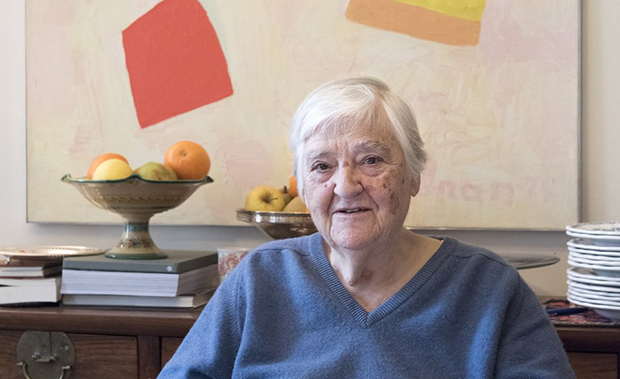
In Memoriam: Etel Adnan (1925–2021)

We start this week out with devastating news for the world of contemporary poetry: Lebanese-American poet and painter Etel Adnan has passed away at the age of 96 in Paris.

Our own Charles Bernstein posted a tribute to Adnan on Jacket2, hailing her as "a beacon of thought in a dirempt world." He continues, "In her writing I sense her hovering just beyond, in view but ungraspable, yet grounding me in ever-changing realizations. Luminous company, trusted guide, necessary source of immediate information, Adnan is a visionary of the meteoric and diasporic. Oscillating between the ecstatic and the unbearable, she finds home in the evasive emplacements of each moment."

PennSound's Etel Adnan author page is home to a modest archive of recordings that nevertheless give a sense of her diverse talents. That collection begins with Adnan's 2006 appearance on episode #118 of Leonard Schwartz's program, Cross-Cultural Poetics, titled "Forms of Violence." Via phone from Paris, she "reads from her book In the Heart of A Heart Of Another Country (City Lights), and meditates on her mother city of Beirut and American violence, inner and outer."

From 2010, we have a Serpentine Gallery reading showcasing The Arab Apocalypse and a 2012 reading commemorating the release of Homage to Etel Adnan (Post-Apollo), which was held at The Green Arcade Books Ideas Goods and co-sponsored by The Poetry Center and Small Press Traffic. Adnan returned to the Serpentine Sackler Gallery in London for a conversation with poet Robert Grenier a few weeks later. This chat between two hybrid artists was the inaugural event for the exhibition, "Etel Adnan: the Weight of the World."

Next we have a marvelous longform discussion with Jennifer Scappettone, recorded September 23–24, 2017, which has been segmented into individual tracks by theme, including "Home Life and School in Beirut," "Education in Philosophy and Beginnings in Painting," "English-Language Poetry and US Politics from the Vietnam War through Today," and "Cultural Identity, Multilingualism, and Translation." Finally, from December 2020, we have a reading and conversation with Bernstein hosted by the Brooklyn Rail’s New Social Environment, which also featured Sarah Riggs, Omar Berrada, and Susan Bee.

We're grateful to be able to share Adnan's work with our audience, and likewise send our thanks to those who've shared resources with us. You can listen to any of the aforementioned recordings by clicking here.

Friday, November 12, 2021

David Antin Discusses Kathy Acker, 2002

Here's another stunning vintage recording from our archives to bring our week to a close: a half-hour video of David Antin discussing Kathy Acker — who he calls "a dazzlingly charming and funny and brilliantly powerful writer, whose work I've always felt very close to" — as part of a symposium on her work held at New York University on November 8, 2002.

"Let me point out I knew Kathy before she was the Kathy Acker you all know," Antin begins, discussing his first meeting her at UC San Diego in 1968, when she was working as a teaching assistant and associating with other "refugees from Brandeis," along with her husband Robert (nominally a student of Marcuse). He goes on to discuss "the climate in which Kathy came to be a poet" — specifically "the proclaimed sexual revolution" and "the year of the assassinations" (Antin's arrival in the city coincided with Robert Kennedy's murder and Valerie Solanas' shooting of Andy Warhol) — then recalls the guidance that he provided to young and aspiring writers like Acker, Mel Freilicher, and others from their social circle, the conceptual art projects he worked closely with (including a Fluxus retrospective), and associations with figures like his wife, Eleanor, Jerry and Diane Rothenberg, Lenny Neufeld, George Quasha, et al., all of which proved to be very influential. "She was exposed to all of these people in various ways that were useful to her," he observes. 

He goes on to talk about her compositional use of constraint ("Her engagement was with so many things but she had to restrain herself to not be all over the place all at once."), her means of getting her work out to wider audiences, and the qualities that made her a singular talent: "Kathy had both intelligence and energy, and she had desire [...] It was the intensity of her desire for life." It's a gossipy, raucous recollection that also reveals deeper truths about how Acker came into her own. You can watch it here.

Wednesday, November 10, 2021

A New Disability Poetics Symposium, 2018

Today we're highlighting A New Disability Poetics Symposium, which was recorded at the LGBT Center at UPenn on October 18, 2018. This ambitious, multi-part gathering was organized by Jennifer Bartlett, Ariel Resnikoff, Adam Sax, and Orchid Tierney, in collaboration with Knar Gavin, Declan Gould, Davy Knittle, and Michael Northen.

The proceedings began with the panel "Larry Eigner's Disability Poetics," moderated by Charles Bernstein, with talks by George Hart, Michael Davidson, and Jennifer Bartlett. That's followed by "Disability and Performance," moderated by Declan Gould, with contributions by torin a. greathouse and Camisha Jones; and "Poetic Experiment and Disability," moderated by Orchid Tierney, with panelists Sharon Mesmer and Gaia Thomas.

These talks are complemented by a number of readings, the first taking place as part of the symposium itself, with sets by Bartlett, Jim Ferris, Ona Gritz, Anne Kaier, Dan Simpson, and Brian Teare. There's a second set recorded at our own Wexler Studios with Kaier, Simpson, Ferris, Gritz, and Michael Northen reading their work. Finally, poet Kathi Wolfe was unable to take part in the symposium, but made home recordings of the pieces she would have read at the event, which we've made available to listeners as well.

Given both the significance of Disability Studies and the growing attention it's receiving from more mainstream audiences, this is a particularly important event, and one that we are very proud to be able to share with a wider audience. To start listening, click here.

Monday, November 8, 2021

Susan Howe and David Grubbs: "Frolic Architecture," 2011

Over the years, we've been able to bring you a wide variety of audio and video from the fruitful and long-running collaboration of poet Susan Howe and musician/composer David Grubbs (Squirrel Bait, Bastro, Gastr del Sol) and today we're happy to present footage of a recent performance of their piece, Frolic Architecture, recorded at Harvard University on November 1, 2011.

The stunning center section of Howe's 2010 book, That This (New Directions), Frolic Architecture was "inspired by Susan Howe's experience of viewing various manuscripts, sermon notebooks, books, and pamphlets of the eighteenth century American Calvinist theologian Jonathan Edwards in the vast collection of Edwards family papers at the Beinecke Rare Book and Manuscript Library in New Haven, Connecticut. Especially by the folder in Box 24 titled 'Wetmore, Hannah Edwards, 1713–1773, Diary, 1736–39, copy in the hand of Lucy Wetmore Whittelsey, with commentary/n.d.'" The texts were composed "using multi-purpose copy paper, scissors, 'invisible' scotch tape, and a Canon copier PC170 [to] collage fragments of this 'private writing' with a mix of sources from other conductors and revealers in the thick of things — before." Howe and Grubbs released a studio version of Frolic Architecture on Drag City subsidiary Blue Chopsticks (home to their previous albums, 2008's Souls of the Labadie Tract and 2005's Theifth) in 2011, which further develops the collaborative nature of the piece — aside from Howe's appropriation of Hannah Edwards Wetmore's diary, Frolic Architecture was originally published as a limited-edition artist's book by Grenfell Press, featuring ten photograms by James Welling (also reproduced in That This).

Working in a similar mode to their earlier collaborations, Grubbs creates an airy and haunting bed of sound, consisting of laptop manipulations of Howe's pre-recorded voice — rhythmic and chaotically scattered phonemes that mimic the poem's collaged scraps and flutter around the poet's live performance — wed to modulated Hammond organ drones. Much like Souls of the Labadie Tract, the two artists' interaction on Frolic Architecture began at a very early and unpublished stage in the text's development, and as Howe acknowledges in the Q&A session that follows the performance, her association with Grubbs has shaped her approach to writing and language in general. While, at first, she deemed Frolic Arcitecture to be an "unperformable poem," Grubbs' efforts to "match [his] fragmentation to [her] fragmentation" yield fantastic results once again.

Friday, November 5, 2021

Short Films by Ken Jacobs on PennSound

We're closing out this week by highlighting a number of stunning short films by Ken Jacobs that we're proud to include as part of our PennSound Cinema collection. They include a half-dozen silent micro-films, each the length of a television commercial, created in 2016: Writhing Cities, Central Park, Snow in Headlights I, Window Cleaner, Dead Leaves, and Deader Leaves. These silent meditations serve as an amuse-bouche to unfamiliar viewers, introducing them to Jacob's use of the Pulfrich effect — an early film theory based on the notion that a projected image reaches each eye at a slightly different time (those interested in learning more can read a wonderfully-detailed explanation by Miriam Ruth Ross here) — built upon looped images that rapidly alternate from positive to negative. The resulting films effect a visual equivalent to the Shepard scale, seeming simultaneously static and in-motion, and creating a lush, immersive three-dimensional image.

This is probably a good point to warn readers that due to this intense flickering effect we recommend that those with epilepsy and similar conditions triggered by light avoid watching these films. They can be challenging even for those without seizure disorders: I started to get a headache after about a half hour with the films, but it was a worthwhile tradeoff for the viewing experience.

After the super-brief clips, we have a trio of longer films: Capitalism: Child Labor (2006), Another Occupation (2011), and Seeking the Monkey King (2012). On the small scale, these films operate much like the aforementioned shorts in terms of their flickering using the Pulfrich effect, however the images are further embellished with color washes, inset details, and other distortions, and evolve over time rather than fixating on one image. They're also scored, with Rick Reed providing music for the first two — which showcase tremoloed drones that shift from peaceful bell-tones to harsh metallic squeals — while J.G. Thirwell's soundbed for the last blends dramatic blockbuster pomp with calmer passages. In Capitalism we meditate on a haunting Lewis Hine-like image of young textile workers, while Another Occupation recycles and degrades found footage of Bangkok, and in Seeking the Monkey King we explore dazzling jewel-like landscapes of crumpled tinfoil while pondering occasional intertitles that rail against the titular monarch.

You can view all of these films, and listen to a three-part 2009 Close Listening program with the filmmaker on our Ken Jacobs author page.

Wednesday, November 3, 2021

Happy Birthday to Tom Weatherly

November 3rd was the birthday of poet Tom Weatherly, which makes it an excellent opportunity to revisit David Grundy's mindblowing Jacket2 feature, "A Short History of Tom Weatherly."  Here's a brief excerpt from his introductory note:
We're familiar by now with the designation of neglected writers as "poets' poets" — essentially, an excuse for their continuing neglect. And we are, or should be, even more familiar with the neglect heaped on African American innovative writers, especially those who refuse to be easily pigeonholed into secure ideological or formal categories. Thomas Elias Weatherly (1942–2014) fits both categories. Since his death, on July 15, 2014, his work has continued to occupy the cracks, lost in the shadows, just another one of the ghosts of American poetry. It shouldn't be this way. Born in Scottsboro, Alabama, in 1942, Weatherly turned to poetry at the age of eight after seeing a vision of Homer, who instructed him to become a "wekwom teks," or "weaver of words." This experience inspired his first poem: "It did seem / That he said / Sing until dead." Weatherly would heed this call throughout his life. 
What follows an unstinting, encyclopedic justification of his estimation of Weatherly's importance. Grundy has gathered, very nearly, everything written about or by Weatherly over his thirty-five year writing life. That includes the complete text of his long out-of-print books Maumau American Cantos (Corinth Books, 1970) and Thumbprint (Telegraph Books, 1971), along with his joint publication with Ken Bluford, Climate/Stream  (Middle Earth Books, 1972), selections from the still in-print Short History of the Saxophone (Groundwater Press, 2006), and a lavish selection of uncollected poetry from his earliest mature poems to what's likely the last poem written before his death in 2014. A selection of critical writings is included as well, most notably his introduction to Natural Process (Hill and Wang, 1970) — an important anthology of African American poetry co-edited with Ted Wilentz — and "Black Oral Poetry in America: An Open Letter," published in Alcheringa in 1971. In fact, our Jacket2 Reissues copy of that issue of Alcheringa was missing one page, naturally in the midst of Weatherly's essay, and Grundy was able to get us a scan to complete our archive.

All of the aforementioned materials would be, in and of themselves, would be more than a worthy tribute to Weatherly's talents and a delight for readers. They are, however, merely one part of the overall feature. Once again, I'll let Grundy explain:
Forming a companion to this work by Weatherly is a series of longer critical essays and shorter tributes. Burt Kimmelman's essay on Weatherly, "The Blues, Tom Weatherly, and the American Canon," shows Weatherly as a blues poet par excellence, carefully tracing his emergence in the New York poetry scene, the importance of his Southern background, and the technical innovations of his work. Ken Bluford's "Essay with Tom Weatherly in It," first published alongside Weatherly's work in Lip magazine in 1970, further points out how Weatherly's use of Southern vernacular traditions both sets him alongside and contrasts him to better-known poets of the Black Arts Movement. My own essay focuses on Weatherly's first book, the Maumau American Cantos, concentrating on Weatherly's writing of the American South and his figurations of sexuality. The piece by Evelyn Hoard Roberts reprinted from the Dictionary of Literary Biography provides a detailed and invaluable biographical overview of Weatherly's early career. 
The shorter tributes he mentions are part of a third sub-section containing all sorts of fascinating ephemera: " fond reminiscences, poems, and obituaries from Akua Lezli Hope, Eugene Richie, Janet Rosen, Aram Saroyan, M. G. Stephens, Rosanne Wasserman, and the late John Ashbery," along with contemporaneous reviews of his work, examples of the poets own "illuminated manuscripts," and a whole slew of audio-visual materials. That includes a newly-unearthed 1968 reading at the St. Mark's Poetry Project that, along with a 1971 reading in Grand Valley, Michigan, can be found on PennSound's Tom Weatherly author page. When we first added the 1971 recording, not long after Weatherly's death, Charles Bernstein offered this summation of its contents: "Weatherly reads the complete serial poem 'Mau Mau American Cantos' for the first ten minutes of the reading ... after that he reads various poems, including 'Lady Fox' from Thumprint but nothing else from that book or Mau Mau." He also hailed Weatherly's work as "powerful, brilliant, often volatile (and distressingly unacknowledged)." Well, now you certainly have the opportunity to evaluate his judgment. 

Monday, November 1, 2021

Eugene Ostashevsky: Scalapino-Hejinian Lecture in Innovative Poetics, 2021

We kick off this new week with video footage of Eugene Ostashevsky delivering his Scalapino-Hejinian Lecture in Innovative Poetics, "Translingualism: A Poetics between Cultures, Nations, and Languages." Originally scheduled for March 17, 2020, Ostashevsky's talk was an early victim of the Covid-19 pandemic, rescheduled until this past September of this year, where it was delivered via Zoom.

This excerpt from the original announcement for the canceled 2020 event seems especially pertinent to the topic of Ostashevsky's talk:

Writing in LARB, Boris Dralyuk calls The Pirate a "raucous modern-day Anatomy of Melancholy, a seriocomic linguistic performance the likes of which we rarely see, in any tongue. It is a beautiful song, broadcast by an outcast whose language is all his own." The Italian newspaper Il Manifesto speaks of The Pirate's "poetics of immigration." The German edition of the book, translated by Uljana Wolf and Monika Rinck, was awarded the International Poetry Prize from the City of Münster, with the jury praising the original's "polyphonic and polyglot verbal acrobatics" and linguistic multiplicity. For the Süddeutsche Zeitung, Ostashevsky's work "argues that one must have distance from language, and also an awareness that no language is only 'mine'; it is rather many languages of different times and speakers that collide or coalesce under the name 'English.' Every language is, in a sense, a parrot language." For another German reviewer, The Pirate "deconstructs the strategies of linguistic exclusion concealed by such concepts as 'indigenous,' 'refugee,' and 'native language.'" 

Originally the Scalapino Lecture in Innovative Poetics, the Scalapino-Hejinian Lectures in Innovative Poetics started in 2011, the year after Leslie Scalapino's death. As amorphous as its namesake's poetry, the series has had events at a variety of locations over the past decade, including the Pratt Institute, Small Press Traffic, Naropa University, and UC Berkeley. You can browse our complete archive of recordings from the series here; Ostashevsky's lecture can be found here.


Friday, October 29, 2021

Halloween Poems: A Brief Playlist

With Halloween coming up this weekend we've put together this brief list of poems celebrating the spookier side of life. With a mix of poets both old and new you're bound to find something to set your nerves on edge.

Lewis Warsh, "Halloween" MP3

Kimberly Lyons, "Halloween Parade" MP3

Aaron Kramer, "Halloween" MP3

Robert Grenier, "Measure's Halloween" MP3

Cecilia Corrigan, "Christmas Halloween is in a body bag..." MP3

Elizabeth Willis, "The Witch" MP3

John Giorno, "The Wisdom of Witches" MP3

Lee Ann Brown, "Witch Alphabet, Mistranslation of Mayakovsky, Pledge & Love" MP3

Robert Duncan, "Witch's Song" MP3

Edgar Allan Poe (read by John Richetti), "Annabel Lee" MP3

Edgar Allan Poe (read by Jerome McGann), "The Raven" MP3

Yuri Andrukhovych, "Werewolf Sutra" MP3

Matthew Rohrer, "Werewolves" MP3

Adrienne Rich, "What Ghosts Can Say" MP3

Michael McClure, "Ghost Tantra #49" MP3

Bernadette Mayer, "Spooky Action from a Distance" MP3

Bob Kaufman (read by Chuck Perrin), "All Hallows, Jack O'Lantern Weather, North of Time" MP3


Wednesday, October 27, 2021

Robert Duncan Reads "Passages" at the Berkeley Poetry Conference, 1965

Today we're highlighting a newly-added recording of Robert Duncan reading at the historic Berkeley Poetry Conference. Recorded on July 16, 1965, this is ostensibly Duncan's reading from that day, introduced by Thomas Parkinson, and the one hour and forty minute set includes sections 1–25 of "Passages," Duncan's series that stretched across Bending the Bow (1968) Ground Work (1984), and Ground Work II (1987).

This new addition complements another recording of Duncan at the Berkeley Poetry Conference, presumable from during his seminar held July 12–16, which includes the titles"Often I am Permitted to Return to a Meadow," "Structure of Rime" numbers 9–11, "Apprehensions," "Osiris and Set (from Roots and Branches)," "A Poem Beginning with a Line by Pindar," "The Continent," and "The Multiversity." Taken together they present a fuller portrait of Duncan's influential presence at this landmark conference, though sadly we still do not have a recording of his July 13th lecture "Psyche-Myth and the Moment of Truth." Listen to both Berkeley recordings by clicking here

On PennSound's Robert Duncan author page you'll find a wide array of readings, talks, films, and more from 1951–1986, along with a 1990 memorial reading. Click here to start browsing.

Monday, October 25, 2021

Bern Porter on PennSound

Today we're highlighting our holdings from the influential author, artist, and publisher Bern Porter, perhaps best known for his pioneering work in the field of Found Poetry.

Our earliest recording is parts one and two of "For Our Friends in Germany," recorded by Mark Melnicove in 1979 at the Eternal Poetry Festival in South Harpswell, Maine. Then there's "Aspects of Modern Poetry," a 1982 WBAI program with Bob Holman that was broadcast live. It's presented in two parts that are roughly a half-hour each.

Next, we have the New Wilderness Audiographics cassette release, Found Sounds, whose two sides consist of two separate sessions, the first made on December 2, 1978 with Dick Higgins and Charlie Morrow; the second from May 9, 1981 and featuring Patricia Burgess (tenor saxophone), Glen Velez (bodhrán, cymbal, tambourine), and Morrow (brass, ocarina, and voice). 

Jumping forward to December 1989, we have a recording from "Williamson Street Night" at the Avant Garde, Museum of Temporary Art in Madison, Wisconsin with contributions by Malok, Elizabeth Was & mIEKAL aND, and our final recording is an interview with Higgins and aND from Woodland Pattern Book Center on March 16, 1990. You can browse all of the aforementioned recordings by visiting our Bern Porter author page.

Thursday, October 21, 2021

Remembering Kerouac on the 52nd Anniversary of His Death

This October 21st marks 52 years since the passing of legendary Beat Generation author Jack Kerouac (1922–1969). While we don't have permission from the Kerouac estate to share recordings of the poet's work — multiple albums, including collaborations with Al Cohn and Zoot Sims, along with polymath Steve Allen, are widely available — we do have a few noteworthy recordings of others reading him within our archives.

Of course, you'll recall that we only recently announced Vivien Bittencourt and Vincent Katz's short film documenting a 1988 tribute reading of Kerouac's Mexico City Blues, which took place at the Knitting Factory. This stunning half-hour video includes live performances by Barbara Barg, Charles Bernstein, Lee Ann Brown, Maggie Dubris, Allen Ginsberg, Richard Hell, Bob Holman, Lita Hornick, Vicki Hudspith, Vincent Katz, Rochelle Kraut, Gerard Malanga, Judith Malina, Eileen Myles, Simon Pettet, Hanon Reznikov, Bob Rosenthal, Jerome Rothenberg, Tom Savage, Elio Schneeman, Michael Scholnick, Carl Solomon, Steven Taylor, David Trinidad, Lewis Warsh, Hal Willner, and Nina Zivancevic, while Mark Ettinger, Dennis Mitcheltree, Charlie Morrow, and Samir Safwat, among others, providing live, improvised accompaniment. Lawrence Ferlinghetti and Michael McClure also appear in brief interview segments. You can watch here.

Then we have another old favorite from the archives: Clark Coolidge and Michael Gizzi reading Kerouac's iconic spontaneous prose piece, "Old Angel Midnight," taken from a 1994 recording session at the West Stockbridge, MA home studio of Steve Schwartz. Coolidge is, of course, well-known for, as Al FilreisAl Filreis phrases it, "his advocacy for Kerouac as properly belonging to the field of experimental poetry and poetics." Here's how he lays out his sense of what he refers to as Kerouac's "babble flow":
[S]ound is movement. It interests me that the words "momentary" and "moments" come from the same Latin: "moveo, to move. Every statement exists in time and vanishes in time, like in alto saxophonist Eric Dolphy's famous statement about music: "When you hear music, after it's over it's gone in the air, you can never capture it again." That has gradually become more of a positive value to me, because one of the great things about the moment is that if you were there in that moment, you received that moment and there's an intensity to a moment that can never be gone back to that is somehow more memorable. Like they used to say, "Was you there, Charlie?" 
Kerouac said, "Nothing is muddy that runs in time and to laws of time." And I can’t resist putting next to that my favorite statement by Maurice Blanchot: "One can only write if one arrives at the instant towards which one can only move through space opened up by the movement of writing." And that’s not a paradox.
Here's how Kerouac himself described the project (which famously appeared in the premier issue of Big Table, along with excerpts from William S. Burroughs' Naked Lunch — content liberated from the suppressed Winter 1958 issue of The Chicago Review): 
"Old Angel Midnight" is only the beginning of a lifelong work in multilingual sound, representing the haddalada-babra of babbling world tongues coming in thru my window at midnight no matter where I live or what I'm doing, in Mexico, Morocco, New York, India or Pakistan, in Spanish, French, Aztec, Gaelic, Keltic, Kurd or Dravidian, the sounds of people yakking and of myself yakking among, ending finally in great intuitions of the sounds of tongues throughout the entire universe in all directions in and out forever. And it is the only book I've ever written in which I allow myself the right to say anything I want, absolutely and positively anything, since that's what you hear coming in that window... God in his Infinity wouldn't have had a world otherwise — Amen."
You can listen to Coolidge and Gizzi's rendition of this classic here, and might also want to check out PoemTalk #124, wherein Coolidge and Filreis, along with J.C. Cloutier and Michelle Taransky, discuss their recording of the poem.