Friday, January 29, 2021

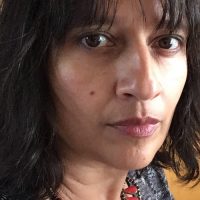
Congratulations to T.S. Eliot Prize-Winner Bhanu Kapil

We wanted to wrap up this week by focusing on a great honor for Bhanu Kapil, who has been awarded the 2020 T.S. Eliot Prize for her collection How to Wash a Heart. The judging panel — which included Mona Arshi, Andrew McMillan, and chair Lavinia Greenlaw — noted that "our shortlist celebrated the ways in which poetry is responding to profound change, and the stylistic freedom that today’s poets have claimed." "From this impressive field," they continue, "we unanimously chose Bhanu Kapil's How to Wash a Heart as our winner. It is a radical and arresting collection that recalibrates what it's possible for poetry to achieve." 

Said longlist "included an exciting mixture of established poets and relative newcomers including three debut collections, work from two Americans, as well as poets of Native American, Chinese Indonesian and British, Indian and mixed race ancestry," making both the finalists and the well-deserving winner reasons for celebration. Video of the virtual award ceremony, which included sets from all 10 finalists, will be available for viewing on the Southbank Centre's website until 1/31.

We are proud to be able to share a wide array of Kapil's work on her PennSound author page, including the most recent recording you'll find there, which was her memorable 2016 visit to our own Kelly Writers House. Among ten other full-length recordings made between 1999 and then, you'll find readings from the Segue Series at the Bowery Poetry Club, Belladonna*the Kelsey Street Press archives, A Voice Box, Boise State's MFA Reading Series, and Boulder's Left Hand Reading Series. Click here to start exploring.


Wednesday, January 27, 2021

Charles Reznikoff Reads from "Holocaust," for International Holocaust Remembrance Day

January 27th is International Holocaust Remembrance Day, marking the day Soviet troops liberated Auschwitz seventy-six years ago. In acknowledgment of the day and the six million European Jews who perished senselessly, we revisit one of the more remarkable and harrowing recordings in our archives:

In late 2009, we were fortunate enough to be contacted by filmmaker Abraham Ravett, who offered us a treasure trove of rare recordings he'd made of poet Charles Reznikoff reading from his final collection, Holocaust, along with a number of photographs. Recorded December 21, 1975, these eighteen tracks — which include a number of retakes and an audio check — were originally recorded for inclusion in the soundtrack to the recently-graduated director's debut film, Thirty Years Later, which he describes as an autobiographical document of "the emotional and psychological impact of the Holocaust on two survivors and the influence this experience has had on their relationship with the filmmaker — their only surviving child."

In addition to the recordings themselves, Ravett graciously shared his recollections of that day — noting, "Mr. Reznikoff's West End apartment was located within a high-rise apartment complex reminiscent of where I grew up during my teens in the Brighton Beach section of Brooklyn, N.Y. He was very kind and gracious to a rather nervous young filmmaker fumbling with his Nagra tape recorder and Sennheiser microphone who hoped that everything would work as planned" — along with a series of eight photographs of the poet, including the stunning image at right.

While Holocaust, as a text alone, serves as a viscerally pointed indictment of Nazi atrocities during the Second World War, not to mention a marvelous example of documentary poetics, in these selections, the auratic resonance of these appropriated testimonies are amplified dramatically, particularly when framed by the frail yet determined voice of the seventy-nine year old poet — who would pass away a month and a day from the date of this recording session — lending the work a gravid anger, a grand sense of monumental enormity.

You can listen to these tracks by clicking here, where you'll also find a link to a separate page housing Ravett's photographs, and don't forget to visit Reznikoff's main PennSound author page, where you can listen to the poet's 1974 reading at the Poetry Center at San Francisco State University (where he was famously introduced by his Objectivist compatriot, George Oppen) and his 1975 appearance on Susan Howe's Pacifica Radio program, "Poetry Today," among other recordings.

Monday, January 25, 2021

PoemTalk #156: on Steve Dalachinsky's "with shelter gone"

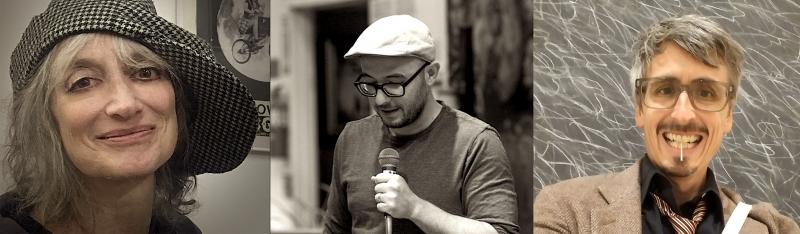
Today we release the latest episode in the PoemTalk Podcast series — that's #166 if you're keeping track — which addresses Steve Dalachinsky's poem "with shelter gone," taken from a 2008 reading at the Bowery Poetry Club. For this program host Al Filreis convened a virtual panel including Bonny Finberg, Julien Poirier, and Jake Marmer, who just happened to host the reading from which the recording under discussion was taken. Dalachinsky's death last September can't help but cast a shadow over the proceedings, particularly given that all three panelists knew him well, however that sense of loss is counterbalanced with happy memories stirred by the immediacy and intimacy of the poet's voice.

Filreis' PoemTalk blog post announcing the new episode begins by acknowledging those complex emotions, which turn this "poem about what one feels and ponders in the midsummer heat in a Brooklyn apartment where the fruitflies are not merely irritating but serve as harbingers of bodily fragility and decay" into a "pre-elegy" that replicates the process of "winding back" which becomes a refrain as the poem unfolds. "Time, here, is that which can be wound back, such that as readers or witnesses to its performance we are no longer suffocating from the city heat," he observes. "Rather, we begin to feel the breezy thrills and spills of old Coney Island, overhearing the music of youth ('you're my coney island baby'), and moving eastward to the edges of the borough — out to cafés of Russian immigrants ... and, in a sense, running the whole complex, intertwined story of Beat despondency and ecstasy, and similarly of jazz, of Jewish Brooklyn, of Russian Jewish immigration — a story run backwards to the eastern limit of that moment just prior to the invention of the cultural convergences one hears here and in most if not all of Dalachinsky’s performances."

You can learn more about this latest program, read Dalachinsky's poem (and watch him perform it), and listen to the podcast here. The full PoemTalk archives, spanning more than a decade, can be found here.

Friday, January 22, 2021

Al Filreis: "What Is Poetry?"

"Someone at my university who edits and publishes a newsletter asked me if I would write 500 words on what makes poetry distinctive," PennSound co-founder Al Filreis writes in a new Jacket2 commentary post. "I balked at such a task. But then decided to produce the statement." Particularly at the end of this week, when poetry was given a prominent and inspiring place in the midst of one of our nation's most significant political rituals (which, as one might expect, subsequently elicited a lot of petty griping) this sort of perspective — even if offered begrudgingly ("for or better or worse, here it is") — might be exactly what we all need.

"Whenever poetry becomes a topic movingly discussed by many people for whom it is not a daily — indeed, not even a monthly — thing," Filreis begins, "I realize once again what draws me to it ever and always. In a poem, how you say what you say is as important as, sometimes more important than, what you say. Is that a radical view? After all, content is central to communicating. But what about times when communication has broken down?" He then turns to the example of Allen Ginsberg's iconic poem "Howl," and specifically, "the riveting performance Ginsberg gave before a huge, engaged, at times ecstatic audience in Chicago in 1959" that you can hear here. "How Ginsberg says 'Howl' is as important as what he says, for sure. Words about crying out can themselves cry out." "So that is poetry," he affirms. "A form of saying. Not so much the things being said."

Later, he turns to the example of Erica Hunt, who'll be joining us shortly as the first of this year's Kelly Writers House Fellows: "Whenever I read — or, better, hear recited — [Hunt's] poem 'Reader we were meant to meet,' I think about how and why I cannot help but listen, cannot turn away from hearing, must attend. Because the poet is not just talking to me, but about me — about why I am necessary 'even in the failure to communicate.'" "Poems I admire require my involvement in the project of 'toppl[ing] distinctions' between who gets to talk and who is being asked to listen," Filreis tells us, "And that and only that kind of engagement — the convergence of writer and reader, of speech-maker and audience, of the talker and the silent, of the poet as subject and the reader normally supposed to be an object — will 'ease doubt.'"

Certainly, this feels pertinent to our present moment; however what we've offered here is just a small taste of Filreis' mini-essay, which merits reading in full. You can do so by clicking here.

Thursday, January 21, 2021

Congratulations to San Francisco's New Poet Laureate, Tongo Eisen-Martin

Today we're catching up with last week's news that Tongo Eisen-Martin has been named San Francisco's eighth poet laureate. Mayor London Breed offered these hopeful words while making the announcement: "I've had the pleasure of working with Tongo when he was teaching artist at the African American Arts and Culture complex, and I've seen his remarkable ability to spur creativity in youth and inspire them to find their own voice." Breed continued, "His work on racial justice and equity, along with his commitment to promoting social and cultural change, comes at such a critical time for our city and our country."

In his introductory comments, Eisen-Martin acknowledged San Francisco's long and thriving poetic history, while striving for even greater outreach and inclusivity: "As deep into the various communities of the city as our poets have already brought the craft, I want to push even further into places where poetry has not yet permeated. Give poetry even more of a mass personality; as mass participation has always been the staple of what could be described as San Francisco futurism."

We recently added an October 2019 reading by Eisen-Martin (along with Eric Dolan and Fego Navarro) from the Berkeley Art Museum/Pacific Film Archive's reading series, organized by Cole Solinger. Listen in to that set, along with readings by Trisha Low, Elaine Kahn, Tatiana Luboviski-Acosta, Ocean Escalanti, Vasiliki Kitsigianis Ioannou, and Jheyda McGarrell, by clicking here.


Sunday, January 17, 2021

Remembering Gregory Corso, On the 20th Anniversary of His Death

January 17th marks the 20th anniversary of the death of Beat legend Gregory Corso. While the loss of any poet is a tragedy, one feels especially sorry for Corso, who had finally attained some modicum of hard-fought peace and closure in his final years, leaving behind the traumas that had marked his childhood and reuniting with his mother after decades of separation (as detailed in the late Gustave Reininger's criminally neglected documentary, Corso: The Last Beat).

We launched our Gregory Corso author page in June 2017, with assistance from Raymond Foye. There, you'll find five full readings plus one individual poem recorded between the 1970s and 1990s. The earliest recording is an April 1971 reading at Duke University, which is followed by an August 1985 appearance at the San Francisco Art Institute as part of their "Art of Poetry" series. Jumping forward to the 90s, there's a March 1991 Brooklyn College reading notable for the appearance of Corso's iconic late poem "The Whole Mess ... Almost" and for the half-hour candid conversation recorded in the car on the way home. From December 1992, there's a stellar reading in New York City also featuring Herbert Huncke, John Wieners, and Allen Ginsberg, and finally, from March 1993, we have a half-hour reading from Rutgers University including "I Met This Guy Who Died," "Earliest Memory," "Youthful Religious Experiences," and "Friends," among other poems.

Ginsberg famously offered high praise for his dear friend, calling him "a poet's Poet, his verse pure velvet, close to John Keats for our time, exquisitely delicate in manners of the Muse," who "has been and always will be a popular poet, awakener of youth, puzzlement & pleasure for sophisticated elder bibliophiles." He continues, judging Corso as "'Immortal' as immortal is, Captain Poetry exampling revolution of Spirit, his 'poetry the opposite of hypocrisy,' a loner, laughably unlaurelled by native prizes, divine Poet Maudit, rascal poet Villonesque and Rimbaudian whose wild fame's extended for decades around the world from France to China, World poet." Per his request, and with the help of donations from his fans worldwide (I still remember the call for funds and might have sent in $5), Corso's ashes were interred in Rome's Cimitero Acattolico right next to the grave of his greatest poetic hero, Percy Bysshe Shelley, and in close proximity to Keats. His tombstone bears his poem "Spirit," written as his epitaph during his lifetime. While that poem — and many more — are on my mind today, the one that seems like the most appropriate tribute is another classic Corso poem addressing mortality that includes a good dose of his trademark humor, "How Not to Die." We have a great recording of Corso reading it at that 1993 Rutgers reading [MP3] and here's the poem in its entirety:

How Not To Die 

Around people
if I feel I'm gonna die
I excuse myself
telling them "I gotta go!"
"Go where?" they wanna know
I don't answer
I just get outa there
away from them
because somehow
they sense something wrong
and never know what to do
it scares them such suddenness
How awful
to just sit there
and they asking:
"Are you okay?"
"Can we get you something?"
"Want to lie down?"
Ye gods! people!
who wants to die amongst people?!
Especially when they can't do shit
To the movies — to the movies
that's where I hurry to
when I feel I'm going to die
So far it's worked

Click here to start browsing the recordings collected on PennSound's Gregory Corso author page.

Thursday, January 14, 2021

Reminder: Kelly Writers House Fellows Program Starts Next Month

The 22nd annual Kelly Writers House Fellows program begins next month, and we can't be more excited about who'll be joining us this year. We first announced this year's roster back in September, and now that the schedule has been finalized, we wanted to refresh everyone's memory. You can RSVP for one or all of this year's events by dropping us a line at whfellow@writing.upenn.edu.

First up, visiting on February 22–23 is Erica Hunt. Hunt is a poet, essayist, and author of Local History, Arcade, Piece Logic, Time Flies Right Before the Eyes, A Day and Its Approximates, Veronica: A Suite in X Parts, and her newest work Jump The Clock: New and Selected Poems out with Nightboat Books in October 2020. Her poems and non-fiction have appeared in BOMB, Boundary 2, The Brooklyn Rail, Conjunctions, The Los Angeles Review of Books, Poetics Journal, Tripwire, FENCE, Hambone, and In The American Tree, among other publications. Essays on poetics, feminism and politics have been collected in Moving Borders, Three Decades of Innovative Writing by Women and The Politics of Poetic Form, The World, and other anthologies. With poet and scholar Dawn Lundy Martin, Hunt is co-editor of the anthology Letters to the Future, Black Women/Radical Writing from Kore Press.

Hunt graduated with a B.A. in English from San Francisco State University in 1980 and an M.F.A. from Bennington College in 2013. She has received awards from the Foundation for Contemporary Arts, the Fund for Poetry, the Blue Mountain Center, and the Djerassi Foundation, and is a past fellow of Duke University/the University of Capetown Program in Public Policy and a past Fellow at the Center for Programs in Contemporary Writing in Poetics and Poetic Practice here at Penn. Currently, Hunt is Bonderman Visiting Professor at Brown University and a Poet in Residence at Temple University.

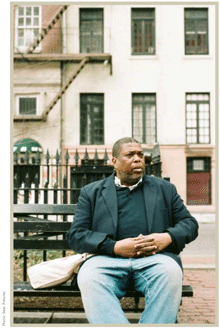
Next, on March 29–30, our guest will be Hilton Als. Als began contributing to The New Yorker in 1989, writing pieces for "The Talk of the Town," and later became a staff writer in 1994, theatre critic in 2002, and lead theater critic in 2012. His reviews are not simply reviews; they are provocative contributions to the discourse on theatre, race, class, sexuality, and identity in America. He is currently working on a new book titled I Don’t Remember (Penguin, early 2021), a book length essay on his experiences in AIDS era New York. Before coming to The New Yorker, Als was a staff writer for the Village Voice and an editor-at-large at Vibe. Als edited the catalogue for the 1994-95 Whitney Museum of American Art exhibition "Black Male: Representations of Masculinity in Contemporary American Art." His first book, The Women, was published in 1996. His book, White Girls, a finalist for the National Book Critics Circle Award in 2014 and winner of the 2014 Lambda Literary Award for Non-fiction, discusses various narratives of race and gender. He wrote the introduction to the Penguin Classics edition of The Early Stories of Truman Capote, and was guest editor for the 2018 Best American Essays. He wrote Andy Warhol: The Series, a book containing two previously unpublished television scripts for a series on the life of Andy Warhol. His in-progress debut play, Lives of the Performers, has been performed at Carolina Performing Arts and LAXART in Los Angeles.

In 1997, the New York Association of Black Journalists awarded Als first prize in both Magazine Critique/Review and Magazine Arts and Entertainment. He was awarded a Guggenheim for creative writing in 2000 and the George Jean Nathan Award for Dramatic Criticism for 2002–03. In 2016, he received the Lambda Literary’s Trustee Award for Excellence in Literature, as well as the Windham Campbell Prize for Nonfiction. In 2017 Als won the Pulitzer Prize for Criticism, and in 2018 the Langston Hughes Medal. In 2016, his debut art show "One Man Show: Holly, Candy, Bobbie and the Rest" opened at the Artist’s Institute. He has curated "Alice Neel, Uptown" and "God Made My Face: A Collective Portrait of James Baldwin" at the David Zwirner Gallery in New York City. He is also curating three successive solo exhibitions at the Yale Centre for British Art, the first exhibit in 2018 featured Celia Paul, the second, in 2019, features Lynette Yiadom-Boakye, the third will feature Paul Doig. In 2019 Als partnered with WNYC's Greene Space on a limited podcast series titled The Way We Live Now: Hilton Als and America’s Poets. He recently contributed an essay to Moonlight, a limited edition book about the film of the same name. Als is an associate professor of writing at Columbia University’s School of the Arts and has taught at Yale University, Wesleyan, and Smith College. He lives in New York City.

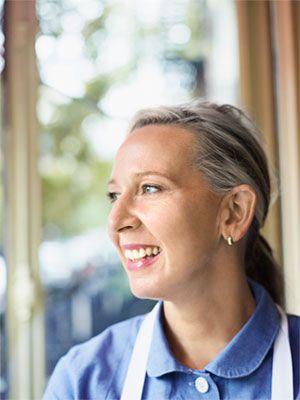
Finally, from April 26–27 we'll be joined by Gabrielle Hamilton. Hamilton is the chef and owner of the acclaimed Prune restaurant in New York City’s East Village, and the author of Prune, the cookbook. Hamilton has won four James Beard awards over her career, perhaps most notably for her New York Times bestselling memoir, Blood, Bones & Butter: The Inadvertent Education of a Reluctant Chef (Random House, 2011). Her other James Beard awards were for Best Chef in New York City in 2011, an award for journalism in 2015 for her essay “Into the Vines” for Afar magazine, and Outstanding Chef in 2018.

Her work has appeared in The New Yorker, The New York Times, GQ, Bon Appetit, Saveur, and Food & Wine. She is an Eat columnist in The New York Times Magazine contributing regularly, and most recently wrote the widely praised essay "My Restaurant Was My Life For 20 Years. Does The World Need It Anymore?" for the April 26, 2020 issue, just a month or so into the 2020 Coronavirus epidemic, about closing her restaurant and the state of the industry generally. Her writing has also been collected several times in the annually published Best Food Writing, and was a featured subject of season 4 of the PBS docuseries Mind of a Chef in 2015. Hamilton received an MFA in fiction writing from the University of Michigan and a BA from Hampshire College. She lives in New York City.

Funded by a grant from Paul Kelly, the Kelly Writers House Fellows program enables us to realize two unusual goals. We want to make it possible for the youngest writers and writer-critics to have sustained contact with authors of great accomplishment in an informal atmosphere. We also want to resist the time-honored distinction — more honored in practice than in theory — between working with eminent writers on the one hand and studying literature on the other.

You can read more about the program and browse through past Fellows going back to the program's start in 1999 by clicking here.

Tuesday, January 12, 2021

Congratulations to Bollingen Prize Winner Mei-mei Berssenbrugge

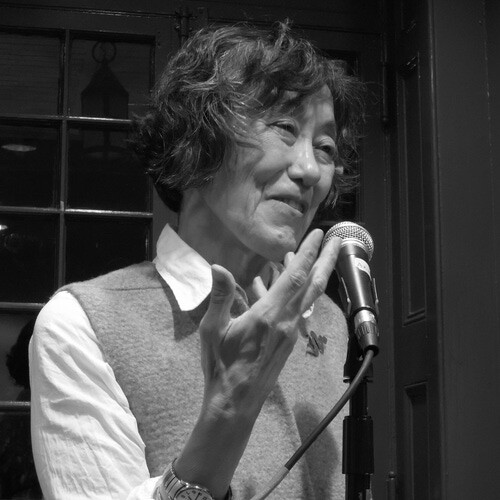
Mei-mei Berssenbrugge has popped up on PennSound Daily frequently over the past few months, between her nomination for this year's National Book Award in Poetry for A Treatise on Stars, and her October reading for POG's Zoom series, but today brings even more reason to celebrate Berssenbrugge: she's been awarded the 2021 Bollingen Prize for Poetry from Yale University. Here is part of announcement, including the judges' rationale:

"Mei-mei Berssenbrugge's poetry explores the permeable boundaries between the human and the natural worlds, as she makes palpable her communion with birds, plants, dolphins, stars, and the beyond," the three-member prize judging committee said. "Emerging from the ferment of the Basement Workshop,  a collective of Asian-American poets, artists, and activists in the 1970s, Berssenbrugge went on to create a visionary ecopoetics that directly confronts our planetary –– and human –– crisis. With her preternaturally long lines, Berssenbrugge composes a syntax of unfolding vistas, stretching our senses of both the plausible and the possible, bringing new modes of affinity and new paths for freedom into view. Berssenbrugge's entanglements of consciousness and perception have created a lyric that moves away from self-centeredness toward the cosmos. A Treatise on Stars is a far-out star flight — profoundly meditative, extravagant, disarming, open. 'Any soul may distribute itself into a human, a toy poodle, bacteria, an etheric, or quartz crystal.' As readers we are, again and again, enthralled by her radical wagers on poems enacting transformation. 'Writing,' the poet tells us, 'can shift the mechanism of time by changing the record, then changing the event.'"

The judges panel included Maureen N. McLane, Nicole Sealey, and our own Charles Bernstein, who won the Bollingen in 2019. You can read the complete announcement herePennSound's author page for Berssenbrugge is home to more than two dozen individual recordings going back as far as 1986, including interviews, radio programs, and a great many readings. You can hear more from A Treatise on Stars in particular by checking out her 2019 Kelly Writers House Fellows reading and the aforementioned 2020 Pog reading.

Wednesday, January 6, 2021

William Carlos Williams Burns the Christmas Greens

In Irish culture January 6th is traditionally recognized as Little Christmas, which marks the official end of the holiday season. On a chilly day like today, even a lapsed Catholic such as myself can't help but shudder just a little at the sight of the previous year's Christmas trees stripped bare and piled at the curbside waiting on trash day. Richard Brautigan's portrait of the grim holiday season after JFK's assassination, "'What Are You Going to Do With 390 Photographs of Christmas Trees?'" (from The Tokyo-Montana Express) does a fine job of paying tribute to this strange phenomenon — the sense of loss that haunts the promise of a fresh new year — but even it pales in comparison to the stark beauty of William Carlos Williams' "Burning the Christmas Greens," one of my favorite hidden gems on PennSound's encyclopedic Williams author page.

First published in the January 1944 issue of Poetry, the poem would later appear in The Wedge that same year. Altogether we have four recordings of Williams reading the poem: one from a May 1945 session at the Library of Congress Recording Library, another from a June 1951 home recording by Kenneth Burke, the third from a reading at Harvard in December of that year, and the last from the 92nd Street Y in January 1954; we also have a 1990 rendition of the poem by Robert Creeley.

"At the winter's midnight" — the thick of the dark / the moment of the cold's / deepest plunge" — "we went to the trees, the coarse / holly, the balsam and / the hemlock for their green," Williams tells us, before launching into a litany of the season's decorative delights. "Green is a solace / a promise of peace, a fort / against the cold," something that "seemed gentle and good / to us," and yet now, "their time past," Williams finds a different sort of solace in the "recreant" force of the conflagration, "a living red, / flame red, red as blood wakes / on the ash." Surrendering ourselves to the experience, we find ourselves, like Williams, "breathless to be witnesses, / as if we stood / ourselves refreshed among / the shining fauna of that fire," ready and grateful to be able to begin the cycle once more.

So even though the calendar's turned over, the presents are put away, and the all-too-swift delights of the season are gone, here's one last chance to reflect on what we've experienced and an opportunity to prepare ourselves for what lies ahead. You can listen to our four recordings of Williams reading the poem on his PennSound author page, or click here to hear the earliest.

Tuesday, January 5, 2021

Two New Belladonna* Readings, 2020

Here's a pair of new recordings from the influential Belladonna* Readings Series to get this first week of the new year off to a great start.

First, from September 22nd of last year, we have a book launch event for Kimberly Alidio’s book, : once teeth bones coral :, which took place over Zoom. James Loop provided introductions for the stellar line-up celebrating Alidio, which included Gabrielle Civil, Krystal Languell, cheena marie lo, and Anne Waldman.

Then, from December 8th, we have the latest In-Flux Zoom reading, featuring authors jay dodd and Cameron Awkward-Rich. Introductions for this event were provided by James Loop, Alma Valdez-Garcia, and Zoe Tuck.

Entering its twenty-second year, Belladonna* is "a reading series and independent press that promotes the work of women writers who are adventurous, experimental, politically involved, multi-form, multicultural, multi-gendered, impossible to define, delicious to talk about, unpredictable, and dangerous with language." You can watch these latest additions by clicking here, and there are countless amazing recordings spanning the series' complete history waiting for you to discover on PennSound's Belladonna* series page.