Monday, September 30, 2024
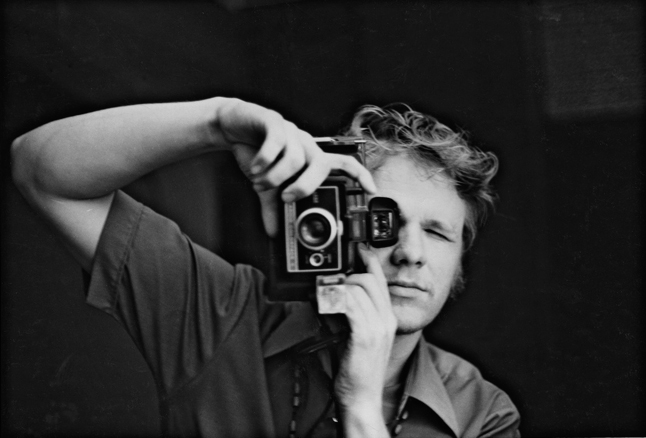
Happy 80th Birthday to bpNichol
Friday, September 27, 2024
Tango with Cows: Book Art of the Russian Avant Garde, 1910-1917
PennSound has been working in collaboration with the Getty Research Institute to present this remarkable collection of historical and contemporary transrational poetry, centered on an exhibition of Russian Futurist book art held at the Getty earlier this year. The exhibition's title — "Tango with Cows" — taken from a poem by Vasily Kamensky, points to the sense of hilarity and irreverence you'll hear in these startlingly original 'beyonsense' poems. Our page of recordings compliments the extensive media collected online at the Getty's website. There, you can find programs, essays, video footage, full scans of the Futurist books, and even a fully interactive slideshow of key books from the exhibition!
Our archive of sound recordings comes in two parts: first, Tango with Cows features Oleg Minin's bilingual readings of essential poems found in book art projects from poets such as Alexei Kruchenykh, Velimir Khlebnikov, and Pavel Filonov. By reading from the Russian before the accompanying English translation, Minin offers listeners the pleasure of sound before recognition — an ideal situation for the revolutionary poetics on display here.
However, the real highlight of this great resource sounds from the second half: we're pleased to present high quality recordings of Explodity: An Evening of Transrational Sound Poetry held on February 4th, 2009. This blockbuster reading casts the zaum' poetries of Khlebnikov and Kruchenykh in the parallel light of historic and contemporary sound poetry, as presented by Christian Bok and Steve McCaffery. After virtuoso performances of English translations of historical Russian poems, Bok and McCaffery present personal selections from the history of sound poetry alongside their own original compositions. On the short list are works by Aristophanes, Raoul Hausmann, F.T. Marinetti, Hugo Ball, Kurt Schwitters, and R. Murray Schafer, just to mention a few.
You can hear more work in this vein on PennSound pages for Christian Bok, Steve McCaffery, Jaap Blonk, Tomomi Adachi, and The Four Horsemen. Additionally, we'd like to suggest our historic pages for F.T. Marinetti and Vladimir Mayakovsky. Our partner UbuWeb offers a huge index of this exciting brach of poetry; we suggest in particular that you visit a companion set of Russian Futurist recordings from the GLM Collection.
Special thanks to Nancy Perloff and everyone at the Getty Research Institute for making this resource possible. We hope these recordings lend the same vision of language that mystified Benedikt Livshits in 1911 (from Nancy Perloff, Curator's Essay): "I saw language come alive with my very own eyes. The breath of the primordial word wafted into my face."
Wednesday, September 25, 2024
PennSound and Jacket2 Resources on Australian Poetry
When it comes to poetry anthologies, I agree with David Antin's long-ago quip — "Anthologies are to poets as zoos are to animals" — and I think that journals and magazines are probably better indicators of what's current in any country's poetry than grand, often agenda-driven anthologies. Here I am presenting the work of fifty-one contemporary poets from Australia. My aim was to make it broadly representative by including innovation and experimentation alongside quasi-romanticism, elegy, and the almost-pastoral. No one in this group writes like another. The common link is simply that each poet is an Australian whether by birth, residence or citizenship.
Monday, September 23, 2024
William Bronk: on 'Poems to a Listener,' 1984 and 1989
Both shows are content-dense yet remarkably intimate, with Bronk offering poems at his own pace and Lyman posing questions, often hinging on a certain turn of phrase or image, as they come to him. Sometimes they're quick exchanges, sometimes protracted. Lyman isn't afraid to needle, and Bronk is willing to tussle as well — at one point, he says "I'm not going to tell you what the light is," then, after a pregnant pause, adds, "you know what the light is!" — and occasionally, if the edit's a bit too tight, it almost feels like Bronk offering his dissension to the line of questioning by moving on to the next poem, but that only makes the back-and-forth more charming. Both are fine examples of why we find public radio compelling, and, of course, recorded poetry as well: there's nothing more than human voices and the breathing space between them, and that's enough. Play one (or both) of these programs through a good set of speakers, sit back, and get carried away for half an hour. Click here to start listening.

5.jpeg)


.jpg)

:format(jpeg):mode_rgb():quality(90)/discogs-images/R-2529703-1289069028.jpeg.jpg)