Monday, December 24, 2018

In Memoriam: Tom Leonard (1944–2018)

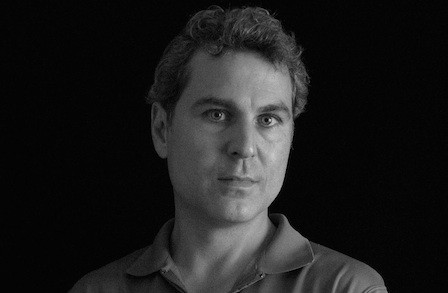
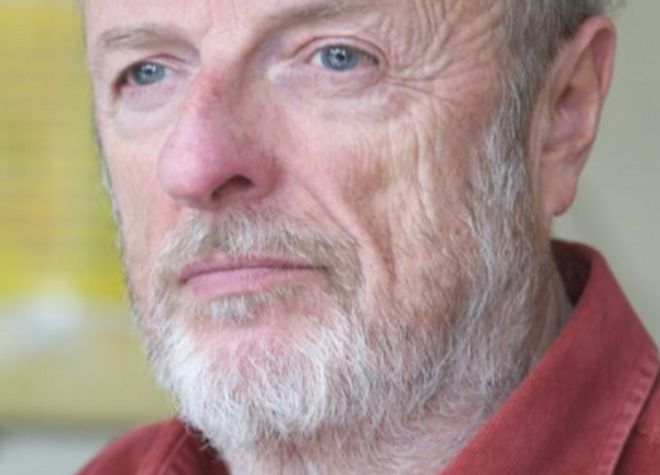
photo by Dominic Charlton (via BBC News)
We're very sad to report the death of poet Tom Leonard, hailed by no less an authority than the BBC as "a giant of Scottish literature," both in his homeland and abroad. 

In their obituary, Asif Khan (director of the Scottish Poetry Library) offered unstinting praise for the late poet, calling him "a pioneer committed to representing the language and concerns of his west of Scotland working-class community at a time when such representations were scant to non-existent," and noting that "The attitudes he exposed in his ground-breaking poem Six O'Clock News remain relevant decades after its publication; his analysis of the way in which accent, grammar, spelling and pronunciation are used to sustain power structures is as penetrating today as it was the day it was written." Khan finishes his encomium as follows: "His humour, his experimentalism, his commitment to his craft and untameable intelligence will be much missed by readers and the many writers he continues to influence."

Elsewhere, in The Scotsman, publisher and poet Kevin Williamson called Leonard "an inspiration who changed Scottish poetry forever and even how we think about our own language." The same tribute offers Leonard's explanation of the origins of his fascination with the Scots language:
"I was aware that my mother spoke using a lot of words that were Scottish, but then she would tell me to speak 'properly,' as she called it," he said. "I think it's a very common phenomenon, and not just in Scotland: you get it in different cities where the urban accent is looked down on, and there are parents who worry about their children not getting on in jobs or to university if they speak like that. So although they speak with a vernacular accent themselves, they tell their children to speak differently, and sometimes they might even punish their children for speaking the same way as they do themselves."
PennSound is proud to have hosted a Tom Leonard author page for many years, starting with the album Selected Poems, recorded at the Scottish Trades Union Congress Centre in Glasgow in April 2011. Working backwards chronologically, there's a 2006 home recording of "Unrelated Incidents," an undated recording of "Jist ti let yi no," his response to Williams' "This Is Just to Say," and a 2005 reading at Oran Mor in Glasgow. Next there's a 1997 recording of selections from Nora's Place and Other Poems 1965-1995, and mid-90s recordings of the individual poems "A Priest Came on at Merkland Street" and "Nora's Place." From there we jump back to 1978 for a home recording of "Shelley's Revolt of Islam (Canto 8 Stanza 2)," one of "Three Texts for Tape" made with the poet's Teac A-3340S recorder — this recording would be the subject of PoemTalk Podcast #80, with panelists Jenn McCreary, Joe Milutis, and Leonard Schwartz. The archive closes out with a pair of multitrack home recordings from the early 1970s: "nor shall death brag" and "kierkegaard either/or."

Friday, December 21, 2018

Bernadette Mayer's 'Midwinter Day' at Forty

Winter will officially begin at 5:23PM EST today, four minutes after sunset on the darkest day of the year. The winter solstice has long been a source of cultural inspiration and poetic inspiration as well, with one of the most notable recent manifestations being Bernadette Mayer's iconic Midwinter Day, which turns forty this year. While not published until 1982, Mayer famously wrote the book — hailed by Alice Notley as "an epic poem about a daily routine ... sedate, mundane, yet marvelous" — in its entirety while marking the the winter solstice at 100 Main Street in Lennox, Massachusetts on December 22, 1978.

As Megan Burns notes in her Jacket Magazine essay on the book: "A long held tradition on Midwinter's Day was to let the hearth fire burn all night, literally keeping a light alive through the longest night of winter as a source of both heat and a symbol of inspiration to come out the other side of the long night closer to spring and rebirth. It is fitting that a poem about surviving death and the intimacy of the family would be centered around this particular day that traditionally has focused on both. The hearth is the center of the home where the family gathers, where the food is cooked and where warmth is provided. Metaphorically, the poem Midwinter Day stands in for the hearth gathering the family into its folds, detailing the preparation of food and sleep and taking care of the family's memories and dreams."

Mayer read a lengthy excerpt from the book at a Segue Series reading at the Ear Inn on May 26th of the following year, which you can listen to on her PennSound author page along with a wide array of audio and video recordings from the late 1960s to the present. Better still, this year celebrations are being held all over the US as well as in Canada and Scotland to honor this "literary holiday." You can read more about these events and find one near you by clicking here.

Wednesday, December 19, 2018

Rachel Zolf: Wexler Studio Session, 2018

We recently added a new Wexler Studio session with poet Rachel Zolf, who stopped by last May to record a selection of new work.  In total there are sixteen pieces, all short vignettes running from sixteen to fifty-three seconds, which are identified by their opening lines. Titles include "Ingredients of a winning visual identity...," "Trapped in this high performance culture...," "You know the drill...," "Reading and gleaning from the same German root...," "Albino Lucille...," and "What's the use of Jews writing limericks..." 

You can listen in by clicking here, and don't forget to browse through nearly thirteen years' worth of recordings of every stripe imaginable, which you can find on PennSound's Rachel Zolf author page.

Monday, December 17, 2018

Whenever We Feel Like It: Laynie Browne, Bianca Stone, and Connie Yu

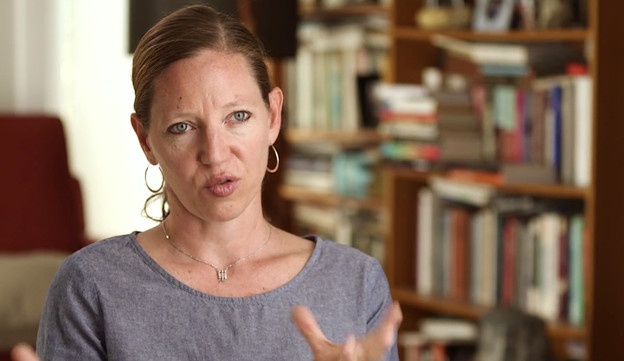
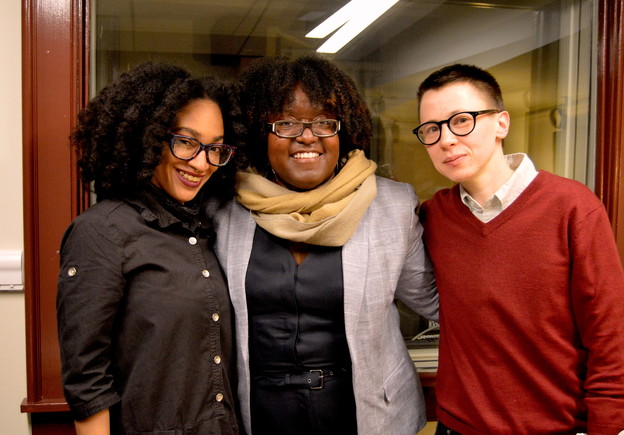
It's been a while since we checked in with the Whenever We Feel Like It reading series, but its most recently-added event is a good opportunity to do so. Recorded on November 27, 2018, this reading features an impressive triple-bill including Laynie Browne, Bianca Stone, and Connie Yu (shown at right). Here are brief bios of each of the authors:

Laynie Browne is a poet, prose writer, teacher and editor. She is author of thirteen collections of poems and three novels. Her most recent collections include a book of poems You Envelop Me (Omnidawn 2017), a novel Periodic Companions (Tinderbox 2018) and short fiction in two editions, one French, and one English in The Book of Moments (Presses universitaires de rouen et du havre, 2018). Her honors include a 2014 Pew Fellowship, the National Poetry Series Award (2007) for her collection The Scented Fox, and the Contemporary Poetry Series Award (2005) for her collection Drawing of a Swan Before Memory. Her poetry has been translated into French, Spanish, Chinese and Catalan. Forthcoming books of poetry include: Amulet: New & Selected Poems,Amulet SonnetsIn Garments Worn by Lindens, and Translation of the Lilies Back into Lists. Current projects include editing an anthology on The Poet’s Novel, and a collaboration with visual artist Brent Wahl on a public art project in Philadelphia, an installation including sculpture and poetry inscribed in thirteen languages in the new Railpark in Callow Hill. She teaches at University of Pennsylvania and at Swarthmore College.

Bianca Stone is a writer and visual artist. She was born and raised in Vermont and moved to New York City in 2007 where she received her MFA from NYU. She collaborated with Anne Carson on Antigonick, a book pairing Carson’s translation of Antigone with Stone’s illustration and comics (New Directions, 2012). Stone is the author of the poetry collection Someone Else’s Wedding Vows, (Tin House Books and Octopus Books, 2014), Poetry Comics From the Book of Hours (Pleiades Press, 2016) and The Mobius Strip Club of Grief (Tin House, 2018). Her poems, poetry comics, and nonfiction have appeared in a variety of magazines including Poetry, jubilat, and Georgia Review. She has returned to Vermont with her husband and collaborator, the poet Ben Pease, and their daughter Odette, where they run the Ruth Stone Foundation, a writing collective, letterpress studio, and artist residency.

Connie Yu is a writer and performer living in Philadelphia, attending to queer Asian worry, meetingplaces for this, that body and what it wears, alternate and constricted transmissions of information. Their poetry and essays have been published in ApiarySupplement, and Jacket2. Recently, they have worked as an educator at Center for Creative Works; and as a curator of gallery shows and contingent programs at the Kelly Writers House.

Also, though it goes without saying, we're proud to remind you that The Whenever We Feel Like It reading series is put on by Committee of Vigilance members Michelle Taransky and Emily Pettit. The Committee of Vigilance is a subdivision of Sleepy Lemur Quality Enterprises, which is the production division of The Meeteetzee Institute. You can browse through the series' history — it will celebrate its tenth anniversary at the Kelly Writers House next March — by clicking here.

Friday, December 14, 2018

Maggie Nelson: Newly Segmented Readings from "Bluets"

As Maggie Nelson's dazzling Bluets nears its tenth birthday it has clearly lost none of its power, and while later works like The Argonauts have perhaps garnered more cultural cache — with good very reason, I might add — Bluets will always be an important transitional work in Nelson's oeuvre. Today, we're highlighting two newly-segmented readings from Bluets, cut by PennSound staff editor Louisa Healey, which Al Filreis recently announced in a recent Jacket2 commentary post.

The earlier of these is from a 2007 appearance on LA-Lit, which is well worth checking out in its entirety for her discussion with hosts Mathew Timmons and Stephanie Rioux, along with generous selections from her earlier books, The Red Parts, Jane: A Murder, and Something Bright, Then Holes, along a then in-progress Bluets. Her readings here encompass sections (or propositions) 52–59, which addresses the science of color along with vision, particularly as a religious phenomenon.

Then, from a 2013 reading as part of the MFA Reading Series at Boise State University, we have a larger excerpt from the book — which takes up the majority of her half-hour set — starting at proposition #204 and continuing through to the book's conclusion with proposition #240. Here's how that segment starts:
Lately I have been trying to learn something about "the fundamental impermanence of all things" from my collection of blue amulets, which I have placed on a ledge in my house that is, for a good half of the day, drenched in sunlight. The placement is intentional — I like to see the sun pass through the blue glass, the bottle of blue ink, the translucent blue stones. But the light is clearly destroying some of the objects, or at least bleaching out their blues. Daily I think about moving the most vulnerable objects to a "cool, dark place," but the truth is that I have little to no instinct for protection. Out of laziness, curiosity, or cru­elty — if one can be cruel to objects — I have given them up to their diminishment.
You can listen to both of these sets, along with many more — including a terrific 2015 appearance on David Naimon's always-amazing radio program, Between the Covers — by clicking here.

Wednesday, December 12, 2018

Douglas Kearney: New Author Page

Our newest author page is for poet, performer, and librettist Douglas Kearney. The majority of the recordings you'll find there come from Kearney's recent two-day visit to our own Kelly Writers House, which included a two-part Close Listening reading and conversation with Charles Bernstein recorded on October 22nd, along with an appearance alongside Brian Goldstein for a "City Planning Poetics" event. This sixth installment in the series, organized by Davy Knittle, was titled "Urban Revitalization" and took place the following day.

In addition to these recordings, which are available in MP3 format or streaming video, we also have video from a trio of recent readings, including a September 2017 reading at the Poetry Center at the San Francisco State University, and a pair of undated recordings from Los Angeles' Museum of Contemporary Art and Harvard University's Vocarium Reading Series.

You can check out all of the aforementioned recordings on our brand new Douglas Kearney author page. Click here to start listening.


Monday, December 10, 2018

Happy Birthday, Emily Dickinson!

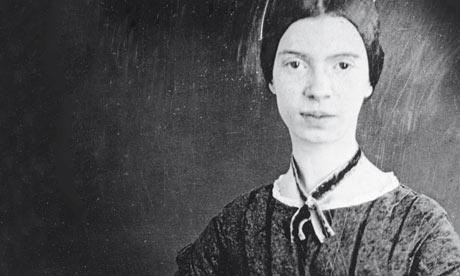
December 10th would have been Emily Dickinson's 188th birthday, and we're celebrating the Belle of Amherst by highlighting a dazzling array of recordings related to the poet that are available throughout the PennSound archive.

While, of course, it would be impossible for us to have recordings of Dickinson reading her own poems, we do have a number of talented readers offering up their best renditions of her work, including Naomi Replansky, John Richetti, Susan Howe, Robert Creeley, and Jeffrey Robinson. Howe, of course, is well-known for her iconic text, My Emily Dickinson, and we have a number of recordings of her reading from and/or discussing that project, from the Radio Readings Project, LINEbreak, and the New York Talk Series, along with excerpts from her 2010 Kelly Writers House Fellows visit, and a complete 1990 lecture on the poet from SUNY-Buffalo. Also from Buffalo in 1990, we have a short recording of Creeley reading and discussing "My Life had stood -- a Loaded Gun," and from 1985 we have a complete trio of lectures on Dickinson recorded at the New College. We can thank David Levi Strauss for those recordings, along with a trio of New College lectures on Dickinson by Robert Duncan delivered in 1981.

Rounding out the collection, there are short excerpts from longer radio programs featuring Elizabeth Bishop (on Howe's Pacifica-FM show) and John Ashbery and Barbara Guest (on WNYC's PEN Portraits) discussing the poet, along with Rae Armantrout's comments on Dickinson from the wonderful Nine Contemporary Poets Read Themselves Through Modernism event at our own Kelly Writers House in 2000. Jumping back to 1979, we have an amazing Dickinson Birthday Celebration from the St. Mark's Poetry Project, which features Jan Heller Levi, Charles Bernstein, Susan Leites, Charles Doria, Virginia Terrace, Madeleine Keller and Vicki Hudspith, Armand Schwerner, Karen Edwards, Jackson Mac Low, and Maureen Owen, along with Guest and Howe. Last but certainly not least, we have a pair of PoemTalk podcasts related to the poet: from 2010, episode #32 discussing Howe's interpretation of Dickinson's "My Life had stood -- a Loaded Gun," while episode #87, from 2015, addresses Dickinson's "She rose to His Requirement," and "Wild Nights -- Wild Nights!."

While these wonderful resources are scattered throughout our site, you can find them all in one convenient place on our Emily Dickinson author page. Head on over there now and honor Dickinson's life and work in your own way.


Friday, December 7, 2018

Michael Lally: "Another Way to Play" Launch Reading, 2018

We're closing this week out with a short recording that serves as a gateway to much more: specifically, it's Charles Bernstein's short mobile video of Michael Lally reading from his recently-released Another Way to Play: Poems 1960–2017 at a launch event held at New York's Howl on April 26th of this year. While the video is only a little less than six minutes, it serves as a fine example of the poet and actor at his very best, starting in medias res with selections from "The Village Sonnets," written between 1959 and 1962, a memoir peppered with cameos by Nina Simone, Bob Kaufman, Allen Ginsberg, Bob Dylan, and more. From there he speaks about his gratitude for his children and their frequent presence in his poems, offering up "Before You Were Born," from Swing Theory, which is dedicated to his youngest son, Finn. The clip ends with the final, and most recent poem in the volume, titled "Love Is the Ultimate Resistance."


While that's just a brief taste of Lally's work, you'll find a number of vintage recordings on his PennSound author page, starting with a 1977 appearance on Public Access Poetry and a set from the Ear Inn, along with a 1978 reading at the West End Bar and another Ear Inn reading with John Ashbery that inaugurated the venerable Segue Reading Series. There's also Lally's 1994 New Alliance Records album, What You Find There, and a 2011 appearance at the Readings in Contemporary Poetry series at Dia Art Foundation, New York:Chelsea. You can listen to all of the aforementioned recordings by clicking here.


Wednesday, December 5, 2018

Charles Bernstein: "Near/Miss" Launch Readings

We couldn't be more excited about PennSound co-director Charles Bernstein's newest book, from University of Chicago Press, Near/Miss. Today, we're proud to be able to present audio and video from four recent launch events for the collection.

The first reading took place on November 7th at  McNally Jackson Books, and featured Amy Sillman, Tracie Morris, and Felix Bernstein, along with the author. Those special guests read selections from the book, including "Pinky's Rule," "Intaglio," "Apoplexie," and "Our United Fates," while Bernstein read "In Utopia," "Drambuie," "Seldom Splendor," and "Fare Thee Well," among others.

Five days later, Bernstein gave a solo reading at Washington, D.C.'s Bridge Street Books on November 12th, which is available in both MP3 and streaming video formats. His set consisted of the poems "Thank You for Saying You're Welcome," "Nowhere Is Just around the Corner," “S'i' Fosse," "Corrections," "Bluebird of Happiness," "I Used to be a Plastic Bottle," and "Also Rises the Sun."

Next, from November 14th at the Penn Book Center in Philadelphia, we have another solo reading that included these titles: "Me and My Pharaoh," "Ballad Stripped Bare," "Our United Fates," "Ring Song," and "Don’t Say I Passed." Finally, there's an hour-long conversation between Bernstein and Peter Straub, which was recorded on November 29th at Books Are Magic in Brooklyn.

Bernstein has conveniently gathered all of these recordings in a Jacket2 commentary post, which you'll find here. These and many, many more readings can be found on Bernstein's PennSound author page.

Monday, December 3, 2018

The Poetics List at 25

This weekend, PennSound co-director Charles Bernstein took note of the fact that this December marks the twenty-fifth anniversary of the venerable Poetics List, which he founded at the Poetics Program at SUNY-Buffalo. While the listserv closed almost five years ago, it's wonderful to be reminded of the wonderful discourse — often illuminating, occasionally contentious — that was a big part of the world of contemporary poetry and poetics for a great many of us. 

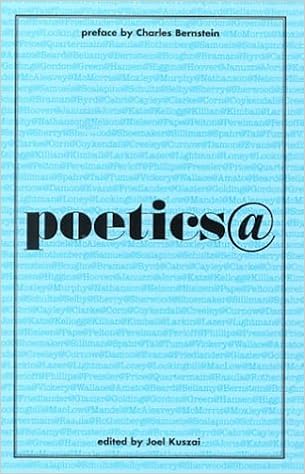
You can still browse a complete archive of the list, now housed at UPenn, here, along with POETICS@, an anthology of early highlights, edited by Joel Kuszai, which Roof Books published in 1999. To mark the occasion, Bernstein posted his introduction to that volume, which begins as follows:
Above the world-weary horizons
New obstacles for exchange arise
Or unfold, O ye postmasters! 
The Poetics List was founded in late 1993 with this epigraph serving as its first message. I had been on email for only about a year at that time, but from the first was fascinated by the possibilities for group exchange made available by the listserve format. I remember endless conversations with friends explaining the mechanism: you send out one message to the list address and everyone subscribed gets the message almost instantaneously. And to reply, you simply hit "R" on the keypad and write your new message. My friends listened in something as close to astonishment as poets doing hard-time ever can. It was as if I were explaining the marvels of xerography to letterpress printers. 
In 1993, most of the poets I knew who had email had those accounts provided by universities and the history of the Poetics List is marked by the change, within a few years, from the dominance of ".edu" (university) email addresses to ".com" (commercial) addresses. At that time, writing email was far more cumbersome than it is today. For the first several years of the Poetics List, most of the messages were written on-line using early versions of Pine or more primitive mail programs, with very limited editing tools available. Typing could be slow and the possibility of revision was limited - especially for those who chose to engage in the spirit of improvised list exchange by spontaneously typing their messages and immediately sending them out. Indeed, it is worth noting that a number of people on the list, working with email systems that had no text buffers, could not retype the lines prior to the one they were typing – making a post to Poetics more like a telegram than a letter. And indeed it was the telegraphic immediacy of this new writing genre that was so electrifying. Group exchange of texts had never been faster or easier.
You can read his complete introduction here, and for those of you still craving an inbox full of poetry every morning, don't forget that The Chicago School of Poetics maintains The Poetics List 2.0, which started one month after the original Buffalo listserv closed down.


Friday, November 30, 2018

Mónica de la Torre: Newly Segmented 2018 KWH Reading

In January of this year, multitalented poet, translator, editor, and scholar Mónica de la Torre stopped by our own Kelly Writers House to give a reading as part of the ongoing Visiting Poet-Scholar Series. Thanks to PennSound staffer Luisa Healey, we're able to showcase newly-segmented MP3s from that event with our listeners.

The evening began with introductions by both Al Filreis and Davy Knittle, followed by de la Torre's opening comments on the place of serial poems within her collected body of work. Her reading highlights works in this mode, with selections coming from throughout her long literary career. Four is represented by several poems — "Photos While U Wait," "On Neuroticism and Cutting Fabric," "Songs that Changed Your Life," and "Happy New Years" — and she dips into Public Domain for "Cease to Stutter Sing-Song." The majority of the reading, however, is dedicated to her latest publication, The Happy End / All Welcome, and her current work-in-progress, Discontinued Repetition. From the former, we hear "Positions Available," "Table #20," "View from an Aeron Chair," "View from a Dodo Chair," "Table #17," and "Human Intelligence Tasks." As for Discontinued Repetition, de la Torre explains that the book is "mainly all translations of the same poem," "Equivalencias," which was originally written in Spanish about two decades ago. Some of the iterations she reads include "The Poem Is Titled Equivalences," "Self-Mastery," "Hola Mi Amor," "Same As It Ever Was," "Latin Lover," and "The Most Mimetic of All." de la Torre concludes the set with a Q&A session, and her responses are broken up thematically, including talk about writing in two languages, poetry produced by algorithm, and philosophies of translation.

You can listen to and watch de la Torre's 2018 KWH reading here, and be sure to scroll down for a wide array of readings spanning fifteen years.

Wednesday, November 28, 2018

David Bromige: Two Newly Segmented Readings

In a recent Jacket2 commentary post, PennSound co-director Al Filreis highlighted a pair of vintage recordings of David Bromige that had recently been segmented by PennSound staff editor Luisa Healey.

The first of these, dating from May 23, 1989, is an appearance by Bromige on A.L. Nielsen's radio program, Incognito Lounge, which aired biweekly on San José's KSJS-FM. The twenty-two minute program starts with a few introductory comments before Bromige starts reading, with selections including "You," "Sounds Like Something I Would Make," "Lines," and the complete twelve-part poem, "It to Experience."

We also have segmented Bromige's seventeen-minute set from a November 1990 tribute reading to Robert Duncan — which also aired on Incognito Lounge that same month. This reading starts with a lengthy introduction, followed by "The Swiss," "Let Me Put This Another Way," "On a Hundred Block Walk from A Cast of Tens," and two untitled poems identified by their first lines: "I am a brainwashed Sudanese poet…" and "I have five minutes to read it…"

You can listen to both of these readings, and many, many more, on PennSound's David Bromige author page, which showcases a vast array of recordings from the mid-60s through to the late-90s, along with a number of posthumous tribute readings.

Monday, November 26, 2018

Three New Belladonna* Readings, 2018

Today we're following up on a recent post announcing new additions to our Belladonna* Reading Series homepage, with three new readings from the last few months.

The earliest of these, from September 19th, is another launch event for Pamela Sneed's new book, Sweet Dreams, this one being held at the St. Mark's Poetry Project. For this event, which was introduced by Kyle Dacuyen and Rachel Levitsky, Snead was joined by guest readers Roya Marsh, Shelley Marlow, and Tracie Morris.

Next, from October 11th, we have a Belladonna* Roll Call Reading Series event, held at Spoonbill and Sugartown's Montrose Avenue location. This special evening featured Patricia Spears Jones presenting Serena Fox and Rachel Blau DuPlessis presenting Orchid Tierney.

Finally, from October 16th, there's quite an impressive reading co-sponsored by Belladonna*, The Operating System, and Ugly Duckling Presse at McNally Jackson Books in Williamsburg. Elae (Lynne DeSilva-Johnson) served as master of ceremonies for the evening, which featured a line-up of Margaret Randall, Urayoán Noel, Lila Zemborain, María Vázquez Valdez, and Elizabeth Zuba.

Now approaching its twentieth year, Belladonna* continues to be as vital a force as ever in our contemporary poetry scene. On our Belladonna* reading series homepage, you'll find an astounding array of audio and video documentation of the organization's ambitious work promoting "the work of women writers who are adventurous, experimental, politically involved, multi-form, multicultural, multi-gendered, impossible to define, delicious to talk about, unpredictable, and dangerous with language," going back to its very origins. Click here to start browsing, or click any of the individual dates above to visit that specific reading.


Wednesday, November 21, 2018

PennSound Presents Poems of Thanks and Thanksgiving

With the US celebrating Thanksgiving tomorrow, I thought it might be worthwhile to resurrect a PennSound Daily feature from way back in 2010: a mini-mix of poems of thanks and thanksgiving — some old, some new — taken from the PennSound archives.

In a classic recording of "Thanksgiving" [MP3] from the St. Mark's Poetry Project, Joe Brainard wonders "what, if anything Thanksgiving Day really means to me." Emptying his mind of thoughts, he comes up with these free associations: "first is turkey, second is cranberry sauce and third is pilgrims."

"I want to give my thanks to everyone for everything," John Giorno tells us in "Thanks 4 Nothing" [MP3], "and as a token of my appreciation, / I want to offer back to you all my good and bad habits / as magnificent priceless jewels, / wish-fulfilling gems satisfying everything you need and want, / thank you, thank you, thank you, / thanks." The rolicking poem that ensues offers both genuine sensory delights ("may all the chocolate I've ever eaten / come back rushing through your bloodstream / and make you feel happy.") and sarcastic praise ("America, thanks for the neglect, / I did it without you, / let us celebrate poetic justice, / you and I never were, / never tried to do anything, / and never succeeded").

"Can beauty save us?" wonders Maggie Nelson in "Thanksgiving" [MP3], a standout poem from her marvelous collection, Something Bright, Then Holes, which revels in the holiday's darker edges and simplest truths: "After dinner / I sit the cutest little boy on my knee / and read him a book about the history of cod // absentmindedly explaining overfishing, / the slave trade. People for rum? he asks, / incredulously. Yes, I nod. People for rum."

Yusef Komunyakaa gratefully recounts a number of near-misses in Vietnam — "the tree / between me & a sniper's bullet [...] the dud / hand grenade tossed at my feet / outside Chu Lai" — in "Thanks" [MP3], from a 1998 reading at the Kelly Writers House.

Finally, we turn our attention to the suite of poems that concludes Mark Van Doren's Folkways album, Collected and New Poems — "When The World Ends" / "Epitaph" / "Farewell and Thanksgiving" [MP3] — the last of which offers gratitude to the muse for her constant indulgence.

To keep you in the Thanksgiving spirit, don't forget this 2009 PennSound Podcast (assembled by Al Filreis and Jenny Lesser) which offers "marvelous expressions of gratitude, due honor, personal appreciation [and] friendship" from the likes of Amiri Baraka, Ted Berrigan, Robert Creeley, Jerome Rothenberg, Louis Zukofsky and William Carlos Williams.

Monday, November 19, 2018

PoemTalk #130: Gwendolyn Brooks' "Riot"

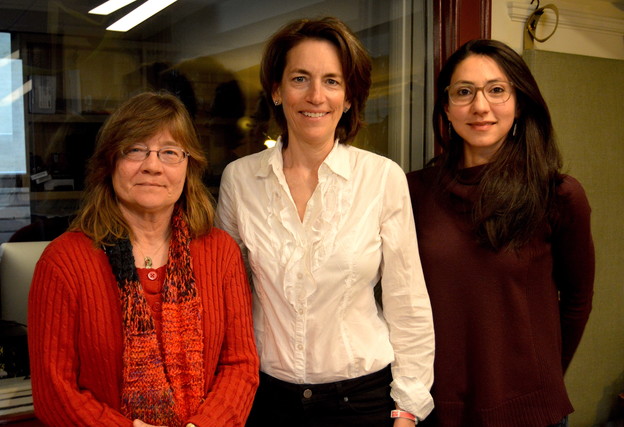
Today we released the latest episode in the PoemTalk Podcast Series (that's #130 if you're keeping track), and it's a very exciting one indeed, focusing on Gwendolyn Brooks' landmark 1969 poem, "Riot." For this show, host Al Filreis convened a panel of (from left to right) Amber Rose Johnson, Tonya Foster, Davy Knittle.

As Filreis explains in his post announcing the new episode on the PoemTalk Blog, "'Riot' is the title poem in the (now rare) chapbook published by Dudley  Randall's Detroit-based Broadside Press in 1969" — he provides a link to a PDF copy at the marvelous Eclipse archive — "and has been collected variously, including in the book Blacks (1994)." He also reprints the chapbook's epigraph, a quote by Henry Miller's Sunday After the War, "It would be a terrible thing for Chicago if this black fountain of life should suddenly erupt. My friend assures me there's no danger of that. I don't feel so sure about it. Maybe he's right. Maybe the Negro will always be our friend, no matter what we do to him."

From there, he moves on to the poem's cadence and typography, starting with a comment by Amber Rose Johnson, "There's so much punctuation working in the poem as she performs it," then he observes, "Stops are emphatic. Lists of things deliberately compile." He continues, "Later Amber Rose hears both riot and collapse in the very voice of the poet, and at the end of the discussion all agree that this poem, especially in performance, is an example of what powerful, memorable poems can do: they find ways to do what they say." 

You'll find the full text of Brooks' poem, and much more discussion of the program here. The full archive of PoemTalk podcasts is available here for your listening pleasure, and Filreis makes a rare recommendation of an earlier PoemTalk episode, "in which Herman Beavers, Tracie Morris, and Jo Park discuss Brooks' poem 'Truth' and Etheridge Knight’s poem-response to it, 'The Sun Came,'" as a fine complement to this program.

Wednesday, November 14, 2018

Donato Mancini: Two Recent Readings

Just a few weeks ago, we highlighted Canadian poet Donato Mancini's recent Wexler Studio Recording Session. Today, we have two more recent additions to announce. The first of these, dating from October 20th of this year, is a Baltimore reading from the "fatrasies" of Philippe de Beaumanoir and the "fatras" of Watriquet de Couvin. That's joined by an October 3, 2017 reading at Simon Fraser University, where Mancini reads "A Flea the Size of Paris: The Fatras," with Ted Byrne and guests Danielle LaFrance and Jacqueline Turner.

Our Donato Mancini author page is home to many more recordings of the poet from over the past five years, including two separate Wexler Studio sessions, readings from Washington, D.C.'s venerable Bridge Street Books, Johns Hopkins University, The Kootenay School of Writing, and Vancouver, BC. You'll also find two recordings from Mancini's residency at University of Windsor, a 2016 home-recorded session of poems from his earlier collections, Buffet World (2011) and Loitersack (2014), and a 2016 appearance on the inaugural episode of Short Range Poetic Device, entitled "Poetry and Poetics Streaming Against the Totality." Click here to start exploring all of the recordings mentioned here.

Friday, November 9, 2018

Divya Victor: New Author Page

Over the past year and a half it's been an amazing experience working with Jacket2 guest editor Divya Victor. She has a keen eye for content, offers effortlessly incisive commentary, and has shaken up and challenged our tight-knit editorial team in the best ways imaginable. If you don't already know this side of Divya, you will soon enough, when we unveil the "Extreme Texts" feature she's been working on for the past year.

One thing Divya is well-known as, however, is a talented and innovative poet, and that's what makes her recently-created PennSound author page a cause for celebration. There, you'll find an archive of work spanning nine years, starting with a 2009 Emergency Series reading at our own Kelly Writers House. That's followed by a 2010 reading of Hellocast Feral Cat Attack (with participant-collaborators) for Les Figues Press, a 2012 St. Mark's Poetry Project reading with Vanessa Place, 2014 readings at Videofag and Counterpath, and "Cicadas in the Mouth," her Leslie Scalapino Memorial Lecture in Innovative Poetics (which you can read as well as watch). Jumping forward to 2017, theres video of her reading "W is for Walt Whitman's Soul" at BookThug, and then a trio of readings from this year: a Wexler Studio Recording Session and a Kelly Writers House conversation with Laynie Browne, both recorded on April 20th, along with a July reading with Cat Tyc for Living Poetry at the Hudson Area Library. Click here to start exploring this treasure trove of recordings.

Wednesday, November 7, 2018

George Quasha reads "Verbal Paradise," 2018

Over the past several years, one of the many herculean tasks Chris Funkhouser has set for himself is recording the work of fellow poet George Quasha. Today we're highlighting a recent addition from that project: audio of Quasha reading his book Verbal Paradise in its entirety. This session took place in Barrytown, New York on July 3rd of this year.

On his author website, Quasha has this to say about Verbal Paradise, which is the first of six projected books in his "preverbs" series: 

The work of preverbs, of which this is the first book to enjoy publication, resists introductory or explanatory remarks, even as it makes them inevitable in the context of poetry. Preverbs precede themselves, so to speak, with hidden trapdoors; but this rather elusive distinction regarding a radical of composition is not like premeditation or conceptualization. One instance has to do with the relationship of preverbs to poetry in any pre-existing sense. The question “is this poetry?” has to remain open; if preverbs have a program it’s an openness regarding their own nature, especially in relation to the big consensual distinctions (poetry, even language). (Preverbially: poetry is what still exists on the other side of the distinction.) The escape-hatch approach to definition-qualification is not a defensive act by which, say, preverbs would ward off all conceptual framing or aesthetic theory (which they quite willingly play with); rather, it’s an expression of their nature to promote mind-degradable utterance. Thinking, unthinking, further thinking; saying, unsaying, further saying.

You can read more about the book here, and listen to it here. Funkhouser's complete Quasha recordings can be found here.

Monday, November 5, 2018

Philly Small Presses Dinner Panel, 1999

Here is a true slice of vintage Kelly Writers House programming, dating all the way back to March 26, 1999. If you were around then, you could've enjoyed a full day of wonderful programming billed as "A Celebration of Philadelphia Writers," which was sponsored by the Humanities Forum.

The day started early with breakfast at the White Dog Cafe and a talk entitled, "So, You Want to Get Published?" That was followed by "Communities and Writers," a lunchtime event on "Writing in Philly," "Philadelphia in Film," and an exhibition opening and book signing that went straight on through to 5:30. For evening plans, you had your choice of The Chosen at the Arden Theatre or a busy night at the Clef Club that started with a talk on "Interplay of Philadelphia Jazz and Poetry," followed by an open-mic poetry jam hosted by KWH.

The keystone event of the day, however — and the one that we're highlighting — is the Philadelphia Small Presses Dinner, held at the Writers House. As the program blurb announces, "Philadelphia is experiencing a literary renaissance, thanks to the many dedicated poets and writers who run reading series, publish literary journals, and run small presses here in Philadelphia. Join some of Philadelphia's literary innovators at the Kelly Writers House for a roundtable conversation about Philadelphia's lively publishing scene." The line-up for the event is quite formidable, including Chris and Jenn McCreary (of Ixnay Press), Dave Deifer (of Xconnect), Michael Magee (of Combo), Heather Thomas and Alicia Askenase (representing 6ix), Gil Ott (of the Philadelphia Publishing Project and Singing Horse Press), Louis Cabri (of PhillyTalks), Kristen Gallagher (of Handwritten Press), and Jena Osman (of Chain). You can listen to this historic discussion here.

Friday, November 2, 2018

Steve McCaffery, "Wot We Wokkers Want" b/w "One Step to the Next"

We close out this week with an interesting artifact from Steve McCaffery"Wot We Wokkers Want" b/w "One Step to the Next" was released on LP and cassette in 1980 by the Underwhich Audio Collective, a small Canadian independent label (based in Toronto, Ontario and Saskatoon, Saskatchewan) that also issued small run releases (usually about 100 copies) by the likes of Owen Sound, the Four Horsemen, Paul DuttonBob Cobbing, Susan Frykberg, Larry Wendt, and DUCT, among others.

Better known by its full title, The Kommunist Manifesto or Wot We Wukkerz Want Bi Charley Marx un Fred Engels, the leadoff track is McCaffery's translation of The Communist Manifesto into the dialect of West Riding of Yorkshire, or, as he puts it, "Redacted un traduced intuht’ dialect uht’ west riding er Yorkshuh bi Steve McCaffery, eh son of that shire. Transcribed in Calgary 25 November to 3 December 1977 un dedicated entirely to Messoors Robert Filliou and George Brecht uv wooz original idea this is a reullizayshun." You can read the piece in its entirety here as part of the PECP Library. Side A also includes "Mid●night Peace" ("a nostalgic translation of the Dadaphony of hell") and "A Hundred And One Zero S One Ng," which is McCaffery's translation of Brecht's translation of the closing section of Robert Filliou's 14 Chansons et Charade.

Side B starts with "One Step Next to the Next," co-created with Clive Robertson, which centers around turntable manipulations of a National Geographic flexi-disc on the Apollo space flights. The closing track, Emesin which "a phrase is intercepted, reversed, synthesized, and obsessively repeated as a stolen micro-unit." As the liner notes explain, "it represents McCaffery's first theft from himself." Listen in to all of these tracks here.

Wednesday, October 31, 2018

Donato Mancini: Wexler Studio Session, 2018

Late this summer, Canadian poet Donato Mancini visited the Wexler Studio at our own Kelly Writers House to record a selection of recent work. This session, which was recently segmented, can now be found on his PennSound author page. Recorded on August 13th of this year, this set includes twenty-five titles, including "Buy my buy high.," "a kind in glass and a cousin," "prevent emergency tours, and," "The nervous system of a tomato plant," "bitter generic," and "january made from table salt."

Our Donato Mancini author page is home to many more recordings of the poet from over the past five years, including a separate Wexler Studio session of selections from his Griffin Poetry Prize-nominated collection, Same Diff, readings from Washington, D.C.'s venerable Bridge Street Books, Johns Hopkins University, The Kootenay School of Writing, and Vancouver, BC. You'll also find two recordings from Mancini's residency at University of Windsor, a 2016 home-recorded session of poems from his earlier collections, Buffet World (2011) and Loitersack (2014), and a 2016 appearance on the inaugural episode of Short Range Poetic Device, entitled "Poetry and Poetics Streaming Against the Totality." Click here to start exploring all of the recordings mentioned here.

Monday, October 29, 2018

Rachel Blau DuPlessis: "INTERFACES" Opening at KWH, 2017

We're starting this week off with video and audio from the opening celebration for INTERFACES: Work by Rachel Blau DuPlessis, held at the Brodsky Gallery at our own Kelly Writers House on November 15, 2017.

As the introductory note for the event observes, "Collage poems as an inter-art practice characterize recent work by Rachel Blau DuPlessis." It continues: "These collage poems, in serial groups like Churning the Ocean of Milk, Life in Handkerchiefs, and Numbers, are charged by DuPlessis's mix of aphorism, aesthetic perception, and sociopolitical comment. A bright visuality, intense poetic commentary, and a confrontative intertextuality combine in these personable and evocative works on paper, which negotiate the afterlife of debris by vibrant uses of its traces." This event features DuPlessis reading selections from her recent books Days and Works (Ahsahta, 2017) and Graphic Novella (Xeroxial Editions, 2015), along with a illustrated talk on her collage work in the exhibition.

It's appropriate that the archive you'll find on PennSound's Rachel Blau DuPlessis author page is as ambitious, complex, and rich as the poet's work. In numerous audio and video recordings going back four decades, you'll find readings from the vast majority of DuPlessis' one hundred and fourteen poems that comprise her twenty-six year magnum opus, Drafts, along with a sampling of the work that came before and after that project. There are also numerous talks, interviews, and other events. Click here to start browsing.

Friday, October 26, 2018

28th Annual Subterranean Poetry Festival

Here's an amazing event to close out your week in spectacular fashion: audio from the 28th annual Subterranean Poetry Festival, which was held in Rosendale, NY on September 8th of this year. Curator Chris Funkhouser — who also was kind enough to provide us with a recording of the event — offers up this introduction to the unique event:

Again asked to “curate” this unique annual event held in Rosendale, NY, I unintentionally brought together writers whose places of residence are equally balanced between nearby regions known as “upstate” and “city”. A moist year for the annual Festival at Widow Jane Mine! Not only did the poets dowse the space with language and song, water steadily dripped from the ceiling all afternoon as accompaniment for everyone, and one poet, Douglas Rothschild, arrived for his boombox-infused performance wearing a wetsuit after paddling an inflatable raft across the underground lake adjacent to the stage (& no one remembered to bring a lamp for the stage so it was darker than usual down there, a sign of the times perhaps). Such dramatic presentations began early on: Tony Torn opened the show by enlisting several of the other performers — Katy Bohinc, Lee Ann Brown, Bob Holman and Rothschild — “a preview of the day to come” — to help him stage a Google translation of cave scene of Alfred Jarry’s Ubu Roi. As always, beautiful to hear a range of voices in the acoustically marvelous setting. Other highlights included hearing Nancy Dunlop’s setting of Blake’s songs, as well as her a lovely duet with Brown, who also sang some of her work — as did Holman while rendering a new work titled The Cut Outs (accompanied by soundtrack; it was a much longer performance, edited for this collection at his request). Philip Good, Michael Joyce, Bohinc, Joan Retallack, Erica Kaufman all prepared stellar sets work and read with gusto reverberating throughout the Mine, as heard in these recordings.

You'll find segmented MP3 files for each of the performers mentioned above here. On the same page, we're lucky to also have audio from last year's iteration of the festival, which featured sets from Rebecca Wolff, Pierre Joris, Pamela Twining, Nicole Peyrafitte, Michael Ruby, John Cayley, David Rothenberg, Dorota Czerner, Andy Clausen, and Adeena Karasick. We're grateful, as always, to Chris Funkhouser for his generosity in sharing these and numerous other wonderful recordings with the PennSound archive.

Wednesday, October 24, 2018

Rodney Koeneke: New Author Page

Our latest author page is for Portland, Oregon-based poet Rodney Koeneke. It's anchored by a brand-new recording session done at our own Wexler Studio on September 24th, which showcases poems from Koeneke's two latest books, 2014's Etruria and 2018's Body and Glass, both of which were published by Wave Books. Titles included in this twenty-six minute set include: "Larry's House of Brakes," "in the backlands of the provence," "tarnish the coppice, punk autumn," "the new sobriety," "scott walker sings," "humber, severn, mersey, thames, and ouse," "another hapless functionary," and "he continually puts autumn in his writing."

In addition to this new set, you'll also find a trio of Segue Series readings from the Zinc Bar and the Bowery Poetry Club from 2015, 2012, and 2004, along with an hour long "Poet as Radio" interview recorded in San Francisco in 2013, and video of a Counterpath reading in Denver in 2014. You can browse all of the aforementioned recordings here.

Monday, October 22, 2018

Two David Bromige Tribute Readings, 2018

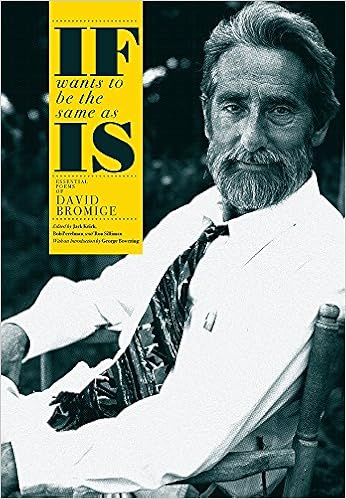
We're starting this week in grand fashion with two recent events — one held in Philadelphia, the other in Vancouver, BC — honoring the late David Bromige and celebrating the recent publication of if wants to be the same as is: The Essential David Bromige.

The first of these two readings was held at our own Kelly Writers House on September 25th of this year, and featured an astounding line-up of friends, fans, and colleagues of the late poet, including Charles BernsteinRachel Blau DuPlessis, Steve Dolph, Ryan Eckes, George Economou, Eli Goldblatt, Tom Mandel, Chris McCreary, Jason Mitchell, Bob PerelmanFrank Sherlock, and Orchid Tierney. That seventy-five minute event is available in both MP3 and streaming video formats.

Then, from just a few days ago on October 12th, we have video from a launch party for the new Bromige collection, which was held at the People's Co-op Bookstore in Vancouver. That event featured readings from Bob Perelman, Meredith Quartermain, George Bowering, Anakana Schojfield, Peter Quartermain, Fred Wah, Paul Debarros, Clint Burnham, Mackenzie Ground, and Chris and Joni Bromige. We've provided an embedded and segmented YouTube playlist for these recordings.

You'll find both of these events on PennSound's David Bromige author page, along with a 2009 tribute to the poet produced by Katherine Hastings of KRCB-FM in Rohnert Park, CA, and a vast array of recordings from 1998 as far back as 1964. Click here to start exploring.

Thursday, October 18, 2018

PoemTalk #129: Sylvia Plath's "The Stones"


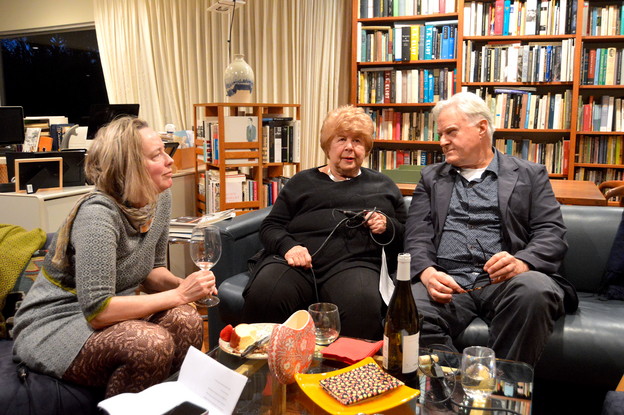
Yesterday we released the latest episode in  the PoemTalk Podcast Series (number 129 in total), where Sylvia Plath's "The Stones" — one part of a 1959 seven-poem sequence called "Poem for a Birthday" — is the poem up for discussion. For this program, host Al Filreis convened a panel of (from left to right) Susan Schultz, Sally Van Doren, Huda Fakhreddine.

In his post announcing the new episode on the PoemTalk Blog, Filreis starts by detailing the panelists' opening observations: "The group, starting with Susan, begins with Plath's constant substitution of the natural and the artficial. They then compile instances of her strategic mixing of metaphors. Sally also points out the 'shifted scenes.' Huda notes the ironic reversals of images of illness and health and the resulting confusion and means and ends. It simply cannot be discerned which person (the speaker-patient? a foetus within? another?) is being constructed by this place, nor what is the relationship between mending and newness." "Moreover," he continues, "if 'This is the city where men are mended,' where does that leave the speaker? Is the next step more hell than rehab? What exactly is this 'after-hell'? Is it associated more with birth than with death, more with beginnings (delivery) than with endings (deliverance)?" 

You'll find the full text of Plath's poem and can read more about the program here. The full archive of PoemTalk podcasts is available here for your listening pleasure.

Wednesday, October 17, 2018

Two New Rudy Burckhardt Films Featuring Kenneth Koch

Today we have a pair of very exciting new additions to our PennSound Cinema author (or auteur?) page for filmmaker and photographer Rudy Burckhardt, both of which feature friend and New York School mainstay Kenneth Koch.

The earlier of the two, The Apple (1967), features a lyric and spoken interlude written by Koch, which was set to music by Tony Ackerman and Brad Burg, and sung by Kim Brody. In stop-motion and live action, it traces the sprawling adventures of its titular fruit. Running just one minute and fifty-four seconds, the film is nevertheless the subject of a marvelous essay by Daniel Kane — "Whimsy, the Avant-Garde and Rudy Burckhardt's and Kenneth Koch's The Apple" — in which he praises it for "the ways in which ideas of temporality, spontaneity, childishness, and parody are expressed within this tiny little film work," thus "revealing the latent and hilarious power of the whimsical affect."

The latter film, On Aesthetics (1999) has a sense of finality about it, coming during Burckhardt's last year and not long before Koch developed leukemia that would ultimately take his life in 2002. Running nine minutes and taking its name from the last poem in Koch's 1994 collection One Train, On Aesthetics — charmingly presented by "KoBu Productions" — features the poet's voice-over reciting the various micropoems contained under that title, from "Aesthetics of the Man in the Moon" and "Aesthetics of Creating Light" to "Aesthetics of Being with Child" and "Aesthetics of Echo," while Burckhardt's camera eye finds appropriate accompanying images, whether literary or abstract.

We're grateful to be able to share this work with our listeners, along with two other Burckhardt films: — The Automotive Story (1954) and Central Park in the Dark (1985) — which you can find here. Our Kenneth Koch author page also houses these films, along with a 1998 reading at our own Kelly Writers House and a few brief recordings from the St. Mark's Poetry Project.

Monday, October 15, 2018

Five New Belladonna* Readings, 2018

We're starting this week off with five new additions to our homepage for the Belladonna* Reading Series, all taken from this year. 

First, from March 1st, we have a Belladonna* intern and staff reading at Out-of-Office at the Brooklyn Art Library. That event featured brief sets from Lindsey Hoover, Christine Ramkarran, Rupert McCranor, Fatima Lundy, Christina Barriero, Kayla Park, Rachel Wilson, Emily Skillings, and Asiya Wadud. We also have audio from a March 19th staff reading at Queens College, with sets by Javier Zamora and Aracelis Girmay.

From April 10th, we have an event organized in conjunction with the Asian American Writers' Workshop and held at the Brooklyn Public Library, in which Abdellah Taïa reads from his Belladonna* chaplet and then talks with Meena Alexander. Jumping ahead to May 14th, we have a reading from New York's Institute of Arabic and Islamic Art, at which Aditi Machado and Iman Mersal read from their Belladonna* chaplets and then take part in a conversation moderated by Omar Berrada.

Finally, from August 16th, we have at event at the Matthew Gallery held in collaboration with Montez Press Radio, at which Pamela Snead read from her book, Sweet Dreams.

Now approaching its twentieth year, Belladonna* continues to be as vital a force as ever in our contemporary poetry scene. On our Belladonna* reading series homepage, you'll find an astounding array of audio and video documentation of the organization's ambitious work promoting "the work of women writers who are adventurous, experimental, politically involved, multi-form, multicultural, multi-gendered, impossible to define, delicious to talk about, unpredictable, and dangerous with language," going back to its very origins. Click here to start browsing, or click any of the individual dates above to visit that specific reading.


Friday, October 12, 2018

Two New Richard Foreman Recordings

We bring this week to a close by highlighting a pair of new recordings of Richard Foreman, noted avant-garde playwright and founder of the Ontological-Hysteric Theater.

First, we have an excerpt from Foreman's 2013 film, Once Every Day, which is accompanied by a link to rent the complete film from Vimeo on Demand. Observing that "the goal, for Foreman, is not to induce pleasure, but rather to demand acute — even obsessive — attention in his viewers," Film Comment's Emma Meyers notes, "the film is most striking for the emptiness of its signs. A woman's feet, clad in high heels and bound together with rope, or the stern face of an old man, do not necessarily signify anything outside of themselves." She concludes, "the effect falls anywhere between refreshingly liberating, mildly amusing, and stalwartly infuriating."

Second, we have candid video and audio footage of Foreman discussing the pioneering queer filmmaker Jack Smith, recorded at New York City's Metrograph on September 10th of this year. You'll find both of these artifacts on PennSound's Richard Foreman author page, amidst a remarkable treasure trove of work from the 1970s up to the present. Click here to start browsing.

Wednesday, October 10, 2018

PoemTalk #128: Sueyeun Juliette Lee's "Perfect Villagers"

Finally, here's the most recent episode in the PoemTalk Podcast Series, which was released just a few weeks back on September 19th. For this program, host Al Filreis and a panel of (from left to right) Sawako Nakayasu, Donato Mancini, and Gabriel Ojeda-Sague discuss a pair of poems — "Dear Margaret Cho" and "Daniel Dae Kim" — from Sueyeun Juliette Lee's sequence "Perfect Villagers," which first appeared in a 2006 chapbook of the same name, and later was republished in 2008's That Gorgeous Feeling.

Here's Filreis's brief description of the commentary on the latter of the two poems, taken from his write-up on the PoemTalk blog: "The four PoemTalkers attempt to assess the effects on Lee's powerful lyric about Daniel Dae Kim enabled by his fame as 'the sexiest man alive' in 2005, per People magazine. The poem, seemingly a verse portrait, begins with 'a perfect symmetry' — he is after all, in the public eye, the truly 'perfect villager' — and concludes with a Korean American body as it is constructed of 'beautiful tangents.'"

You can read both poems and learn more about this episode here. The full archive of PoemTalk episodes can be found here.

Monday, October 8, 2018

PoemTalk #127: John Ashbery's "The Short Answer"

Since we ended last week with a recent PoemTalk episode on Amiri Baraka — just in time for his birthday this weekend — it might be a good idea to catch up to the latest episode in the series. Before we get to the most-recent program, we have episode #127, on John Ashbery's "The Short Answer," which was released in August of this year. For the discussion of this Quick Question-era poem, host Al Filreis was joined by (from left to right) Susan McCabe, Marjorie Perloff, and Robert von Hallberg at Perloff's Los Angeles-area home.

As Filreis explains in his write-up on the PoemTalk blog, "There are, abounding, the usual marooned pronouns, and the typically high 'daftness quotient,'" however he notes that he and Perloff chose this poem "with the goal of exploring of what it means to read closely and talk in detail about a seemingly 'minor' poem from a 'major' poet, from a late book not especially praised — a poem that might strike readers as an effect of Ashbery's incessant and seemingly easeful poetic fermentation." He concludes, "Perhaps, too, the poem evinced a style grown old."

You can read Ashbery's poem in full, and as was the case with the previous episode, interact with both audio of the finished podcast and raw video of the recording session here. The full archive of PoemTalk episodes can be found here.