Wednesday, April 29, 2020

John Richetti Reads Alfred, Lord Tennyson, 2020

UPenn emeritus professor John Richetti is back with a new addition to his immense collection of recordings for our PennSound Classics page. This time, he's made home recordings of five poems by Alfred, Lord Tennyson: "Break, Break, Break," "The Kraken," "Milton," "Now Sleeps the Crimson Petal," and "Tears, Idle Tears." You can listen to these tracks by clicking here.

Numerous previous sessions with Richetti are available on PennSound Classics, spanning more than a decade. In addition to his prodigious "111 Favorite Poems for Memorizing," "The PennSound Anthology of Restoration & 18th-Century Poetry," and his audio anthology of English Renaissance Verse, he has recorded selections from Matthew Arnold, W.H. Auden, William Blake, Elizabeth Barrett Browning, Robert Browning, Lord Byron, Samuel Taylor Coleridge, Emily Dickinson, John Donne, John Dryden, George Herbert, Ben Jonson, John Keats, Andrew Marvell, John Milton, Edgar Allan Poe, William Shakespeare, Percy Bysshe Shelley, Algernon Charles Swinburne, Lord Tennyson, Walt Whitman, William Wordsworth, and William Butler Yeats. These lovingly-made recordings, rendered in Richetti's distinctive tenor, are a tremendous resource for the classroom or for any lover of British Poetry. With the exception of the aforementioned anthologies, PennSound Classics is divided by author, so you can see Richetti's ample contributions alongside those of many other poets and scholars. To start browsing, click here. Richetti's most recent Tennyson recordings can be found by clicking here.


Monday, April 27, 2020

KWH Fellows Virtual Event with Jenna Wortham and Wesley Morris Tonight

While COVID-19 has forced the postponement of much of the Kelly Writers House's spring roster of cultural programming, we're grateful to still be able to present some events in a slightly-altered format. KWH Fellow Erín Moure was able to make a virtual visit last month, and this year's final fellows, Jenna Wortham and Wesley Morris of The New York Times' Still Processing podcast, will take part in a similar online event this evening at 6:30PM EDT (10:30PM UTC).

You can tune in tonight via KWH-TV or our YouTube Channel. If you'd like to receive up-to-the-minute info about this event you can write to whfellow@writing.upenn.edu (though n.b. no RSVP is required to attend). Lily Applebaum will share to that list the various ways you can ask Jenna and Wesley a question before or during the broadcast.

Jenna Wortham, born in Virginia, is a technology reporter and staff writer for The New York Times Magazine. Jenna received her bachelor’s degree in medical anthropology from the University of Virginia then moved to San Francisco to work with San Francisco Magazine, Girlfriend Magazine, write for SFist and later, Wired. She joined The New York Times in 2008 and has since worked on issues like pop culture, technology, race, and queer identity. Some of her works include Girl Crush Zine among many others which have appeared in The Morning News, Matter, Vogue, The Awl, Bust, The Hairpin, and The Fader among other publications. In 2016, she started co-hosting with Wesley Morris The New York Times podcast Still processing , a culture podcast that won a 2017 Webby Award in the Podcast & Digital Audio category, and was nominated for a 2019 Shorty Award.

Wesley Morris, born in Philadelphia, is an American journalist, film critic, and co-host for New York Times podcast Still Processing along with Jenna Wortham. He graduated from Yale University where he did film criticism at The Yale Daily News after which he wrote film reviews and essays for the San Francisco Examiner and the San Francisco Review. In 2002, he joined The Boston Review where he reviewed films along Ty Burr. During his time at The Boston Review, he won the Pulitzer Award for Criticism and was cited as having, “smart, inventive film criticism, distinguished by pinpoint prose and an easy traverse between the art house and the big-screen box office.” Throughout his career, he featured in shows like NECN, For the Love of Movies: The Story of American Film Criticism, and wrote for ESPN’s website Grantland. In October 2015, he joined The New York Times as critic-at-large and also made significant contributions for The New York Times Magazine. Morris was a finalist for the National Magazine Award for Columns and Commentary, recognized for his 2014 Grantland columns, "Let's Be Real," "After Normal," and "If U Seek Amy."


Friday, April 24, 2020

PoemTalk #147: On William Carlos Williams' "By the road to the contagious hospital"

We've just released the latest episode in the PoemTalk Podcast Seriesits 147th overall — which returns once more to the subject of our first and thirtieth episodes: William Carlos Williams. An international panel that includes Imaad Majeed (in Colombo, Sri Lanka), Irene Torra Mohedano (in Paris, France), and Gabriel Ojeda-Sagué (in Chicago, USA) join host Al Filreis for a Zoom-mediated conversation.

Filreis begins his PoemTalk blog post on this episode with some important info on both the poem under discussion and the specific recording used in this show. "By the road to the contagious hospital" is, he notes "the well-known first poem in the disjunctive, manifesto-like, non-sequential sequence titled Spring and All, first published in Paris in 1923" and "has often been called 'Spring and All,' as if the title poem." Out of eight total recordings of this poem on PennSound's Williams author page, this program uses one from a reading at Harvard University on December 4, 1951. "Prior to start of the poem," Filreis notes, "Williams offers an animated introductory thought, a version of his famous double dicta: (1) poems are not beautiful thoughts but are made of words; and (2) anything, including that which is deemed unworthy and unbeautiful, can be the subject matter of a poem." "Was he referring, in advance of the reciting this piece, to the muddy, pulpy early spring ground it explores? Or to the people quarantined in the hospital — toward which, on a daily round, he was driving — who were suffering some sort of contagion?," he asks. "Surely both, although after the first line the poem makes no further mention of virus or disease," leading Filreis to wonder "Was this a poem recalling the recent, desperate time of the Spanish flu pandemic?"

You can read about this program, watch the raw video feed or listen to the MP3 mixdown, and read the poem under discussion by clicking here. The full PoemTalk archives, spanning more than a decade, can be found here.


Wednesday, April 22, 2020

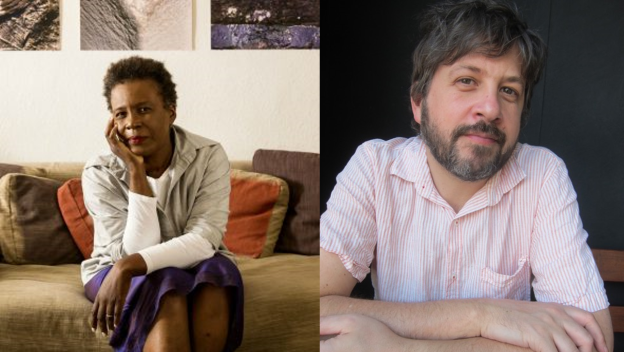
New at J2: David Naimon Interviews Claudia Rankine, 2014

This week Jacket2 published "One Side or the Other of That 'You,'" a transcript of David Naimon's 2014 Between the Covers interview with Claudia Rankine

Not surprisingly, their hour-long conversation is largely focused on Rankine's instant classic, Citizen: An American Lyric, covering the book from practically every angle: the project's inception and composition; the relationship between text and imagery within Citizen; the role of Graywolf Press in bringing her ideas to fruition; the influence of her collaborations with her husband, filmmaker John Lucas; Citizen's relationship with her previous book, Don't Let Me Be Lonely; what current events, like President Obama's birth certificate, didn't make it into the book; and the continuing resonance of the book's perspectives on American race relations, including Rankine's then-recent visit to Ferguson, MO. It's truly a fascinating listen, serving as a good introduction to the book for anyone who hasn't yet read it, while also revealing newly pertinent things about the text. 

Consider, for example, this exchange between the two, which has shocking relevance in the face of news that the COVID-19 crisis is disproportionately affecting members of the African American community:
Naimon: You mention that [questions of the legitimacy of black experience] seeps into the bodies of all blacks and this idea of the bodily experience feels very present in Citizen. You have a line, "resilience does not erase moments lived through," "the body has memory." Can you talk a little bit about the body in relationship to your poetry? 
Rankine: You know, the first question you asked me was about the origin of this book, and I said it was Serena Williams, and it was Serena Williams, but I was also very much interested in the health of people, especially black people, the rates of high blood pressure, diabetes, all of those things within the black community. So, I started out doing a lot of research on why certain diseases, obesity hit the black community so high. On a certain level, you feel like it has to be tied to trauma and has to be tied, on some level, to having to negotiate more than one should have to negotiate. Much of that material got stripped away, but it was also one of my concerns, initially.
You can read more of this revelatory interview by clicking here, and while Naimon's brilliant Between the Covers is now hosted by Tin House, we are very proud to have shared its poetry-centric programs from 2014–2017, which you can find here.


Monday, April 20, 2020

Daphne Marlatt: 'Like Light off Water: Passages from Steveston' (2008)

Today we're highlighting a recent addition to the PennSound author page for Canadian poet Daphne MarlattLike Light off Water: Passages from Steveston. Originally released on CD by Otter Bay Recordings in 2008, this album presents passages from Marlatt's beloved 1974 collaboration with photographer Robert Minden with musical embellishments written and performed by Minden and Carla Hallett. As Douglas Barbour observes, Steveston is "a carefully documented and deeply personal overview of the town in history," including its time as an internment camp for Japanese Canadians during the Second World War.

This is not the first time that Marlatt and Minden have revisited the Steveston project. The creators reconfigured the manuscript for a twenty-fifth anniversary edition, which separates the poems and photos into different portfolios, with both adding mew material. Speaking about the project as a whole, Marlatt notes, "There was something in Steveston which drew us, over and over again, and which our work attempted to enunciate — something under the backwater quiet, the river hum of comings and goings, the traffic of work, that was shouting at us to tell it." Writing in The WholeNote Magazine in 2009, Dianne Wells offered high praise for the album: "Marlatt's words bring you to the river's mouth and into a sensuous landscape of lives lived in canneries, fishing camps, on the sea and over time. Listen to the sounds of vintage waterphones, bowed carpenter’s saws, found object percussion and voice – a delicate resonance which surrounds Marlatt's poetic voicing, rhythm and imagery." She continues, hailing the music's ability to conjure up "the rippling and twinkling of water and light, together with haunting depictions of mysterious and erotic undercurrents mixed with the gentle beauty of the night sky.”

You can listen to all eight tracks — including "Imagine: A Town," "Moon," and "Intelligence (As If By Radio?" — by clicking here.


Friday, April 17, 2020

Peter Gizzi Reads from 'Now It's Dark' and 'Threshold Songs,' 2020

Not long into this new year, Peter Gizzi sat down with Charles Bernstein in Brooklyn for a recording session covering work both old and new. Today we're proud to make these recordings available on Gizzi's PennSound author page.

The first half of this set showcases thirteen poems from Gizzi's forthcoming collection, Now It's Dark, scheduled to be published by Wesleyan University Press in December of this year — a collection "concerned with grieving, with poetry and death, with beauty and sadness, with light." Titles read by Gizzi here include "Speech Acts for a Dying World," "Every Day I Want to Fly My Kite," "The Present Is Constant Elegy," "The Afterlife of Paper," "Inside Out Loud," "Last Poem," "Some Joy for Morning," along with the title poem.

In the second half, Gizzi reads selections from 2011's Threshold Songs, which, as Alan Gilbert notes, "speaks to and from the dead," having been "written in the wakes of the deaths of his mother, brother, and a close friend." Bernstein has observed that the collection "pushes against both abstraction and lyric voicing, ensnaring the close listener in an intensifying cascade of dissociative rhythms and discursive constellations." "Songs also say, saying also sings," he continues, "and what at first seems to resist song becomes song." He continues, "These enthralling, sometime soaring, poems approach, without dwelling in, elegy. They are the soundtrack of a political and cultural moment whose echoic presence Gizzi makes as viscous as the 'dark blooming surfs of winter ice.'" Some of the poems from this volume include "The Growing Edge," "Basement Song," "Analemma," "Lullaby," "Apocrypha," and "Bardo."

You can listen to these exciting new recordings by clicking here, and while you're on Gizzi's PennSound author page, don't forget to browse through the rest of our holdings, which span nearly three decades.

Wednesday, April 15, 2020

Revisiting Charles Bernstein's "Down To Write You This Poem Sat" Playlist

In 2016, the Oakville Gallery in Oakville, Ontario asked PennSound co-director Charles Bernstein to assemble a playlist of selections from the PennSound archives in conjunction with the exhibition entitled Down To Write You This Poem Sat. Oakville recently revisited the work and the playlist as part of their new online program, Salon, which is a great reason for us to do the same.

"Art and poetry share a long and rich history, from the visual poetry experiments of the modernist avant-garde to the association of the Beat Generation with artists like Andy Warhol," the gallery's website offers. "Today, this conversation continues, with artists and poets borrowing freely from one another and often active in both areas." It continues: "Down To Write You This Poem Sat brings together a number of works that move between visual forms and the written word. One of the defining features of this intersection has been the way language is increasingly loosening itself from the printed page, responding both to new technological developments and social and political change. Titled after Canadian poet bpNichol's First Screening — a collection of animated poems written for the Apple IIe computer — Down To Write You This Poem Sat explores this shift, with artists and poets readily making use of new media while drawing on the language and techniques of mass culture through film, writing, performance, and installation."

Bernstein's list is broken into Contemporary and Historical subheadings. The former includes selections from Caroline Bergvall, Christian Bök, Tonya Foster, Susan Howe, Tan Lin, Steve McCaffery, Tracie Morris, Julie Patton, Tom Raworth, Jerome Rothenberg, and Cecilia Vicuña. On the Historical list, you'll find tracks from Guillaume Apollinaire, Amiri Baraka, Louise Bennett, Sterling Brown, John Clare, Velimir Khlebnikov, Harry Partch, Leslie Scalapino, Kurt Schwitters, Gertrude Stein, William Carlos Williams, and Hannah Weiner. You can browse through the gallery's Soundcloud playlist by clicking here, while our own page for the playlist can be found here.

Monday, April 13, 2020

Congratulations to Prix Batty Weber Winner Pierre Joris

While we're congratulating PennSound poets for richly-deserved honors, we wanted to highlight wonderful recent news for Pierre Joris, who was recently named as the 2020 Lauréat du Prix Batty Weber by Luxembourg's Ministry of Culture. The nation's highest literary honor, the Batty Weber Prize has been awarded every three years since 1987. The seven-person prize jury offered this grand summation of Joris' life's work and his value to the cultural life of both Luxembourg and the world as a whole:
Pierre Joris' poetic and essayistic work is an expression of his tireless and versatile exploration of the transcendence of borders in an attempt to achieve a cosmopolitan vision. "Routes, not roots" should therefore be understood as a programmatic title that emphasises the claim of Joris' "nomad poetics" of moving between languages (English, French, German, Arabic, Luxembourgish), between literatures, and between cultures. In his poetry, he uses the seductive and experimental nature of words to weave a net of surprising juxtapositions of different literary and cultural texts (from the avant-garde, the Beat generation, Rilke, Ezra Pound, T.S. Eliot over Maghrebi literature to pop culture), which enables the reader to explore the world from its edges, to stroll through the diaspora, and to feel at home there. Joris' poetry, which postulates and expects an openness of mind, an agility of thought, and the willingness to deconstruct language, is therefore a modern answer to all forms of ideological curtailment and myopia. Joris is not just a convinced and convincing literary citizen of the world, he also takes his reader on a journey to an in-between, the nomad's true home. 
The linguistic nomad Joris is also a literary ambassador. His translation of Paul Celan's oeuvre from German into English is monumental. He has also translated from English into French and vice versa. Joris moves between the arts in his domopoetics, a series of collaborations in which he and the artist Nicole Peyrafitte combine literature, performance and visual arts. This makes him a crossover artist, a theorist of nomad art, a wordsmith and an optimistic utopian, who believes in the magic of language and who invigorates it — in times of rising nationalisms, Joris responds to insularity with the affirmation of mutual respect and dialogue.
Given the diversity of Joris' creative and critical output, it's no surprise that his PennSound author page is home to a broad array of recordings spanning nearly a quarter century, from readings from his own poetry, discussions of his work as both translator and editor, talks on many different topics — Paul Celan, Kenneth Irby, Gerrit Lansing, the Holocaust, etc. — and interviews. A great place to start is Charles Bernstein's 2005 Close Listening program with Joris, which includes a lengthy conversation between the two and a selection of his creative work. Once more, we congratulate Joris for this tremendous acknowledgment of a life's service to literature.


Thursday, April 9, 2020

Congratulations to Guggenheim Winners Metres, Teare

Today was a life-changing day for the 175 writers, scholars, artists, and scientists who were named 2020 Guggenheim Fellowship winners, and we're incredibly proud to count two PennSound poets among them: Philip Metres and Brian Teare.

Metres is the author of ten books, including Shrapnel Maps (Copper Canyon, 2020), The Sound of Listening: Poetry as Refuge and Resistance (University of Michigan, 2018), Pictures at an Exhibition (University of Akron, 2016), Sand Opera (Alice James, 2015), I Burned at the Feast: Selected Poems of Arseny Tarkovsky (Cleveland State, 2015), Compleat Catalogue of Comedic Novelties (Ugly Duckling Presse, 2014), To See the Earth (Cleveland State, 2008), and Behind the Lines: War Resistance on the American Homefront (University of Iowa 2007). His work — poetry, translation, essays, and criticism — has garnered a Lannan fellowship, two NEA fellowships, six Ohio Arts Council Grants, the Hunt Prize, the Adrienne Rich Award, three Arab American Book Awards, the Watson Fellowship, the Lyric Poetry Prize, and the Cleveland Arts Prize. Metres has been called "one of the essential poets of our time," whose work is "beautiful, powerful, magnetically original." His poems have been translated into Arabic, Farsi, Polish, Russian, and Tamil. He is professor of English and director of the Peace, Justice, and Human Rights program at John Carroll University. He lives with his family in Cleveland, Ohio. His PennSound author page is home to a number of brief recordings and videos, along with a 2015 reading at Xavier University and a session for From the Fishouse.

Teare's most recent book, Doomstead Days, offers a series of walking meditations on our complicity with climate crisis. His poems document the interdependence of human and environmental health and use fieldwork and archival research to situate chronic illness within bioregional and industrial histories. As the New York Times noted, "Teare's voices let us weigh the insoluble questions of how to live as an ethical being in the face of violence and environmental collapse." Longlisted for the National Book Award, Doomstead Days was also a finalist for the National Book Critics Circle, Kingsley Tufts, and Lambda Literary Awards. Teare is the author of five previous books, including Pleasure, Companion Grasses, and The Empty Form Goes All the Way to Heaven. His honors include the Brittingham Prize and Lambda Literary and Thom Gunn Awards, and fellowships from the NEA, the Pew Foundation, the American Antiquarian Society, the Headlands Center for the Arts, and the MacDowell Colony. After over a decade of teaching and writing in the San Francisco Bay Area, and eight years in Philadelphia, he's now an Associate Professor at the University of Virginia, and lives in Charlottesville, where he makes books by hand for his micropress, Albion Books. His PennSound author page includes a trio of PennSound Podcast interviews with Rachel Zolf and Brent Armendinger, along with Jaime Shearn-Coan's interview of Teare. You'll also find a trio of readings in Philadelphia and a few recordings from tribute events.

We congratulate these two outstanding poets, along with the rest of their cohort, for this tremendous achievement and are deeply honored to be able to share their work with our listeners.

Tuesday, April 7, 2020

In Memoriam: Hal Willner (1956–2020)

Late this afternoon came word that legendary New York producer Hal Willner had died from complications of COVID-19 at the age of 64. Willner spent forty years at Saturday Night Live, where he coordinated music for sketches, and produced albums for Lou Reed, Marianne Faithfull, Iggy Pop, Laurie Anderson, Jeff Buckley, Bill Frisell, Bonnie Raitt, Los Lobos, and Lucinda Williams, among many others. 

The highlights of his prolific career are numerous, and yet Willner was just as well known for passionate musical projects that were obscure, idiosyncratic, and not destined to make a lot of money, including tributes to the work of Nino Rota, Kurt Weill, Charles Mingus, Thelonious Monk, Harold Arlen, Harry Smith, and Harry Partch. This is a man, after all, who produced an album of reinterpreted songs from classic Disney films, and whose last major project was a pair of albums of "Pirate Ballads, Sea Songs & Chanteys" sung by the likes of Patti Smith, Tom Waits, Nick Cave, and Bryan Ferry. Willner approached these projects with unabashed ardor, gathering dazzlingly talented collaborators and creating truly transcendent experiences for his listeners, and he brought the same deep enthusiasm to his work with another group of artists who were obscure, idiosyncratic, and not destined to make a lot of money: poets.

Most notably, Willner had long relationships with both Allen Ginsberg  — shown above with Willner in a photo shared today by Steve Silberman — and William S. Burroughs, producing a pair of albums for each: Ginsberg's The Lion for Real (1989) and Wichita Vortex Sutra (2004), and Burroughs' Dead City Radio (1990) and Spare Ass Annie and Other Tales (1993). Both authors were no strangers to making records, but the ones they made with Willner are truly lavish affairs, their words buoyed by soundscapes woven by a diverse array of truly remarkable musicians. Also well worth highlighting is the 1997 compilation Closed on Account of Rabies: Poems and Tales of Edgar Allan Poe, where you can have the truly surreal experience of hearing Christopher Walken read "The Raven" (Abel Ferrara also reads the iconic poem on the record's second disc), and where Ed Sanders and Ken Nordine rub shoulders with Debbie Harry and Dr. John. We are very proud to be able to share two poetry-centric albums produced by Willner on our site: Bob Holman's In With the Out Crowd (1998) and Kathy Acker's Redoing Childhood (1999, which we've written about at length here on PennSound Daily).

Speaking personally, encountering those Willner-produced Ginsberg recordings as a teenager had an indelible effect upon my life, and no doubt are a big part of why I've spent the last dozen years working at PennSound. Poetry was cool, and sterile studio recordings of poetry were pretty cool as well, but then you heard the wonders Willner worked on record — take, for example, the simple elegy of "To Aunt Rose," which starts as a poignant snapshot of things past and blooms with oceanic woodwinds and rusty strings — and you knew that there was amazing potential that very few had the foresight to realize. We have already suffered many painful losses from COVID-19, and no doubt there will be many more to come, but this one hits me especially hard. It's well worth your time to connect with some of Hal Willner's brilliance, whether on PennSound or elsewhere. May he rest in peace.


From the Jacket2 Team: Publishing During the COVID-19 Crisis

Today the Jacket2 editorial team shared a new commentary post to our readers and contributors addressing the ongoing pandemic. Here's how it opens:
Like many of you, we are adapting to increased safety measures around COVID-19 at the University of Pennsylvania and other campuses. Our work here at Jacket2 will likely be delayed and/or interrupted; our publication schedule for both commentaries and J2 content at large will be slower than usual as we adapt to the global pandemic. Many of our editors are working remotely, and we will continue to curate Jacket2 as a space to convene and sustain a life in/through poetry during times of scarcity, stress, and shifting imagined communities. We remain committed to bringing you open access content when institutional access and travel for research become compromised and complicated. 
It continues, acknowledging that "this is a moment for practical, compassionate, and critical thinking," and towards that end, the team "invites queries for our commentaries section, and especially invite commentaries about poetry during times of catastrophe, global or local disasters, and crises of the neoliberal state."

From there, it goes on to highlight Jacket2 content that feels especially pertinent at this moment, including "writers contemplating illness, the disabled body, and medicalized sociality," and "resistant and incisive writing by Asian American poets, scholars, and critics in our institutions and communities," along with the fine work done by Kundiman and the Asian American Writers Workshop in the midst of this troubling time of rising hate crimes against people of Asian descent.

This brief distillation scarcely does the post justice, therefore we wholeheartedly recommend you read it in its entirety at Jacket2.

Monday, April 6, 2020

Kenneth Rexroth: New PennSound Author Page

Our latest author page — for groundbreaking San Francisco poet, translator, and editor Kenneth Rexroth — is, admittedly, somewhat modest, especially for a figure with such an outsized personality. Think of it as merely the beginning of a collection that will grow with time. For now, however, we were so excited to get permission to share Rexroth's work that we didn't want to wait to make the recordings presently in our holdings available to our listeners.

That includes Rexroth's reading of "Thou Shalt Not Kill," his paean to the late Dylan Thomas — the A side to the 1957 Fantasy LP Poetry Readings in the Cellar, with Lawrence Ferlinghetti on the B side, and accompaniment by The Cellar Jazz Quintet throughout — which runs twenty-two minutes. That's joined by a one-and-a-half minute recordings of "Climbing Milestone Mountain, August 22, 1937," for which we have no information regarding its date or location. 

In time, we hope to be able to make more recordings from this pioneering figure in the fields of both poetry-in-performance and poetry on record available. We're grateful to Bradford Morrow, who oversees the Rexroth estate, for granting us permission to share what we have, and also to Ken Knabb, who initially contacted us about the absence of a Rexroth PennSound author page, which started the process leading to the creation of one. You can listen in to the aforementioned recordings by clicking here.

Friday, April 3, 2020

Naomi Replansky in the New York Times


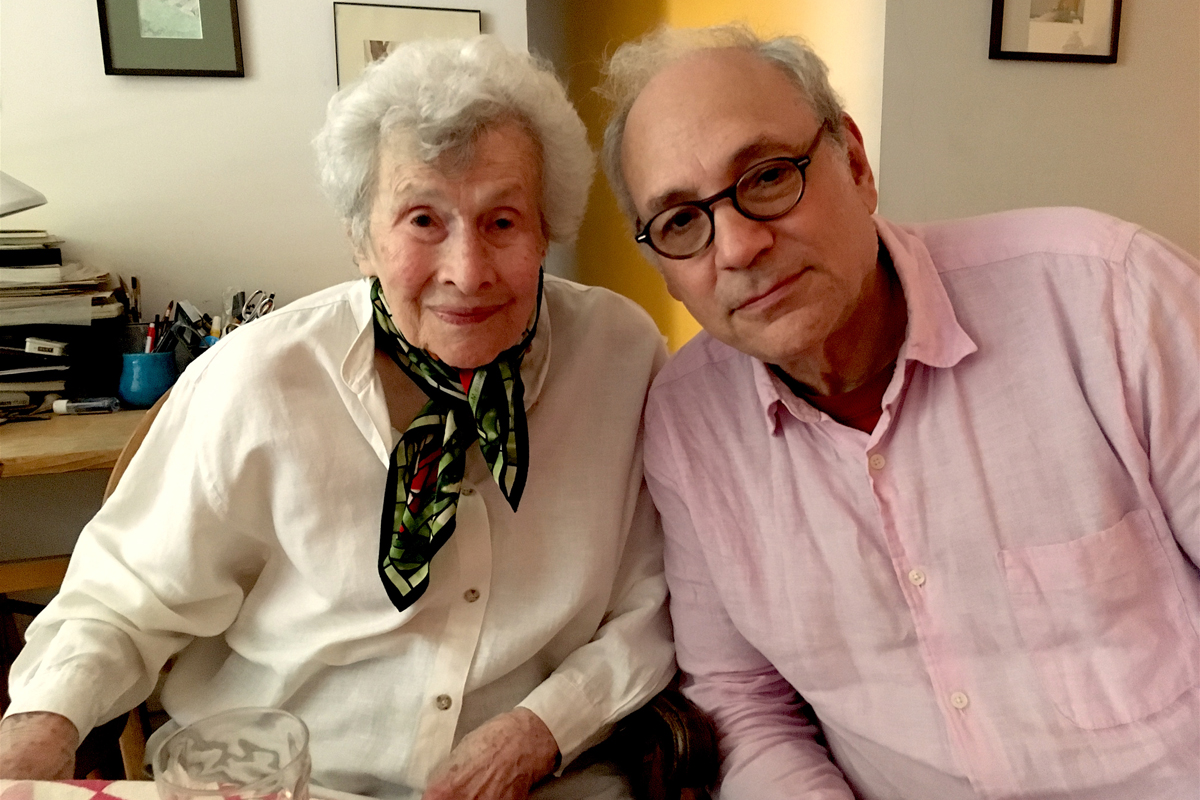
If you were browsing through The New York Times last Saturday, you might have chanced upon Ginia Bellafante's article, "They Survived the Spanish Flu, the Depression and the Holocaust," with the subhead "Two extraordinary women — one 101, the other 95 — lived through the worst of the 20th century. They have some advice for you," and noticed that one of those women was the one and only Naomi Replansky (shown at right with Charles Bernstein in 2016).

After tracing Replansky's early life through the context of public health emergencies caused by the Spanish flu, typhoid, and polio, it brings us back to the present, where, amidst New Yorkers worries about COVID-19, "Naomi and her 95-year-old wife, Eva Kollisch, were at home in their one-bedroom apartment on the Upper West Side, listening to Marian Anderson on vinyl." "They were not unsettled," Bellafante tells us, quoting an e-mail from the poet: "Confinement doesn't bother me. My shaky frame can handle more confinement." From there, it traces their long relationship, with Grace Paley serving as matchmaker, and their lifelong struggles with anti-Semitism, before closing with an optimistic perspective via Replansky's poem, "Ring Song": "When I live from hand to hand /Nude in the marketplace I stand. / When I stand and am not sold / I build a fire against the cold. / When the cold does not destroy / I leap from ambush on my joy."

It's truly a wonderful article, well worth your time, and similarly a great opportunity for us to remind our listeners of the equally wonderful recordings that we're proud to host on our Naomi Replansky author page. Chief among them is an April 2016 Close Listening program featuring both Bernstein and Al Filreis as interlocutors, which nicely complements Replansky's November 2016 reading at our own Kelly Writers House. There's also a 2017 recording of Replansky reading Grace Paley's poetry at Brooklyn's Books Are Magic, a lengthy 2015 session where she reads a total of thirty-seven titles from her 2012 Black Sparrow Collected Poems, a pair of sessions set at the home of Marcia Eckert and Tom Haller in 2014 and 2015, where she reads from the same volume, along with a 2015 set made at on the same date where she reads a selection of twenty-two favorite poems by others including Shakespeare, Blake, Hopkins, Stevens, Yeats, Dickinson, and Celan. Our collection is rounded out by a 2012 reading at New York's Poets House and a 2009 session for the magazine Lilith, as well as a link to PoemTalk #111, where Filreis, Bernstein, Ron Silliman, and Rachel Zolf discuss two of Replansky's poems. You can listen to all of the aforementioned recordings by clicking here.


Thursday, April 2, 2020

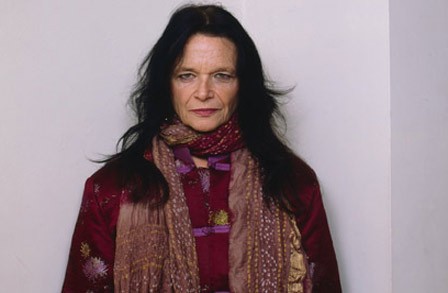
Happy 75th Birthday to Anne Waldman

Today we're celebrating a major milestone for one of the most vital forces in contemporary poetry: Anne Waldman, who turns seventy-five today! Where does one start to appreciate the indelible influence Waldman has had upon our aesthetic community? Her prolific poetic output over the last half-century, which, while always evolving, still feels immediately and unmistakably recognizable? Her tireless work as an editor for Angel Hair and United Artists up to her present guidance of Fast Speaking Music? Her fostering presence as an early Artistic Director of the St. Mark's Poetry Project and her co-founding of Naropa University's Jack Kerouac School of Disembodied Poetics? For me, it all started with Paul Carroll's 1968 anthology, The Young American Poets, which I stumbled upon while browsing the stacks as an undergrad many, many years ago. Since then, I've been happy to follow Waldman wherever she may lead, and if we were luck enough to have another seventy-five years with her, I'm sure she'd do nothing less than constant amaze us.

PennSound's Anne Waldman author page provides a thorough survey of the poet's long and fruitful career, provides a thorough survey, with recordings from 1969 ("Three Minutes of My Life" from the LP anthology Tape Poems) all the way up to a 2017 reading at the Dia Art Foundation. There are numerous full readings for Belladonna*, the Bowery Poetry Club, the Naropa Institute, the Sue Scott Gallery, the CUNY Graduate Center, Zinc Bar, the St. Mark's Poetry Project, and our own Kelly Writers House, along with a number of complete album releases and myriad individual tracks, talks, radio interviews, films, and more. There's no better way to celebrate this legendary poet on her birthday than to share some of her work. Click here to start browsing and listening!