PennSound's author page for
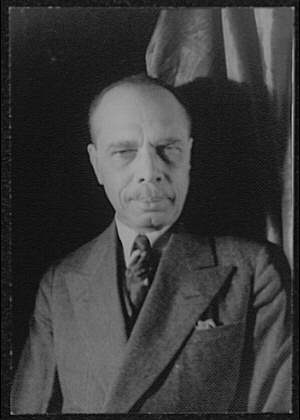
James Weldon Johnson — a key figure in the Harlem Renaissance and former leader of the NAACP — is edited by Chris Mustazza, building upon his archival research. Here's his description of the project:
These recordings of James Weldon Johnson were made on December 24, 1935 at Columbia University and are part of a larger collection of recordings known as The Contemporary Poets Series. Johnson is the only African American poet in the series, which ran from 1931 through the 1940s. The addition of the Johnson recordings to PennSound is crucial for a number of reasons, one of them being the function of Johnson's poetry as an ethnographic preservation of culture through the transduction of the sounds of language.
The first two recordings in the collection, "The Creation" and "Go Down Death," both from Johnson's 1927 collection God's Trombones, seek to preserve the sounds of African American folk sermons of the early 20th century. Johnson's poetics in the introduction to God's Trombones speaks extensively about how these poems are a visual representation of the sounds of the preachers of the sermons, a kind of musical score and libretto. He works to represent the cadences of these dynamic sermons through punctuation and lineation, with em-dashes representing a pause longer than a comma, and line breaks an even longer pause. In this regard, Johnson's work serves as a kind of proto-Projective Verse: he scores these poems for sonic representation. As such, the addition of the recordings to PennSound allows us to hear firsthand the poems as Johnson heard them when he composed them. And, in doing so, Johnson's vision of preserving the sounds and cultural significance of these sermons for posterity is realized.
The poems from Johnson's 1917 collection of poems, Fifty Years and Other Poems, are also sonic representations and cultural preservations. For example, Johnson's use of dialect poetry in some of the poems is a representation of speech sounds. By the time of these recordings, Johnson had spent a significant amount of time thinking about the aesthetic effects of writing dialect poetry, during which time he renounced the practice, and here returns to it (perhaps after being convinced of the the value of dialect poetry by Sterling A. Browns's 1932 collection of poetry, Southern Road). Johnson deftly uses dialect to great aesthetic effect, especially in "Sence You Went Away," a poem that creates a slippage between the dialect for "since" and the sound of "sense" (i.e. which could be read as "Sense, you went away"). Here, too, Johnson's poetry and poetics prefigure aesthetic movements of the later 20th century.
This very important collection is publicly available here in PennSound for the first time ever. For this, we thank Jill Rosenberg Jones and the James Weldon Johnson estate for their permission to distribute the recordings, as well as the staff at the Columbia University Rare Book and Manuscript Library for their assistance in digitizing these materials. Thanks, too, to the Penn Digital Humanities Forum for supporting a project that made these digitizations possible. I hope you will enjoy listening to these recordings.


:format(jpeg):mode_rgb():quality(90)/discogs-images/R-2529703-1289069028.jpeg.jpg)





.png)
