Monday, March 31, 2025

PennSound Marks International Transgender Day of Visibility

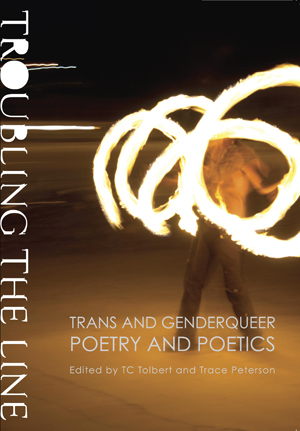
Today we proudly celebrate International Transgender Day of Visibility by revisiting two launch readings for TC Tolbert and Trace Peterson's germinal anthology Troubling the Line: Trans and Genderqueer Poetry and Poetics (Nightboat Books, 2013), which we added to our site last fall.

Hailed as the first collection of its kind, Troubling the Line was — as Matthew Cheney noted in rain taxi — "big and vehemently eclectic," in order that "the diversity of writers and poems across its pages is animated by such a rich diversity of identities that generalizing about them becomes impossible." Stacey Balkun, writing for the University of Arizona Poetry Center's blog 1508, echoes this sentiment. She singles out Peterson's framing of the book as "'an opening gesture to provoke what TC and [she] both hope will be a long and productive conversation' about genderqueer poetics" and praises its open-ended curation, saying of Peterson's introduction:
She rejects definition, proving instead how genderqueer poetics is no one thing (except that it's definitely not binary). Rather than set out to rigidly delineate the term genderqueer, Peterson offers us a refreshing sense of possibility. She discusses how the editors chose trans and genderqueer as "the most inclusive umbrella terms" they could find to describe "lived identities that challenge gender norms," building bridges between rather than walls around the terminologies of identity.
The earlier of these events was held on May 8, 2013 at New York's Bureau of General Services—Queer Division and ran over two hours, including sets by Peterson, Ariel Goldberg, Ely Shipley, Aimee Herman, Jake Pam Dick, Maxe Crandall, Joy Ladin, Jamie Shearn Coan, Eileen Myles (reading John Wieners as well as their own work), and Kit Yan. The latter, which took place at the St. Mark's Poetry Project on December 11th of the same year, featured Ching-in Chen, Joy Ladin, Jaime Shearn Coan, Julian Talamantez BrolaskiDawn Lundy MartinSamuel AceTrish SalahZoe Tuck, and Emerson Whitney along with Raymond Foye reading John Wieners and Peterson reading both reading kari edwards (as well as her own work). Click here to start exploring.

Friday, March 28, 2025

PoemTalk #206: on Lewis Warsh's "Polar Night"

Yesterday saw the release of the newest episode in the PoemTalk Podcast series, which focuses on Lewis Warsh's poem "Polar Night," taken from a 2008 reading as part of the Chapter and Verse series at at Chapterhouse CafĂ© in Philadelphia. Joining host Al Filreis for this program are (from left to right) Anselm Berrigan, Kate Colby, and Laynie Browne.

Filreis begins his program notes at Jacket2, by discussing the provenance of both the poem and its recording: "The poem was published in the poetry collection Alien Abduction in 2015. (This was his first book of poems since Inseparable of 2008, so we assume 'Polar Night' was written around then but not in time to be included in the 2008 book.)" He then frames the program through that collection, noting "Our discussion of the poem aligns well with a comment made by Dorothea Lasky about Alien Abduction as a whole: 'Warsh listens closely to everything, and in this book we find the mix of everything that makes up life... In it too we find a life that is always strange because it is living and constantly changing.'" 

You can listen to this latest program, listen to and read and the poem, and learn more about the show here. PoemTalk is a joint production of PennSound and the Poetry Foundation, aided by the generous support of Nathan and Elizabeth Leight. Browse the full PoemTalk archives, spanning more than two hundred episodes, by clicking here.

Wednesday, March 26, 2025

David Shapiro on PennSound

In light of last week's cowardice on the part of Columbia University, we thought it might be worthwhile to remember another historic moment when the school's student body needed to serve as a moral compass for a wayward administration: namely the 1968 campus occupation, during which beloved poet David Shapiro —  famously pictured at right sitting at the desk of university president Grayson L. Kirk, smoking one of his cigars.

A precocious and prolific polymath, Shapiro first hit the cultural scene as a teenager, working as a professional violinist with several orchestras and publishing his first work in Poetry at the age of sixteen. That infamous photo was taken during the end of the first of three tenures at Columbia: he earned his BA in 1968, returned for a Ph.D. in 1973, and eventually joined the faculty. Beyond his own poetry, Shapiro published both art and literary criticism, along with work as a translator and editor (perhaps most notably, An Anthology of New York Poets with Ron Padgett). His influence was felt widely and he will be missed by many.

We direct listeners to Shapiro's PennSound author page, where you can browse a small collection of more recent recordings, including a pair of Segue Series events and a reading for Dia Art Foundation, and a 1976 ten-year memorial for Frank O'Hara at the Poetry Project, which also featured Joe LeSeuer, Patsy Southgate, Jane Freilicher (reading James Schuyler), Anne Waldman as MC, Kenneth Koch (reading "Awake in Spain"), Carter Ratcliffe, Tony Towle, Patsy Southgate, and Peter Schjedahl. Our most recent addition to the page, sent to us by Peter Gizzi after Shapiro's passing, is a pair of recordings from a 2004 visit to UMass Amherst, which includes both a talk on painters Fairfield Porter and Jasper Johns and a lengthy reading. Click here to start exploring.

Monday, March 24, 2025

Kristin Prevallet and Steven Brent, "What She Said" (2018)

Here's a fascinating performance from Kristin Prevallet for your listening pleasure: a 2017 collaboration with musician Steven Brent, titled "What She Said," which first appeared on Brent's 2018 album, Even the Failures Are Beautiful, which you can listen to in its entirety here.

In "What She Said," Prevallet presents us with a lengthy inventory of questions asked of an unnamed "she," which casts a wide net, encompassing all manner of somatic and psychological experience, and occasionally folds back on itself, before evolving into a more objective narrative in the final section. It's undergirded by Brent's subtle soundscape, which blends a foundation of menacing drones, atonal guitar chime, and orchestral gravity with periodic overlays of ticking typewriters and threshing clacks, and Prevallet's performance here is just as musical and important, wavering from sedate calm to a more fervent delivery, sometimes speaking naturalistically and other times veering into stop-start Creeley-style hesitations, which interact beautifully with the sounds around it. Click here to listen now. It will be nine and a half minutes well spent.


Friday, March 21, 2025

Henry Hills and Sally Silvers: 'Little Lieutenant,' 1994

PennSound has been very happy to host work by filmmaker Henry Hills since our launch. Today we're focusing on one particularly interesting work from his complete filmography: Little Lieutenant, a 1994 collaboration with choreographer and co-director Sally Silvers. 

Here is how Hills summarizes the film on his website:
Little Lieutenant is a look back at the late Weimar era with its struggles and celebrations leading up to world war, a period piece. Scored to John Zorn's arrangement of the Kurt Weill song, "Little Lieutenant of the Loving God", and drawing its imagery both from the original song and its somewhat idiosyncratic rearrangement, the film presents an internal reading of Silvers' solo scored to the same musical piece, "Along the Skid Mark of Recorded History". 
Closely following the Zorn arrangement, the film was storyboarded in 30 scenes (the arrangement changes approximately every 4 measures) and principally shot in a small studio employing rear screen projection, with foreground movement choreographed to interact with the projected imagery which reflects themes apparent in the song and its arrangement (Weimar cabaret scenes, labor footage, empty industrial landscapes, water, slides of moody photographs by James Casebere, a kinescope of Silvers' performance of the solo at the Joyce Theatre, battle newsreels, Walther Ruttmann's film Berlin: Symphony of a Great City, and a restructured animation, The Youth Machine). Scenes range through a Citizen Kane-esque pan up a forboding structure, idyllic lovers in both pastoral and industrial settings, labor marches, a lonely walk down a deserted alley, a bar brawl, a Motown-ish girl group, a dream sequence, and a giddy animation, up to the terrors of war and a bittersweet conclusion: an elaborate music video.

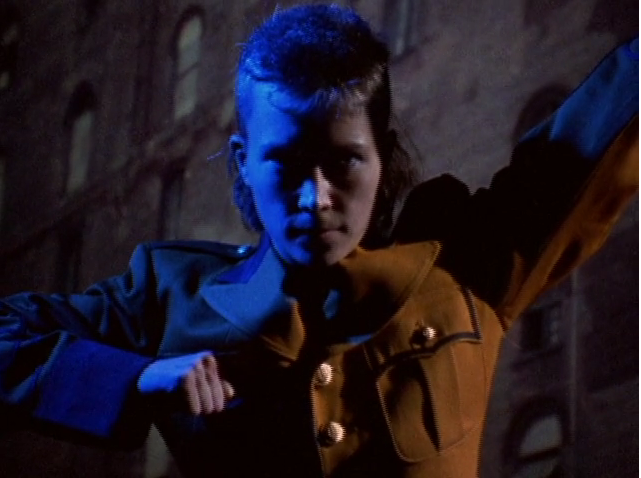
Silvers and Cydney Wilkes portray dual aspects of the Salvation Army Lieutenant who sang the song in the Brecht/Weill play “Happy End”, with Kumiko Kimoto and Leonard Cruz as the lovers and Pilar Alamo and Toby Vann filling out the group. The film was conceived by Zorn, Silvers, and Hills, co-directed by Silvers and Hills, choreographed by Silvers, shot and edited by Hills, and funded by a grant from the NEA Dance Program, with assistance from the Segue Foundation and the loan of a rear screen by Ken Jacobs.  

On that same page you can also see Zorn's score and read "Catalysts: Little Lieutenant," a scene-by-scene explication of the film. To watch this film, and many more Hills works from throughout his career, visit PennSound's Henry Hills author page.

Friday, March 14, 2025

Ed Sanders on PennSound

We bring this week to a close by shining the spotlight on our author page for legendary poet, publisher, and provocateur Ed Sanders, which is home to a modest collection of recordings spanning more than fifty years.

The earliest of these is a brief document of Sanders' contributions to the Berkeley Poetry Conference in 1965: some comments on his anti-war activism and the poem "Cemetery Hill." We jump forward to 1997, we have a forty-five minute reading by Sanders at the New York State Writers Institute in Albany, and leap again into the 21st century for the final four recordings.

The first of these is the 2003 short film Perf-Pro, which documents a performance and conversation with Beat scholar Kurt Hemmer at Harper College. Next there's a 2013 event at which Sanders and the Fugs pay tribute to their fallen member, Tuli Kupferberg, and a 2018 reading at the Artists Collective in Kingston, NY. Finally, Sanders' brief set from the 2019 opening of his Glyph Show, at Mothership in Woodstock, NY rounds out the page. We're grateful to Chris Funkhouser who shared many of these recordings with us. Click here to start exploring.

Tuesday, March 11, 2025

Happy Birthday, Joe Brainard

Today we celebrate endlessly influential author and artist Joe Brainard, born on this day in 1942. Our Joe Brainard author page is anchored by four readings from the St. Mark's Poetry Project recorded between 1971 and 1981. They include copious excerpts from his magnum opus, I Remember, along with selections from his journals and numerous other pieces such as "Thanksgiving," "Insomnia," "Worry Wart," "The Zucchini Problem," "Today (Monday, February 23rd, 1981)," and "Sick Art." Additionally, you'll find excerpts from Train Ride read at SFSU in the mid-1970s and a stellar reading with Bill Berkson at Intersection for the Arts in 1971, plus more I Remember selections taken from a 1974 Giorno Poetry Systems session and a recording session at home in Calais, VT in 1970. 

Filmmaker Matt Wolf (who directed the much-lauded Wild Combination, a documentary on the life of avant-pop cellist Arthur Russell) is back with an exciting new project — I Remember: A Film About Joe Brainard — a haunting and gorgeous meditation that deftly intertwines both imagery and audio to create a compelling tribute to the artist and author. We're very glad to see Brainard commemorated in such grand fashion, and happier still that Wolf was was kind enough to share an exclusive clip with PennSound. In it, longtime friend, collaborator and confidante Ron Padgett discusses Brainard's early development as a visual artist and his ability to work confidently in a wide variety of media and forms, never becoming complacent in one style.
You'll find all of the recordings mentioned above by clicking here. It's also worth checking out Andrew Epstein's 2014 Brainard birthday post on his New York School-focused blog, Locus Solus, which features excerpts from a tribute poem by James Schuyler, excerpts from I Remember "thinking about birthdays, and our frustrating efforts to understand 'time,'" and a few examples of his artwork. Brainard's birthday is also a wonderful reason to revisit the Make Your Own Brainard site, where you can make your own collages using fragments from his visual work.

Monday, March 10, 2025

Haraldo de Campos on PennSound

Today we're highlighting our author page for poesia concreta pioneer, Haroldo de Campos, which is anchored by a 2002 video from the Guggenheim Museum celebrating his life and work. Presented in conjunction with the exhibition Brazil: Body and Soul, this January 12, 2002 event featured both performances and discussion of de Campos' work by a wide variety of poets, translators and critics.

The video begins with introductory comments by Pablo Helguera and organizer Sergio Bessa, who are followed by a staging of de Campos' 1950 poem/play "Auto do Possesso (Act of the Possessed)," translated by Odile Cisneros and directed by Cynthia Croot. Craig Dworkin is next, reading his translation of "Signantia quasi coelum / signância quase cĂ©u," follwed by a brief set by Cisneros, who reads her translations. The performances conclude with Marjorie Perloff and Charles Bernstein reading Bessa's translation of "Finismundo," after which Perloff and Bernstein take part in a panel discussion moderated by Bessa.

Next, from 2005's Rattapallax we have a single track, "Calcas Cor de Abobora." Finally, we have a 2017 video of our own Charles Bernstein performing at New York's Hauser and Wirth Gallery with Sergio Bessa on September 28, 2017. This event, co-sponsored by the Poetry Society of America and held in conjunction with an exhibit by Mira Schendel at the gallery, included Bessa speaking about de Campos and Bernstein reading his translations of Drummond, Cabral, Cruz e Sousa, Leminksi, and Bonvicino.

On our Haroldo de Campos author page, you'll also find a link to Bernstein's 2003 essay "De Campos Thou Art Translated (Knot)", first published in the Poetry Society of America's Crosscurrents.

Friday, March 7, 2025

Alan Bernheimer, 'Particle Arms' (1982)

Today, we shine the spotlight on Alan Bernheimer's play, Particle Arms, which was performed November 21, 1982 as part of the Poets Theatre at Studio Eremos in San Francisco. Particle Arms features a vertible who's who of Bay Area poetics, including cast members Steve Benson, Tom Mandel, Kit Robinson, Eileen Corder, and Steven Rodefer, set designer Johanna Drucker, and even Lyn Hejinian, who wrote the play's program.

The play lives up to its description, as "tracing the trajectory of two men and a woman over an Edward Hopper hotelscape, peopled by psychological misfits, to an economy dependent on stunt work," dabbling in noir delights and failed romance with hilarious results, however Particle Arms is not just great entertainment, but also an evocative time capsule of a close-knit community of friends and artists — as evidenced by the "experiment in collective autobiography," The Grand Piano, which features many of these poets and their contemporaries.

In addition to Particle ArmsBernheimer's PennSound author page features links to twenty episodes of the influential radio program, In the American Tree, hosted by the poet during the show's 1979-1980 season — including interviews with Ted Greenwald, Erica Hunt, and Bill Berkson, among others — as well as his own November 10, 1978 appearance on the show, as Hejinian and Robinson's guest. There's also a 2001 reading from the St. Mark's Poetry Project and the 1980 talk "Subject Matter" from the New Langton Arts Center. Listeners might also want to check out Bernheimer's collection of photos and documents from the production of Particle Arms, which is linked on the page as well. Click here to start exploring.

Wednesday, March 5, 2025

Spending "Ash Wednesday" with T. S. Eliot

With Christians worldwide marking Ash Wednesday today, we thought it might be worthwhile to revisit T. S. Eliot's iconic poem of the same name, which is available on PennSound two ways: a recording by the poet himself, and a rendition by John Richetti made for our PennSound Classics page.

In a 2014 essay for The Guardian, Roz Kaveney identifies the poem as one of "the first fruits of T. S. Eliot's conversion [to Anglicanism]" and acknowledges that "we think of ["Ash Wednesday"], not wholly inaccurately, as an essentially liturgical piece ... Yet that is not all that is going on here." "For a religious poem," Kaveney continues, "'Ash Wednesday' has a distinctly secular aspect some of the time. Even more than 'The Waste Land,' it is heavily intertextual; you can read its allusions as metonymous, that is to say as bringing into his text the whole of the texts that they echo." Much of the poem is shaped by Eliot's stagnant marriage to Vivienne, the poem's dedicatee, producing "moments of nightmare" full of guilt, disorder, and sinfulness. "It's interesting that there is so much talk of fertility here and it is always gardens and never children," Kaveney notes, hypothesizing that Eliot was sublimating his desire for a daughter within the poem: "There is something deeply sad, but also dishonest, in this replacement of what he perhaps really desired with an etiolated and inauthentic religious vision; Eliot at his best speaks more honestly than that, even when he is being cryptic."

As for that "call to spiritual awareness" in the poem's latter half, Kaveney observes that "There's something worrying, if logical, about Eliot's vision of himself as a preacher calling the world to order — it was after all, the original family business, running revivals was why his ancestors moved to the Midwest. The problem is that the organic society he shows us is so totally a decoration, people walking and talking in a landscape, and a piper playing plaintive tunes; in the later sections of 'Ash Wednesday,' the quotations of liturgy are progressively stronger than the bits that are Eliot." The critic concludes, "This is a poem – the same can be said of Dante – in which the visions of hell are stronger than the visions of heaven, in which the original evocation of the heavenly ... is much more effective than the later parts; Eliot is trying urgently to convince us, and sacrificing much to that attempt, and yet he falls short of what he is trying to do."

As noted above, our archives include a recording of Eliot reading the poem in three segments, each containing two parts, which was made at the Speech Lab at Columbia University in 1933, the first of several sessions over two years that would yield documents of the majority of Eliot's most iconic poems. You can listen to that recording here on PennSound's T. S. Eliot author page. We also have a recording made by John Richetti for PennSound Classics at our own Wexler Studios in May 2022 as part of a set of twenty-nine poems by Eliot. Listen to that performance by clicking here.

Monday, March 3, 2025

David Antin: "Sky Poem #1" (1987)

Today we're revisiting video documentation of "Sky Poem #1," staged by David Antin in Santa Monica, CA during May 1987.

The latter half of the video is largely taken up with an interview with Antin, who discusses the his impressions of the piece's execution and his plans for further poems in the series, as well as the relationship between this sort of poem and his talk pieces. "In a way, even if the text of this is fixed, I had to write a text that wouldn't be so fixed," he explains, "it wasn't fixed, because one line goes away, and then another one goes away and no one is quite sure of exactly what it refers to, and has a family of possible things it could refer to, all of which are interesting: who are we? who are they? what is it we get together? what is it that could fall apart of be taken apart? and what is it we could lose?" 

Given the importance of ambiguity to the piece's interpretation, it's particularly interesting to be able to hear the responses of so many spectators (one personal favorite: "Corinne, it's a poem! Come here, I have to tell you about this. It's a poem and the poet is the man up on the roof and he is conducting the airplanes, and it's an eighteen-minute piece so we have to stay here and we can't talk."). "There were probably hundreds of different texts that people generated out of what I did because it was stimulating other people to come up with their own versions," he observes "so a lot of different poems got written today."

You can watch this video on PennSound's David Antin author page, which is home to forty years' worth of recordings, by clicking here.