Last Friday saw the launch of a truly astounding feature at
Jacket2:
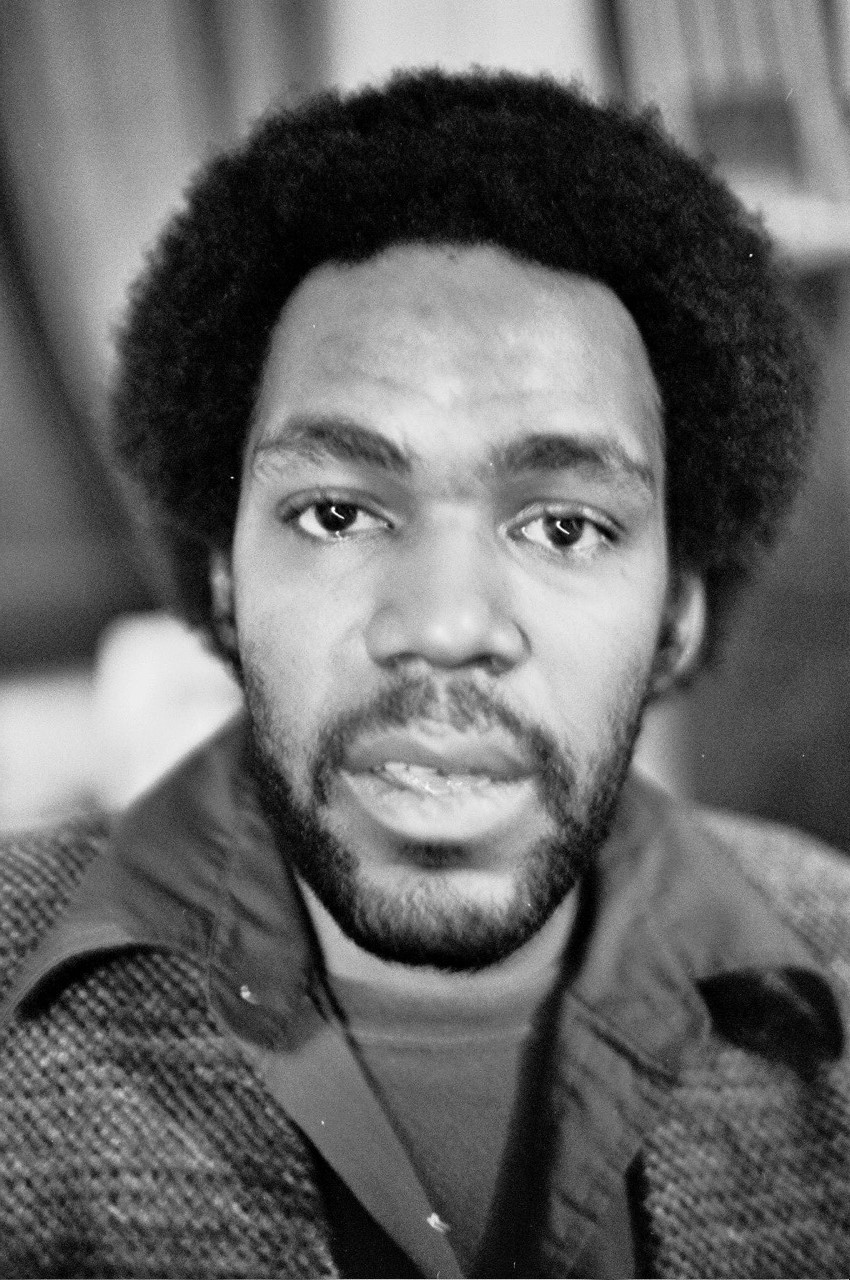
"A Short History of Tom Weatherly," lovingly edited by David Grundy. Here's how he begins his introductory note:
We're familiar by now with the designation of neglected writers as "poets' poets" — essentially, an excuse for their continuing neglect. And we are, or should be, even more familiar with the neglect heaped on African American innovative writers, especially those who refuse to be easily pigeonholed into secure ideological or formal categories. Thomas Elias Weatherly (1942–2014) fits both categories. Since his death, on July 15, 2014, his work has continued to occupy the cracks, lost in the shadows, just another one of the ghosts of American poetry. It shouldn't be this way. Born in Scottsboro, Alabama, in 1942, Weatherly turned to poetry at the age of eight after seeing a vision of Homer, who instructed him to become a "wekwom teks," or "weaver of words." This experience inspired his first poem: "It did seem / That he said / Sing until dead." Weatherly would heed this call throughout his life.
What follows an unstinting, encyclopedic justification of his estimation of Weatherly's importance. Grundy has gathered, very nearly, everything written about or by Weatherly over his thirty-five year writing life. That includes the complete text of his long out-of-print books
Maumau American Cantos (Corinth Books, 1970) and
Thumbprint (Telegraph Books, 1971), along with his joint publication with Ken Bluford,
Climate/Stream (Middle Earth Books, 1972), selections from the still in-print
Short History of the Saxophone (Groundwater Press, 2006), and a lavish selection of uncollected poetry from his earliest mature poems to what's likely the last poem written before his death in 2014. A selection of critical writings is included as well, most notably his introduction to
Natural Process (Hill and Wang, 1970) — an important anthology of African American poetry co-edited with Ted Wilentz — and "Black Oral Poetry in America: An Open Letter," published in
Alcheringa in 1971. In fact, our
Jacket2 Reissues copy of that issue of Alcheringa was missing one page, naturally in the midst of Weatherly's essay, and Grundy was able to get us a scan to complete our archive.
All of the aforementioned materials would be, in and of themselves, would be more than a worthy tribute to Weatherly's talents and a delight for readers. They are, however, merely one part of the overall feature. Once again, I'll let Grundy explain:
Forming a companion to this work by Weatherly is a series of longer critical essays and shorter tributes. Burt Kimmelman's essay on Weatherly, "The Blues, Tom Weatherly, and the American Canon," shows Weatherly as a blues poet par excellence, carefully tracing his emergence in the New York poetry scene, the importance of his Southern background, and the technical innovations of his work. Ken Bluford's "Essay with Tom Weatherly in It," first published alongside Weatherly's work in Lip magazine in 1970, further points out how Weatherly's use of Southern vernacular traditions both sets him alongside and contrasts him to better-known poets of the Black Arts Movement. My own essay focuses on Weatherly's first book, the Maumau American Cantos, concentrating on Weatherly's writing of the American South and his figurations of sexuality. The piece by Evelyn Hoard Roberts reprinted from the Dictionary of Literary Biography provides a detailed and invaluable biographical overview of Weatherly's early career.
The shorter tributes he mentions are part of a third sub-section containing all sorts of fascinating ephemera: " fond reminiscences, poems, and obituaries from Akua Lezli Hope, Eugene Richie, Janet Rosen, Aram Saroyan, M. G. Stephens, Rosanne Wasserman, and the late John Ashbery," along with contemporaneous reviews of his work, examples of the poets own "illuminated manuscripts," and a whole slew of audio-visual materials. That includes a newly-unearthed 1968 reading at the St. Mark's Poetry Project that, along with a 1971 reading in Grand Valley, Michigan, can be found on
PennSound's new Tom Weatherly author page. When
we first added the 1971 recording, not long after Weatherly's death, Charles Bernstein offered this summation of its contents: "Weatherly reads the complete serial poem 'Mau Mau American Cantos' for the first ten minutes of the reading ... after that he reads various poems, including 'Lady Fox' from
Thumprint but nothing else from that book or
Mau Mau." He also hailed Weatherly's work as "powerful, brilliant, often volatile (and distressingly unacknowledged)." Well, now you certainly have the opportunity to evaluate his judgment.
We've had the privilege of publishing some truly groundbreaking work at
Jacket2 over the years, and this is definitely one of the projects I'm most proud of. Start reading now by clicking
here.