Wednesday, November 29, 2023

PoemTalk #190: on Aldon Nielsen's "Tray"

We just released the latest episode in the PoemTalk Podcast series, and it's a rare one in which the poet under discussion is part of the panel. At right, you'll see the knock-out trio of Aldon NielenTyrone Williams, and William J. Harris assembled by host Al Filreis to discuss Nielsen's "Tray," from his collection of the same name. Not quit as rare for PoemTalk, but still quite special: this episode was also recorded life in front of an audience at the Kelly Writers Houses' Arts Café.

In his write-up of this new episode on Jacket2, Filreis explains the overall structure of the poem as well as the specific sections covered in this show: "There are 29 sections in the poem; the group discussed the first 6. In the book titled Tray, published by Make Now Press in 2017, the title poem takes up the first 37 pages; the sections we discussed run to page 14." He also notes that, "Usually, of course, we play an audio recording of the poem from we're about to discuss as archived in PennSound, but on this day, because we had the honor of Aldon's presence we asked him to perform those sections."

You can listen to this latest program and learn more about the show here. PoemTalk is a joint production of PennSound and the Poetry Foundation, aided by the generous support of Nathan and Elizabeth Leight. Browse the full PoemTalk archives, spanning more than a decade, by clicking here.

Tuesday, November 28, 2023

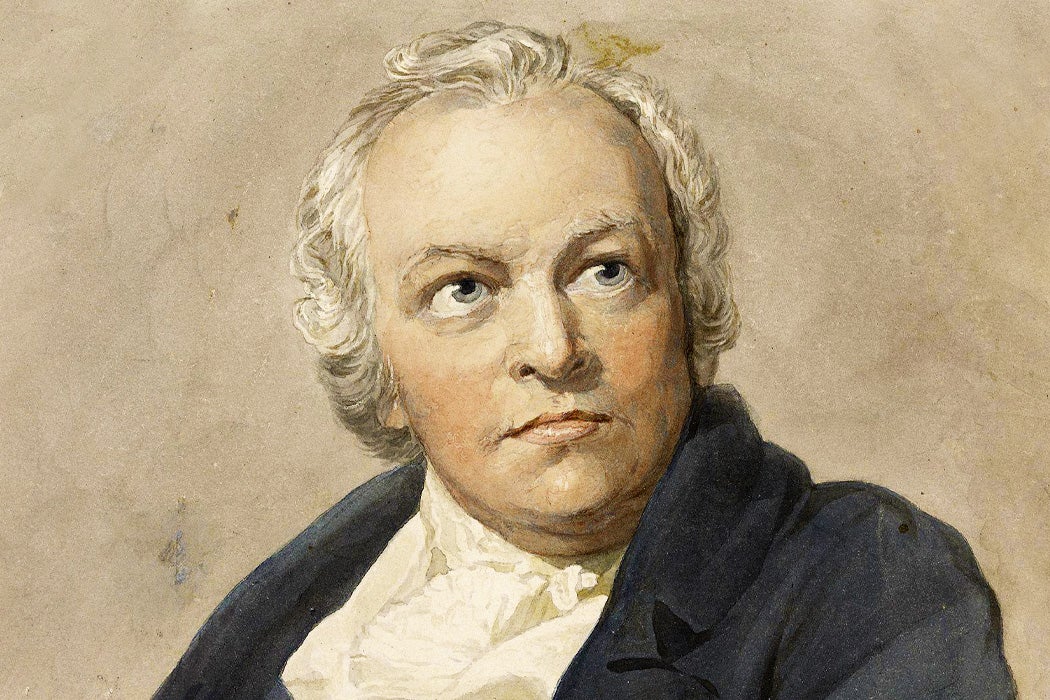
Happy Birthday William Blake

Today would have been the 256th birthday of visionary British poet William Blake, whose work continues to captivate audiences almost two centuries after his death. While recording technology did not exist during Blake's lifetime, PennSound is proud to be home to a recently-revamped William Blake author page, that collects a wide array of performances of the poet's work from throughout the archives.

The centerpiece of our Blake page is Allen  Ginsberg's groundbreaking 1970 album, Songs of Innocence and Experience by William Blake, tuned by Allen Ginsberg, which features an all-star roster of jazz sessionmen (including Don Cherry, Elvin Jones and Bob Dorough) providing an engaging and wide-ranging musical accompaniment for Ginsberg and Peter Orlovsky's vocals. The album's twenty-one tracks consist of more or less equal samplings from both volumes, and we've provided links to images of each page of text from Blake's illuminated manuscripts, as archived on the William Blake Archive. An assortment of recordings of Ginsberg performing Blake poems at readings from the 70s through to the 90s complements this classic LP.

Ginsberg's performance of "The Garden of Love" (from Songs of Experience) was the subject of PoemTalk Podcast #4 — featuring a panel of Al Filreis, Charles Bernstein, Rachel Blau DuPlessis and Jessica Lowenthal — and Ginsberg's great friend and Jack Kerouac School of Disembodied Poetics co-founder, Anne Waldman, performed her own version of this setting on her 2002 album By the Side of the Road. Bernstein too has a pair of recordings here: The Grey Monk" (originally recorded for the Romantic Circles website) and "The Sick Rose" (edited from his montaged set from the Kelly Writers House event celebrating the release of Poets for the Millennium, Vol. 3). From that same event, we also have Jerry Rothenberg reading excerpts from The Marriage of Heaven and Hell.

Another formidable set of Blake recordings comes from UPenn professor emeritus John Richetti, who recorded a set of 15 tracks for the site in 2014, including "The Lamb," The Chimney Sweeper," "Holy Thursday," "The Sick Rose," "The Tyger," and "The Poison Tree." You'll also find a pair of recordings from Aaron Kramer reading from and discussing Blake's poetry, along with 
Lee Ann Brown's spirited rendition of "Ah! Sunflower," and the late, great Naomi Replansky reading a trio of poems — "London," "The Question Answered," and "The Sick Rose" — in 2015.

To listen to any and all of these recordings, click here to visit our William Blake author page.

Friday, November 24, 2023

Dawn Lundy Martin on PennSound

We wrap up this week by taking a look at the recordings available on our Dawn Lundy Martin author page, which offers listeners the opportunity to check out readings and talks from 2006 to 2016.

The earliest pair of recordings come from an April 2006 visit to New York City, which yielded sets for both Belladonna* and the Segue Series; Martin would return for another Segue reading at the Bowery Poetry Club in December 2008. Our first recording from A. L. Nielsen's Heatstrings Theory archives is an October 2009 reading at Penn State University, and Nielsen was also kind enough to share a March 2016 appearance by the poet as part of a reading celebrating What I Say: Innovative Poetry by Black Writers in America, held in Brooklyn for that year's National Black Writers Conference at AWP. Then, from Andrew Kenower's A Voice Box archives, we have a pair of Bay Area readings: a 2010 reading at David Buuck's house and a 2013 reading at Tender Oracle held as part of the East Bay Poetry Summit. Finally, we have "On Discomfort and Creativity," the 2016 Leslie Scalapino Lecture in Innovative Poetics, held at Naropa University’s Jack Kerouac School of Disembodied Poetics. Video of that event is available, along with a link to the text in Something on Paper.

Four of the earlier readings mentioned above have been segmented into individual MP3s, providing listeners the unique opportunity to listen to multiple iterations of the same poems — including "The Undress," "The Morning Hour," "Bearer of Arms 1775-1783," and "The Symbolic Nature of Chaos" — read at separate events. Taken together, they also provide an interesting document of Martin's evolving style from her first publications up to just before her most recent collection, Good Stock, Strange Blood (Coffee House Press, 2017), which earned Martin the Kingsley Tufts Poetry Award in 2019 for "creating 'fascinating, mysterious, formidable, and sublime' explorations of the meaning of identity, the body, and the burdens of history along with one’s own private traumas." You can experience Dawn Lundy Martin's formidable voice by clicking here.

Wednesday, November 22, 2023

PennSound Presents Poems of Thanks and Thanksgiving

With the US celebrating Thanksgiving this week, it's time to revisit a perennial PennSound Daily tradition that started way back in 2010: a mini-mix of poems of thanks and thanksgiving — some old, some new — taken from the PennSound archives.

In a classic recording of "Thanksgiving" [MP3] from the St. Mark's Poetry Project, Joe Brainard wonders "what, if anything Thanksgiving Day really means to me." Emptying his mind of thoughts, he comes up with these free associations: "first is turkey, second is cranberry sauce and third is pilgrims."

"I want to give my thanks to everyone for everything," the late John Giorno tells us in "Thanx 4 Nothing" [MP3], "and as a token of my appreciation, / I want to offer back to you all my good and bad habits / as magnificent priceless jewels, / wish-fulfilling gems satisfying everything you need and want, / thank you, thank you, thank you, / thanks." The rolicking poem that ensues offers both genuine sensory delights ("may all the chocolate I've ever eaten / come back rushing through your bloodstream / and make you feel happy.") and sarcastic praise ("America, thanks for the neglect, / I did it without you, / let us celebrate poetic justice, / you and I never were, / never tried to do anything, / and never succeeded").

"Can beauty save us?" wonders Maggie Nelson in "Thanksgiving" [MP3], a standout poem from her marvelous collection, Something Bright, Then Holes, which revels in the holiday's darker edges and simplest truths: "After dinner / I sit the cutest little boy on my knee / and read him a book about the history of cod // absentmindedly explaining overfishing, / the slave trade. People for rum? he asks, / incredulously. Yes, I nod. People for rum."

Yusef Komunyakaa gratefully recounts a number of near-misses in Vietnam — "the tree / between me & a sniper's bullet [...] the dud / hand grenade tossed at my feet / outside Chu Lai" — in "Thanks" [MP3], from a 1998 reading at the Kelly Writers House.

"I miss everything / all the time, even / what's in front of me," Kate Colby reflects in "Home to Thanksgiving (1867)" [MP3], ably mimicking the sense of loss that simultaneously haunts and heightens the holiday season for many of us.

Kenneth Irby begins his 1968 poem, "Thanksgiving Day and Lowell's Birthday" [MP3] with a succinct synopsis of the holiday's meaning: "This is / the day set aside / for public harvest's / gratitude, / giving back of all the energies of devotion /for an instant equal / to the energies gathered / of earth's sustenance given / or what was attended / watching the slow shift of season / knowledge thankful for to have gathered /before the shift — not so slow and more like a / sudden awareness come on too late — / before cold winter." You can read along with Irby at Jacket2, where the poem was published as part of the career-spanning 2014 feature, "On Kenneth Irby."

While many might be familiar with Charles Bernstein's delightfully-thorny "Thank You for Saying Thank You," I'm offering up a recording of his 2015 mutation of that poem, "Thank You for Saying You're Welcome" [MP3], which inverts the sentiments of the original: "This is a totally / inaccessible poem. / Each word, / phrase & / line / has been de- / signed to puz- / zle you, its / read- / er, & to / test whether / you're intel- / lect- / ual enough — / well-read or dis- / cern- / ing e- / nough — to ful- / ly appreciate th- / is / poem."

Finally, we turn our attention to the suite of poems that concludes Mark Van Doren's Folkways album, Collected and New Poems — "When The World Ends" / "Epitaph" / "Farewell and Thanksgiving" [MP3] — the last of which offers gratitude to the muse for her constant indulgence.

To keep you in the Thanksgiving spirit, don't forget this 2009 PennSound Podcast (assembled by Al Filreis and Jenny Lesser) which offers "marvelous expressions of gratitude, due honor, personal appreciation [and] friendship" from the likes of Amiri BarakaTed BerriganRobert CreeleyJerome RothenbergLouis Zukofsky and William Carlos Williams.

Tuesday, November 21, 2023

Susan Howe and David Grubbs: "Frolic Architecture," 2011

Over the years, we've been able to bring you a wide variety of audio and video from the fruitful and long-running collaboration of poet Susan Howe and musician/composer David Grubbs (Squirrel Bait, Bastro, Gastr del Sol) and today we're happy to present footage of a recent performance of their piece, Frolic Architecture, recorded at Harvard University on November 1, 2011.

The stunning center section of Howe's 2010 book, That This (New Directions), Frolic Architecture was "inspired by Susan Howe's experience of viewing various manuscripts, sermon notebooks, books, and pamphlets of the eighteenth century American Calvinist theologian Jonathan Edwards in the vast collection of Edwards family papers at the Beinecke Rare Book and Manuscript Library in New Haven, Connecticut. Especially by the folder in Box 24 titled 'Wetmore, Hannah Edwards, 1713–1773, Diary, 1736–39, copy in the hand of Lucy Wetmore Whittelsey, with commentary/n.d.'" The texts were composed "using multi-purpose copy paper, scissors, 'invisible' scotch tape, and a Canon copier PC170 [to] collage fragments of this 'private writing' with a mix of sources from other conductors and revealers in the thick of things — before." Howe and Grubbs released a studio version of Frolic Architecture on Drag City subsidiary Blue Chopsticks (home to their previous albums, 2008's Souls of the Labadie Tract and 2005's Theifth) in 2011, which further develops the collaborative nature of the piece — aside from Howe's appropriation of Hannah Edwards Wetmore's diary, Frolic Architecture was originally published as a limited-edition artist's book by Grenfell Press, featuring ten photograms by James Welling (also reproduced in That This).

Working in a similar mode to their earlier collaborations, Grubbs creates an airy and haunting bed of sound, consisting of laptop manipulations of Howe's pre-recorded voice — rhythmic and chaotically scattered phonemes that mimic the poem's collaged scraps and flutter around the poet's live performance — wed to modulated Hammond organ drones. Much like Souls of the Labadie Tract, the two artists' interaction on Frolic Architecture began at a very early and unpublished stage in the text's development, and as Howe acknowledges in the Q&A session that follows the performance, her association with Grubbs has shaped her approach to writing and language in general. While, at first, she deemed Frolic Arcitecture to be an "unperformable poem," Grubbs' efforts to "match [his] fragmentation to [her] fragmentation" yield fantastic results once again.

Friday, November 17, 2023

Congratulations to National Book Award Winner Craig Santos Perez

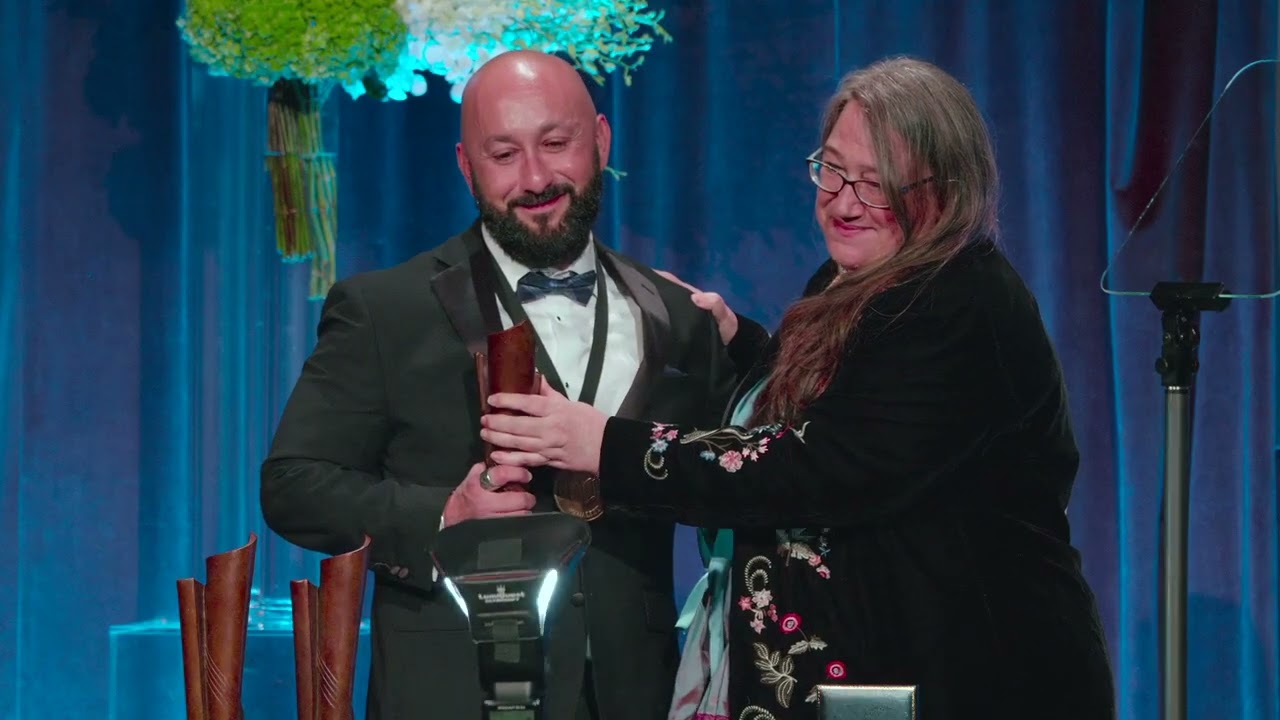
We send our heartiest congratulations to indigenous Chamoru poet Craig Santos Perez (shown at right with jury chair Heid E. Erdrich) who won this year's National Book Award for from unincorporated territory [åmot] earlier this week.

The fifth book in the from unincorporated territory series devoted to Perez's native Guam, [åmot] was hailed in the judges citation for "observ[ing] and assert[ing] storytelling as an act of resistance — a written form of 'åmot,' the Chamoru word for 'medicine.'" Accepting the award, Perez told the audience that "When I started writing, my mission was to inspire the next generation of Pacific Islanders." Without a doubt, he's already accomplished that, and this win will allow his work to reach even wider audiences.

On Perez's PennSound author page you can listen to readings from earlier installments in the from unincorporated territory series, in readings from Oakland and our own Kelly Writers House, along with a 2009 appearance on Cross Cultural Poetics, hosted by Leonard Schwartz. Listeners may also be interested in "Last Commentator in Paradise," Perez's series of commentary posts on Jacket2, where he explored "issues of representation, displacement, witness, and resistance." Again, we congratulate Perez for this monumental honor.

Wednesday, November 15, 2023

James Schuyler at Dia Art Foundation, 1988

Today we are remembering a historic reading took place exactly 35 years ago today: James Schuyler's November 15, 1988 reading at the Dia Art Foundation, which is available as both video and segmented audio on Schuyler's PennSound author page.

Schuyler materials are very hard to come by, largely due to the the ways in which his mental illness hindered his considerable talents. One oft-cited example: his first major collection of poetry, Freely Espousing, wasn't published until 1969 — long into the careers of his core New York School comrades John Ashbery, Kenneth Koch, and Frank O'Hara, and closer to when second-generation poets like Ted Berrigan, Ron Padgett, and Anne Waldman released their first books. Likewise, this reading, which took place not long after Schuyler turned 65, was his first ever; he'd die less than two-and-a-half years later.

When we first launched the video in 2015, it elicited many excited responses among fans and scholars. One particularly useful commentary came from New York School specialist Andrew Epstein, who offered some very useful contexts for the reading on his blog, Locus Solus: "Reclusive, plagued by intermittent bouts of severe mental illness, painfully shy, Schuyler had never before read his work in public, even though he'd been publishing since the 1950s. That evening, Schuyler's close friend John Ashbery gave a wonderful and incisive introduction (which can also be found in Ashbery's Selected Prose), and throngs of Schuyler's admirers from the literary and art world flocked to the Dia Center on Mercer Street." He continues, quoting David Lehman's The Last Avant-Garde — "For many in the audience it felt like a historic occasion. The line of people waiting to get in, many poets, writers, and artists among them, snaked around the corner" — and offering up Charles North's assessment: "The Dia reading was the most thrilling I think I've ever been to, the loudest applause I've ever heard — thunderous."

His authoritative report continues, observing that "the reading was a very big deal for Schuyler himself and his letters and diaries record the anxious build-up and the exhilarated aftermath of his debut performance," before offering up copious excerpts from those documents, concluding with Schuyler's estimation that "I was a fucking sensation." Epstein can't help but agree, and neither will you once you get a chance to see the venerable poet reading "February," "Empathy and New Year," "December," "Unlike Joubert," or other favorites.

We'd like to thank Schuyler's literary executor Raymond Foye and the Dia Art Foundation for allowing us to share this remarkable document with our listeners.

Monday, November 13, 2023

In Memoriam: Hugh Seidman (1940–2023)

We start this week off with sad news via Michael Heller that poet Hugh Seidman passed away last week at the age of 83. To honor the late poet, we've assembled a PennSound author page for Seidman from various recordings scattered throughout the site.

The earliest of these is a half-hour Segue reading at the series' first home, the Ear Inn, alongside James Sherry on November 16, 1991. Next up, we have a trio of recordings of Seidman and poets Lawrence Joseph and D. Nurkse made for the WBAI-FM radio program Cat Radio Cafe on December 4, 2005, including an hour-long reading, a forty-five minute discussion segment, and a brief concluding track with author bios. Finally, from the Poets House-organized George Oppen Centennial Symposium at the Tribeca Performing Arts Center in April 2008, we have a brief set by Seidman reading five sections from Oppen's "Route."

We send our sincere condolences to Seidman's friends, family, and colleagues. Click here to start exploring his work.

Friday, November 10, 2023

Richard Foreman: 'Astronome: A Night at the Opera,' 2010

In celebration of the 70th birthday of composer John Zorn, we are proud to announce the addition of Richard Foreman's presentation of Zorn's opera,  Astronome: A Night at the Opera to the PennSound archives.

Astronome: A Night at the Opera was originally released on DVD by the iconic label Tzadik in July 2010 (you can still purchase a copy here) and we're grateful to their permission (and Zorn's) to share this recording through our site. As the liner notes comment: "Foreman's dynamic staging of John Zorn's opera Astronome premiered in February of 2009 at his Ontological-Hysteric Theatre in New York. For this video, ten performances were captured on film from hundreds of angles and edited by filmmaker Henry Hills.

Our Richard Foreman author page is home to a comprehensive survey of his work spanning five decades.  Edited by Jay Sanders, the collection begins with excerpts from early works — Rhoda in Potatoland (1975), Livre des Splendeurs (1976, Paris), Blvd. de Paris: I've Got the Shakes (1977), Threepenny Opera (1976), Book of Splendors; Part II (Book of Leaves) Action at a Distance (1977), Sophia = (Wisdom): Part 3: The Cliffs (1972) — before moving on to films and complete plays. They include Luogo and Barsaglio (Place and Target) (1980), La Robe de Chambre de Georges Bataille (1983), Cure (1986), Symphony of Rats (1988), Lava (1989), Eddie Goes to Poetry City Parts 1 and 2 (1990-1991), The Mind King (1992), Samuel's Major Problems (1993), My Head Was a Sledgehammer (1994), I've Got the Shakes (1995), The Universe (1996), Permanent Brain Damage (1996), Benita Canova (1997), The Missing Jewels of Benita Canova (1997; Elka Krajewska's behind-the-scene documentary [with interviews] of Benita Canova), Pearls for Pigs (1997), Paradise Hotel (1998), Bad Boy Nietzsche! (2000), Now That Communism Is Dead My Life Feels Empty! (2001), Maria del Bosco (2002), Panic! (How to be Happy! (2003), King Cowboy Rufus Rules the Universe (2004), The Gods Are Pounding My Head! (aka Lumberjack Messiah) (2005), What to Wear (2006), and  Zomboid (2006). Next up there's Foreman's 2006 appearance on Close Listening, a pair of Segue Series readings, a 2006 appearance at the Penn Humanities Forum, a half-dozen appearances on Cross-Cultural Poetics, and Foreman's 2017 film, Now You See It Now You Don't

To start browsing through all of these amazing documents, click here to visit PennSound's Richard Foreman author page.

Tuesday, November 7, 2023

Harryette Mullen on 'The Poetry Show,' 1987

We've got an exciting recent addition to our Harryette Mullen author page to kick off this new week: a March 18, 1987 appearance on Morton Marcus' long-running The Poetry Show on Santa Cruz, CA's KUSP-FM. Running just shy of an hour, this program features Mullen reading selections from and discussing her 1991 Tender Buttons collection, Trimmings.

Writing in Boston Review about Recyclopedia — the 2006 Graywolf Press reissue of Trimmings and two other related early books, S*PeRM**K*T, and Muse & Drudge — Joyelle McSweeney cites Trimmings as the collection that "broke with both the form and content of [Mullen's] earlier lyrics, which largely concerned memory and family narratives." Inspired by and speaking to the “Objects” section of Stein’s Tender Buttons, these poems "investigate the dual trappings in which women go out to meet the world: their clothing and their bodies. Flinty shards of language line up in herky-jerk sentences to act out different parts of speech."

Listen in to this program and many more recordings spanning more than thirty years on PennSound's Harryette Mullen author page, including numerous readings from the Segue Series, the St. Mark's Poetry Project, Cornell University, Woodland Pattern Book CenterSUNY-Buffalo, UT Austin, Poets House NYC, the Belladonna* Reading Series, and our own Kelly Writers House, as well as the radio program Cross Cultural Poetics. Also, don't forget that Mullen will be joining us in April as one of the 2024 Kelly Writers House Fellows.


Monday, November 6, 2023

Remembering Carl Rakosi on his 120th Birthday

This November 6th would have been the 120th birthday of Objectivist poet Carl Rakosi, who passed away at the venerable age of 100 in the summer of 2004. To celebrate this milestone, today we survey the recordings of Rakosi available on his PennSound author page.

Much like his friend George Oppen, Rakosi took a quarter-century break from poetry from the early 40s until the release of Amulet in 1967, so all of our holdings come from that second act. Our earliest recording you'll find there is a May 13, 1971 appearance on Charles Armakanian's KPFA program Ode to Gravity, in which Rakosi reads and discusses a dozen or so poems. That's followed by two half-hour films that capture the "Objectivists and After" panel at the National Poetry Festival, in June 1973. Next up are two readings at the Library of Congress that took place twenty years apart: the first at the LOC Recording Laboratory on May 4, 1976 (where, per the catalogue listing, "Mr. Rakosi reads four poems from his collection entitled Amulet; seven from Ere-voice; and nine from Ex-cranium, night."), while the latter, introduced by Robert Hass, took place in the Mumford Room on April 11, 1996. 

Jumping forward two years, we have a three-hour panel discussion on the Objectivists from Naropa University's Summer Writing Program also featuring  Michael Heller, Jenny Penberthy, and Rachel Blau DuPlessis recorded on June 17, 1998. Then, from our own Kelly Writers House, we have a 99th birthday celebration that took place on October 30, 2022. Our final recording of Rakosi is a silent five minute clip from filmmaker Nathaniel Dworsky filmed during the last year of the poet's life at the Arboretum of Golden Gate Park, which shows Rakosi strolling with his companion, Marilyn Kane, talking and writing.

You can listen to all of the aforementioned recordings — plus a single track from The World Record: Readings at the St. Mark's Poetry Project, 1969-1980 and PoemTalk #83, which focuses on "In What Sense I Am I" from the 99th birthday celebration — on PennSound's Carl Rakosi author page. Click here to start browsing.

Friday, November 3, 2023

Haroldo de Campos at PennSound

We'll bring this week to a close by highlighting our author page for poesia concreta pioneer, Haroldo de Campos, which is anchored by a 2002 video from the Guggenheim Museum celebrating his life and work. Presented in conjunction with the exhibition Brazil: Body and Soul, this January 12, 2002 event featured both performances and discussion of de Campos' work by a wide variety of poets, translators and critics.

The video begins with introductory comments by Pablo Helguera and organizer Sergio Bessa, who are followed by a staging of de Campos' 1950 poem/play "Auto do Possesso (Act of the Possessed)," translated by Odile Cisneros and directed by Cynthia Croot. Craig Dworkin is next, reading his translation of "Signantia quasi coelum / signância quase céu," follwed by a brief set by Cisneros, who reads her translations. The performances conclude with Marjorie Perloff and Charles Bernstein reading Bessa's translation of "Finismundo," after which Perloff and Bernstein take part in a panel discussion moderated by Bessa.

Next, from 2005's Rattapallax we have a single track, "Calcas Cor de Abobora." Finally, we have a 2017 video of our own Charles Bernstein performing at New York's Hauser and Wirth Gallery with Sergio Bessa on September 28, 2017. This event, co-sponsored by the Poetry Society of America and held in conjunction with an exhibit by Mira Schendel at the gallery, included Bessa speaking about de Campos and Bernstein reading his translations of Drummond, Cabral, Cruz e Sousa, Leminksi, and Bonvicino.

On our Haroldo de Campos author page, you'll also find a link to Bernstein's 2003 essay "De Campos Thou Art Translated (Knot)", first published in the Poetry Society of America's Crosscurrents.

Wednesday, November 1, 2023

Joseph Ceravolo on PennSound

Today we're highlighting our holdings from beloved New York School poet Joseph Ceravolo (1934–1988), which we're very proud to be able to present through the generosity of his widow, Rosemarie.

Our earliest recording was made at the poet's home in the spring of 1968 and largely consists of poems from Wild Flowers Out of Gas (published the previous year) including "A Song of Autumn," "Drunken Winter," "Skies," "Happiness in the Trees," "White Fish in Reeds," and "Dangers of the Journey to the Happy Land." That's followed by "Poems and Background" from the 1969 album Tape Poems (ed. Eduardo Costa and John Perreault) and another set of home recordings from 1971. Running a little more than half an hour, this set also includes selections from Wild Flowers Out of Gas, plus "Ho Ho Ho Caribou" (here divided into its ten sections), the first three sections of "The Hellgate," and "Where Abstract Starts." 

Up next is a lengthy set of forty-nine poems recorded at the University of Chicago on May 11, 1976. Some titles included in this set: "Winds of the Comet," "Sleeping Outside My Mind," "The Spirit Mercury," "Interior of the Poem," "Kyrie Eleison," and "Good Friday." As Rosemary Ceravolo notes, there are some differences in titles between these recordings and the table of contents of 2012's Collected Poems since "Joe must have changed or added titles after he did the readings." Our last recording is Ceravolo's October 21, 1978 set at the Ear Inn that contains a number of poems-in-progress from the collection Mad Angels, often represented by a first line rather than its finished title, including "Tongues" and "Night Ride," along with a selection of early poems published in 1979's Transmigration Solo: "Sleep in Park," "Descending the Slope," "Romance of Awakening," and "Migratory Noon."

Along with these original recordings, we offer our listeners two marvelous complements. First, there's the September 2013 celebration of Ceravolo's work at the Kelly Writers House, organized by CAConrad, along with "The Lyrical Personal of Joe Ceravolo," an ambitious 2013 Jacket2 feature organized by Vincent Katz. Click here to listen to everything mentioned above.