Friday, April 28, 2023

PennSound and Jacket2 Resources on Australian Poetry


It seemed fitting to wrap up this week by highlighting Australia-centric content from both PennSound and Jacket2.

There's no better place to start than our Australian Poets anthology page, which is home to a comprehensive anthology of contemporary Australian voices, organized by the indispensable Pam Brown and first unveiled in 2013. In addition to links to preexisting author pages for Kate Lilley and John Tranter, it includes (then-)new recordings from a total of twenty-five poets: Adam Aitken, Ali Alizadeh, Judith Bishop, Ken Bolton, Bonny Cassidy, Stuart Cooke, Laurie Duggan, Kate Fagan, Michael Farrell, Liam Ferney, Duncan Hose, Jill Jones, Kit Kelen, John Kinsella, Peter Minter, Tracy Ryan, Jaya Savige, Pete Spence, Amanda Stewart, Ann Vickery, Corey Wakeling, Alan Wearne, Fiona Wright, Tim Wright, and Mark Young. This astounding collection of recordings is amazing in and of itself, but even more so when you realize that it's a supplement to an even more momentous Jacket2 feature: "Fifty-One Contemporary Poets from Australia", also organized by Brown, which was released in five installments over the course of 2012. Here's how she she opens her preface to the collection:
When it comes to poetry anthologies, I agree with David Antin's long-ago quip — "Anthologies are to poets as zoos are to animals" — and I think that journals and magazines are probably better indicators of what's current in any country's poetry than grand, often agenda-driven anthologies. Here I am presenting the work of fifty-one contemporary poets from Australia. My aim was to make it broadly representative by including innovation and experimentation alongside quasi-romanticism, elegy, and the almost-pastoral. No one in this group writes like another. The common link is simply that each poet is an Australian whether by birth, residence or citizenship.
She continues: "This collection could probably be read as an anthology, and so I grant a comment on omission. There are many other poets writing and publishing in Australia, probably around four hundred, who aren't included here. A problem for any editor assembling a collection of writing from Australia is the inclusion of multiracial poetries. At the outset, I should say that there are no Australian indigenous nor Torres Strait Islander poets in this selection of poems." That omission, however, is answered somewhat by Robbie Wood's astounding 2012 Jacket2 feature "On Australian Aboriginal Poetry: 'The Last Evening Glow Above the Horizon.'" Unlike typical Jacket2 features, which publish all of their content in one shot, Wood has filed new addenda to his anthology in 2015, 2016, and 2017, and I presume we might have further installments to look forward to in the future as well.

Taken together, these features represent some of my favorite PennSound and Jacket2 content over my long tenure with both sites. They also serve as an important reminder of the tireless work done by John Tranter — through Jacket, but also long before that through various publishing and broadcasting ventures — that both helped foster Australia's thriving poetry scene and also brought worldwide attention to it. Click on any of the links above to start browsing.

Tuesday, April 25, 2023

In Memoriam: John Tranter (1943–2023)

Today we share the tragic news that poet John Tranter has passed away on April 21st, just days shy of his 80th birthday. While his loss will be felt worldwide, we are feeling it more acutely at PennSound's sister site Jacket2, which has archived and continued the mission of Tranter's germinal Jacket magazine since 2011. Julia Bloch penned this tribute on behalf of our editorial team:
We here at Jacket2 are mourning the loss of John Tranter, founder, publisher, and editor of Jacket magazine.

In 1997, John Tranter began publishing Jacket, one of the earliest all-online journals of poetry and poetics. Launched in what was still a field saturated with print, the original quarterly Jacket offered something different. Free, open-access, and impervious to the constraints of page count or paper bindings or subscription income, Jacket taught its readers how to engage with what was then a relatively new medium. As Tranter wrote on the site in its early days, “You can’t actually subscribe to the magazine — just drop by every few weeks. All the past issues will always be there, and the current number will be posted piece by piece until it’s full. You can also read future issues as they are posted piece by piece.” The journal’s first issue, in October 1997, included Philip Mead’s interview with Black Australian surrealist poet Lionel Fogarty, Susan M. Schultz’s essay on the Buffalo poetics program, and Kurt Brereton’s feature on “CyberPoetics of Typography,” which declared, “The page is no longer a flat surface but a virtual field unfolding in time. Words, sounds, images and graphics are now all part of the poetics of the web.”

In an essay called “The Left Hand of Capitalism,” which he originally published in 1999 in London’s Poetry Review, Tranter writes about how this paradigm-shifting moment in online publishing combined the sheer scope of the internet with the niche qualities of a poetry magazine to offer a different kind of economic model: radically accessible with seemingly infinite distribution. “Here’s an example of the reach of the Internet,” Tranter wrote. “In the first issue of Jacket, I published an interview I had recorded with the British poet Roy Fisher, and received an enthusiastic email from a fan. The fellow was grateful for the chance to read an interview with his favourite poet, he said, and went on to explain: ‘It’s hard to find material on Roy Fisher, up here in Nome, Alaska.’”

Jacket quickly grew in reputation not in spite of its DIY roots but by virtue of them. The Guardian lavished praise on the magazine’s aesthetic: “The design is beautiful, the contents awesomely voluminous, the slant international modernist and experimental.” Time called it “an Internet cafĂ© for postmodernists.” And Lisa Gorton wrote in the Australian Book Review: “People often speak of poetry as a solitary undertaking. Tranter’s Jacket shows how it derives from conversations, allegiances and betrayals — from the human work of inheritance and innovation. Jacket is often playful but it is serious in this purpose: to serve as an archive not just for poems but for those poems’ particular worlds.”

Tranter himself was always forthrightly modest about the undertaking. In a 2013 PennSound podcast, Tranter told Jacket2 publisher Al Filreis: “My background is in book production and magazine production, and in a sense I see Jacket really as just a way of typesetting a magazine and distributing it instantly and cheaply all around the world. […] It solves completely and instantaneously the big problem of poetry, and that is distribution. How do you get copies of a litle book of poetry into a little bookstore in East London? It’s impossible; you can’t do it. But Jacket can do it.” Indeed, Filreis concurs: Jacket simply changed the way poetry could be distributed worldwide.

Tranter, who grew up on a farm and had a background in offset lithography book printing, told Filreis that baling wire was a fitting metaphor for the tools he used to launch Jacket single-handedly from his home office in Balmain, in the inner west of Sydney: “I found I had all these talents: I was an editor, I read widely, I was interested in literature, I was interested in photographic images, I was interested in the layout of the page, how you stuck bits together and got it to work properly, how to navigate from the contents page to the rest of the book, and so on. And when I realized I also had HTML skills, I thought, I happen to have all the skills you needed to tie together a whole lot of stuff you might need to make an issue of a poetry magazine.”

For forty monumental issues — each one archived at Jacket2 — Tranter assiduously curated thousands and thousands of pieces of poetry, essays, interviews, features, and commentary on modern and contemporary poetry and poetics. Pam Brown joined Tranter as an associate editor in 2004; in her Commentary series for Jacket2, Brown revisits a number of highlights from Jacket, including Maged Zaher’s feature on Egyptian poetry, Carolyn Burke’s “featurette” on Mina Loy, and “the mis-translations, mis-quotations and bricolage poetry of Sydneysider Chris Edwards.”

In 2011, Tranter retired from his intense daily work on Jacket. The complete archive of the magazine moved intact here to Penn, where it remains open and available to all readers. And then Jacket2 launched.

One of the first conversations we had about launching Jacket2 was how to honor the core of Tranter’s original aesthetic and material vision for Jacket: modernist, international, and published on a rolling schedule. We inherited the notion of a “feature” as a category or department that would collate a huge variety of content on a single topic or figure — often the equivalent of more than three hundred printed pages. We used our own baling wire, as it were, to expand the site by adding podcasts, streaming video, and galleries. And we hosted Tranter’s own Jacket2 Commentary series, in which he reflected on the forty issues of Jacket he edited.

Tranter, who was seventy-nine at the time of his death, published twenty-two collections of poetry and also worked as a radio producer with the Australian Broadcasting Corporation, producing programs on history, archaeology, a documentary on carnival sideshow workers, interviews with poets and critics, and radio anthologies of poetry from Thomas Malory to Frank O’Hara and John Ashbery. He edited a number of significant print anthologies, including The New Australian Poetry, The Tin Wash Dish, and The Penguin Anthology of Modern Australian Poetry (coedited with Philip Mead), and his many honors and awards included a Queensland Premier’s Award for Poetry. He founded the Australian Poetry Library, and he was an honorary member of the Australian Academy of the Humanities.

But Jacket is surely Tranter’s biggest legacy. As Tranter’s daughter Kirsten recently wrote to us here in Philadelphia, “Jacket was something he was incredibly proud of — it was a culmination of his love of bringing people and poetry together, and his love of the creative potential of technology — and he was delighted when it went on to have another life at Penn.” We couldn’t have been more honored to offer Jacket its new home here.

We will miss you, John.
The impact Jacket had on my development as a poet cannot be understated. It gratified my burgeoning interests in an era when online literary resources were incredibly sparse and welcomed me into a living, growing literary community. Likewise, his notion of poetry as a "gift culture" greatly shaped my worldview, setting the stage for my work at PennSound, my pedagogy, my aesthetics, and more. To be entrusted with guiding Jacket in its second life is a humbling honor to this day.

Monday, April 24, 2023

Join Us in Conversation with Wayne Koestenbaum 4/25

Please join us on Tuesday, April 25th at 10:30AM EDT as we bring the 2023 Kelly Writers House Fellows program to a close as  joins hosts Simone White and Al Filreis for an interview/conversation with poet, critic, novelist, artist, and performer Wayne Koestenbaum. You can tune in live via this YouTube link.

Born and raised in San Jose, California, Wayne Koestenbaum is a poet, critic, novelist, artist, and performer, having published nineteen books, including The Queen’s Throat, which was a national Book Critics Circle Award finalist. Praised by many for his work’s blend of risk and joy, Susan Sontag called The Queen’s Throat a “brilliant book.” His other books include Camp Marmalade, The Pink Trance Notebooks, My 1980s & Other Essays, Andy Warhol: A Biography, and Jackie Under My Skin: Interpreting an Icon. In 2020, Koestenbaum won the American Academy of Arts and Letters Award. Previously an Associate Professor of English at Yale, he is now a Distinguished Professor of English, French, and Comparative Literature at the CUNY Graduate Center in New York City.

For more about Writers House Fellows, including the 22-year history of video recordings of Fellows' visits, please visit this site.

Thursday, April 20, 2023

William Fuller: New Author Page

Today we're highlighting our most recently created author page for William Fuller. Fuller is a classic example of the "poet with a day job" phenomenon, having released eight celebrated books of poetry over the last thirty years while spending much of the same time working in the financial services industry at the Northern Trust Corporation of Chicago.

Fuller joined us in the Wexler Studios on March 16th of this year to record a career-spanning set of thirty-three poems running just over fifty minutes, starting with 2003's Sadly and continuing through Watchword (2006), Hallucination (2011), Quorum (2013), Playtime (2015), and his latest, Daybreak (2020), before concluding with a selection from the forthcoming Signal Flow. Titles include "The Later Chapters," "Deceased Makers," "Hope for Happiness," "Agricultural Barometer," "The Circuit," "Evening Dies Insane," "Bolero," "Old Fuller Burying Ground," "Nottamun Town," "Writing Policy," "Tracate," "The Waterfall," "Windowpane," "Willow Willow," "Galaxy," and "Other Sky." Savannah Sparks engineered this session, which was edited by Zach Carduner.

You can listen to these new recordings, along with a classic Segue Series set from 1987, on PennSound's brand-new William Fuller author page. Click here to start browsing.

Tuesday, April 18, 2023

Happy Birthday, Bob Kaufman!

April 18th is the birthday of Bob Kaufman, a quintessential San Francisco poet of the post-war period, who served as a vital bridge between jazz poetry's development during the Harlem Renaissance and its ongoing evolution during the Beat era on both coasts. Kaufman was an innovator in the surrealist tradition, as well as co-founder of the germinal journal Beatitude, and a vital voice that continues to inspire generations of writers. Born in 1925, Kaufman — who died in 1986 — would have turned 97 today.

PennSound's Bob Kaufman author page, curated by Raymond Foye — who co-edited 2019's Collected Poems of Bob Kaufman from City Lights with Neeli Cherkovski and Tate Swindell — is anchored by Bob Kaufman, poet: the life and times of an African-American man, a stunning 1992 audio documentary written and produced by David Henderson, which comes to us courtesy of Naropa University Audio Archive, Henderson, and Cherkovski. Extensive timetables have also been generated for both one-hour installments, providing details on the various speakers, topics discussed, etc. Individual poems read by Kaufman have also been broken out into their own MP3 files.

Additionally, we're proud to be able to share a twenty-one minute recording made by A. L. Nielsen, for which we have no details regarding date or location, and a brief recording of Kaufman reading the poem "Suicide," which comes to us courtesy of Will Combs. Combs' recording forms the basis for PoemTalk #158, in which Christopher Stackhouse, Maria Damon, and Devorah Major join host Al Filreis for a discussion of the poem. Click here to start browsing.


Monday, April 17, 2023

PoemTalk #183: on Dodie Bellamy's 'Vomit Journal'

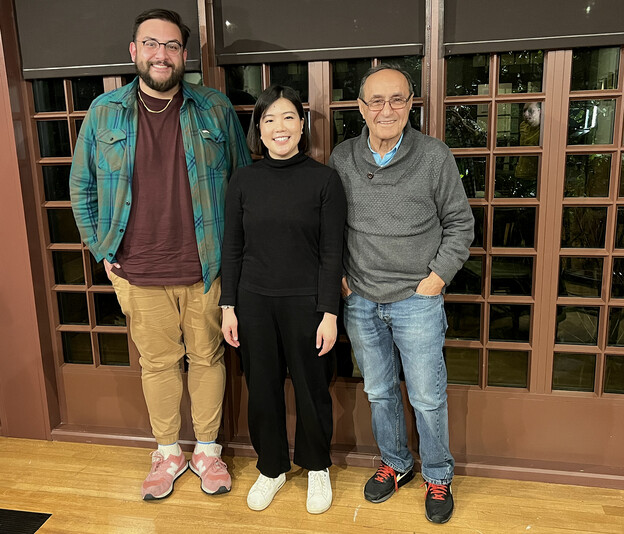
Today we proudly release the 183rd episode in the PoemTalk Podcast series, which focuses on a series of excerpts from Dodie Bellamy's Vomit Journal. For this program, host Al Filreis was joined by a panel that included (left to right) Henry Steinberg, Chantine Akiyama Poh, and Murat Nemet-Nejat.

Originally published in 2015's When the Sick Rule the World, the excerpt from Vomit Journal under discussion consists of seven entries written between April and June 1997. As Filreis notes in his Jacket2 blog post announcing the new episode, Bellamy made a special recording just for this episode, which listeners can also find on her PennSound author page.
Listen to this latest program, peruse a PDF of Bellamy's work, and learn more about the show here. PoemTalk is a joint production of PennSound and the Poetry Foundation, aided by the generous support of Nathan and Elizabeth Leight. Browse the full PoemTalk archives, spanning more than a decade, by clicking here.

Friday, April 14, 2023

M.C. Richards on PennSound

We might all aspire to lead lives as rich as that of M.C. Richards, the poet, potter, and translator whose eighty-five years included a stint teaching at the fabled Black Mountain College (where she also participated in the first happening), an early experiment in communal living at Stony Point's "the Land" (along with John Cage, David Tudor and others), and friendships with Jackson Mac LowCharles Olson, Paul Williams, Robert Rauschenberg and Franz Kline. Her vivacity undimmed by the passage of time, she devoted her later years to working with the developmentally disabled at the Camphill Village in Kimberton, PA.

On PennSound's M.C. Richards author page you'll find a 1997 recording made at Indre Studios in Philadelphia, which comes to us courtesy of a close friend, Jasper Brinton, who provided us with a little background to the session. "She made this tape essentially under some strain: she did not live to see it published to any degree; but understood its importance for her legacy," he notes. "The quality of the recording is excellent. Her voice strong. Earlier in 1991 Station Hill Press published Imagine Inventing Yellow: New and Collected Poems of M.C. Richards. The tape includes a few of these poems but also later work she saw fit to preserve."

We're very glad to be a part of that preservation process. You can listen to the seventy-five minute recording, consisting of nearly two dozen poems — including "March," "Strawberry," "Imagine Inventing Yellow," "Morning Prayer," "How to Rake Water," "Sweet Corn," and "For John Cage on His 75th Birthday" — along with plentiful fascinating asides and remarks by the author, by clicking here.

Wednesday, April 12, 2023

Charles Borkhuis: 1997 Ear Inn Reading Now Segmented

Today we're glad to showcase poet, essayist, and playwright Charles Borkhuis' 1997 reading at the Ear Inn as part of the Segue Series with Kathleen Fraser, which was recently segmented by PennSound staffer Daniel Boyko.

Running just short of 35 minutes, Borkhuis' set starts with a brief introduction and his own opening remarks, including his apology that he "dressed like a refugee from a bad David Lynch film today." He then proceeds to read a total of 20 pieces, consisting of excerpts from Proximity: Stolen Arrows and Alpha Ruins along with individual titles including "Blank Page Already Black," "Touch My Money and Leave," "The French Disease," "Old Ladies Meet (for Cynthia Hogue)," "Sight Lines," "Pebbles in the Mouth," "Eye to Eye," "Intimacy," "Bitter Than Dead," "Write What I Say," and "Cold Pillows."

You can listen to the aforementioned tracks on PennSound's Charles Borkhuis author page, which is home to a modest collection of recordings that demonstrate the author's diverse talents. Starting with this Ear Inn recording, you'll find Black Light: Two Radio Plays from 2002, a 2004 appearance on Cross-Cultural Poetics, another Segue Series reading from the Bowery Poetry Club in 2006, a 2014 set for Dia's Readings in Contemporary Poetry, and a 2022 virtual reading as part of the LCP Salon. Click here to start exploring.

Monday, April 10, 2023

Kenneth Rexroth on PennSound

We start off this new week by revisiting our modest collection of recordings by groundbreaking San Francisco poet, translator, and editor Kenneth Rexroth.

Among many notable achievements, it's easily forgotten that Rexroth was a pioneer of poetry on the phonograph, as evidenced by "Thou Shalt Not Kill," his paean to the late Dylan Thomas, which served as the A side to the 1957 Fantasy LP Poetry Readings in the Cellar, with Lawrence Ferlinghetti on the B side, and accompaniment by The Cellar Jazz Quintet throughout. That twenty-two minute track is joined by a one-and-a-half minute recordings of "Climbing Milestone Mountain, August 22, 1937," for which we have no information regarding its date or location. 

In time, we hope to be able to make more recordings from this pioneering figure in the fields of both poetry-in-performance and poetry on record available. We're grateful to Bradford Morrow, who oversees the Rexroth estate, for granting us permission to share what we have, and also to Ken Knabb, who initially contacted us about the absence of a Rexroth PennSound author page, which started the process leading to the creation of one. You can listen in to the aforementioned recordings by clicking here.

Friday, April 7, 2023

"Chanson Tzara" with Lee Harwood by Alexander Baker, 2012

In the early 60's the late poet Lee Harwood heard for the first time, in a London cafe, a poem by Tristan Tzara. An "immediate convert" to Dada, Harwood tracked down a few of Tzara's then difficult to find poems and translated them; he eventually also tracked down Tzara himself and met him in Paris. "Chanson Tzara" — with text, translation, and narration by Harwood, and sound and realization by Alexander Baker — is a sound work created around that encounter.

This twenty-seven minute audio composition is an ambitious and fully-dimensional tribute to both Tzara and the chaotic spirit of Dada made contemporary, starting with a hectic sound collage of found samples, ring modulated radio noise, music, and text-to-speech voice generation, which eventually gives way to a touching and elegiac voiceover by Harwood that weaves together memories, translations, and the young poet's conversation with Tzara.

You can listen to this recording on PennSound's Lee Harwood author page, which is also home to his contribution to the Rockdrill series, The Chart Table, Lee Harwood: Poems 1965–2002, a 2008 reading as part of the Shearsman Reading Series at Swedenborg Hall in London, and a 1998 set at the St. Mark's Poetry Project with Ange Mlinko. Click here to start exploring.

Wednesday, April 5, 2023

Daphne Marlatt: 'Like Light off Water: Passages from Steveston' (2008)

Today we take a closer look at one of the most iconic works by Canadian poet Daphne Marlatt in a unique setting. Like Light off Water: Passages from Steveston was originally released on CD by Otter Bay Recordings in 2008, and presents passages from Marlatt's beloved 1974 collaboration with photographer Robert Minden with musical embellishments written and performed by Minden and Carla Hallett. As Douglas Barbour observes, Steveston is "a carefully documented and deeply personal overview of the town in history," including its time as an internment camp for Japanese Canadians during the Second World War.

This is not the first time that Marlatt and Minden have revisited the Steveston project. The creators reconfigured the manuscript for a twenty-fifth anniversary edition, which separates the poems and photos into different portfolios, with both adding mew material. Speaking about the project as a whole, Marlatt notes, "There was something in Steveston which drew us, over and over again, and which our work attempted to enunciate — something under the backwater quiet, the river hum of comings and goings, the traffic of work, that was shouting at us to tell it." Writing in The WholeNote Magazine in 2009, Dianne Wells offered high praise for the album: "Marlatt's words bring you to the river's mouth and into a sensuous landscape of lives lived in canneries, fishing camps, on the sea and over time. Listen to the sounds of vintage waterphones, bowed carpenter’s saws, found object percussion and voice – a delicate resonance which surrounds Marlatt's poetic voicing, rhythm and imagery." She continues, hailing the music's ability to conjure up "the rippling and twinkling of water and light, together with haunting depictions of mysterious and erotic undercurrents mixed with the gentle beauty of the night sky.”

You can listen to all eight tracks — including "Imagine: A Town," "Moon," and "Intelligence (As If By Radio?" — by clicking here.

Monday, April 3, 2023

George Quasha reads 'ripping scales,' 2023

Today we're highlighting the latest dispatch from PennSound Contributing Editor Chris Funkhouser's long-running project to document the poetry of friend and neighbor George Quasha. Back in January, we announced a pair of home recording sessions made in November and December 2022, and today we've got a new set from last month to share with our listeners.

In this 90-minute installment, recorded on March 18th, Quasha continues his way through Waking from Myself with the section entitled ripping scales. You'll recall that in his December set, he started that book with the tuning by fire segment.

You'll find these recordings on PennSound's George Quasha author page, along with lengthy selections from many of his books including Not Even Rabbits Go Down This Hole, Dowsing Axis, Hearing Other, The Ghost In Between, Verbal Paradise, Glossodelia Attract: Preverbs, The Daimon of Moment: Preverbs, Scorned Beauty Comes Up Behind: Preverbs, Things Done for Themselves: Preverbs, and Polypoikilos: Matrix in Variance: Preverbs, among others. Click here to start listening.

Saturday, April 1, 2023

PigeonSound Turns 14

This April Fool's Day marks fourteen years since our PennSound Daily announcement of our PigeonSound ™ service, which sadly never got off the ground given — among other things — the widespread rejection of pigeon post in the United States. Turntables still continue to sell healthily, flip phones are coming back, and every hipster has a vintage typewriter they paid too much money for, but the same enthusiasm could not be rekindled for avian poetry delivery, and so our fleet coos in waiting for more genteel and discerning times.

Here's our original announcement, which, in true April Fool's Day fashion, came a month early, alongside the unveiling of our Twitter account:
It's been less than 24 hours since we launched our PennSound Twitter page, and already we have 50 followers. Sign up to follow our feed to get micro-updates — from co-directors Al Filreis and Charles Bernstein, and managing editor Michael S. Hennessey — highlighting changes to the site, new additions and favorite recordings from our archives. Recent tweets have featured Bernadette Mayer & Lee Ann BrownTracie Morristhe PennSound Podcast series and our video page

Are you getting the most out of your PennSound experience? Aside from Twitter, don't forget all of the other ways in which you can keep up to date with the site through the web or your cell phone: first, there's the PennSound Daily newsfeed, which automatically delivers entries like this one to your iGoogle page, Google Reader, or favorite feed reader.PennSound is also on FaceBook, along with pages for our sister sites, including the Kelly Writers House and the Electronic Poetry Center. One additional option is the Kelly Writers House's Dial-a-Poem service: just dial 215-746-POEM (7636), and aside from news on upcoming KWH events, you can also hear a recording from a past reading, courtesy of the PennSound archives.

Finally, for those of you who feel overwhelmed by all this new technology, and liked the world a lot more before it Twittered, Tumblred and Bloggered, we're currently beta-testing yet another, more traditional means of transmission. Utilizing homing pigeons equipped with state-of-the-art (well, state-of-the-art circa WWI) wire recording technology, PigeonSound ™ (see prototype at right) will be able to deliver three minutes of telephone-quality audio up to several hundred miles from our home base at UPenn's Center for Programs in Contemporary Writing (our apologies to the rest of the world). Though there have been numerous unfortunate setbacks to date, we hope to have the program up and running by the first of next month with our inaugural offering: The Selected Poems of Ern Malley (read by the author himself). From sites that tweet to birds that tweet, we have all of your poetry options covered at PennSound.