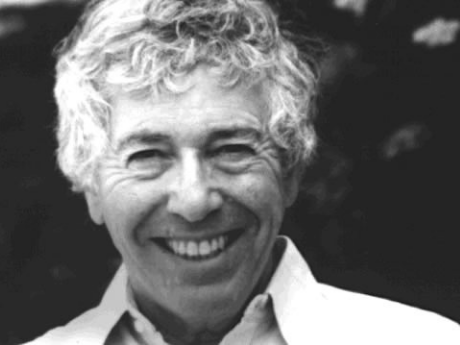
Music with Roots in the Aether is a music-theater piece in color video. It is the final version of an idea that I had thought about and worked on for a few years: to make a very large collaborative piece with other composers whose music I like. The collaborative aspect of Music with Roots in the Aether is in the theater of the interviews, at least primarily, and I am indebted to all of the composers involved for their generosity in allowing me to portray them in this manner.The piece turns out to be, in addition, a large-scale documentation of an important stylistic that came into American concert music in about 1960. These composers of the "post-serial" / "post-Cage" movement have all made international reputations for the originality of their work and for their contributions to this area of musical compositions.The style of the video presentation comes from the need I felt to find a new way to show music being performed. The idea of the visual style of Music with Roots in the Aether is plain: to watch as closely as possible the action of the performers and to not "cut" the seen material in any way — that is, to not editorialize on the time domain of the music through arbitrary space-time substitutions.The visual style for showing the music being made became the "theater" (the stage) for the interviews, and the portraits of the composers were designed to happen in that style.
Monday, July 21, 2025
Robert Ashley: Music with Roots in the Aether (1974)
Friday, June 27, 2025
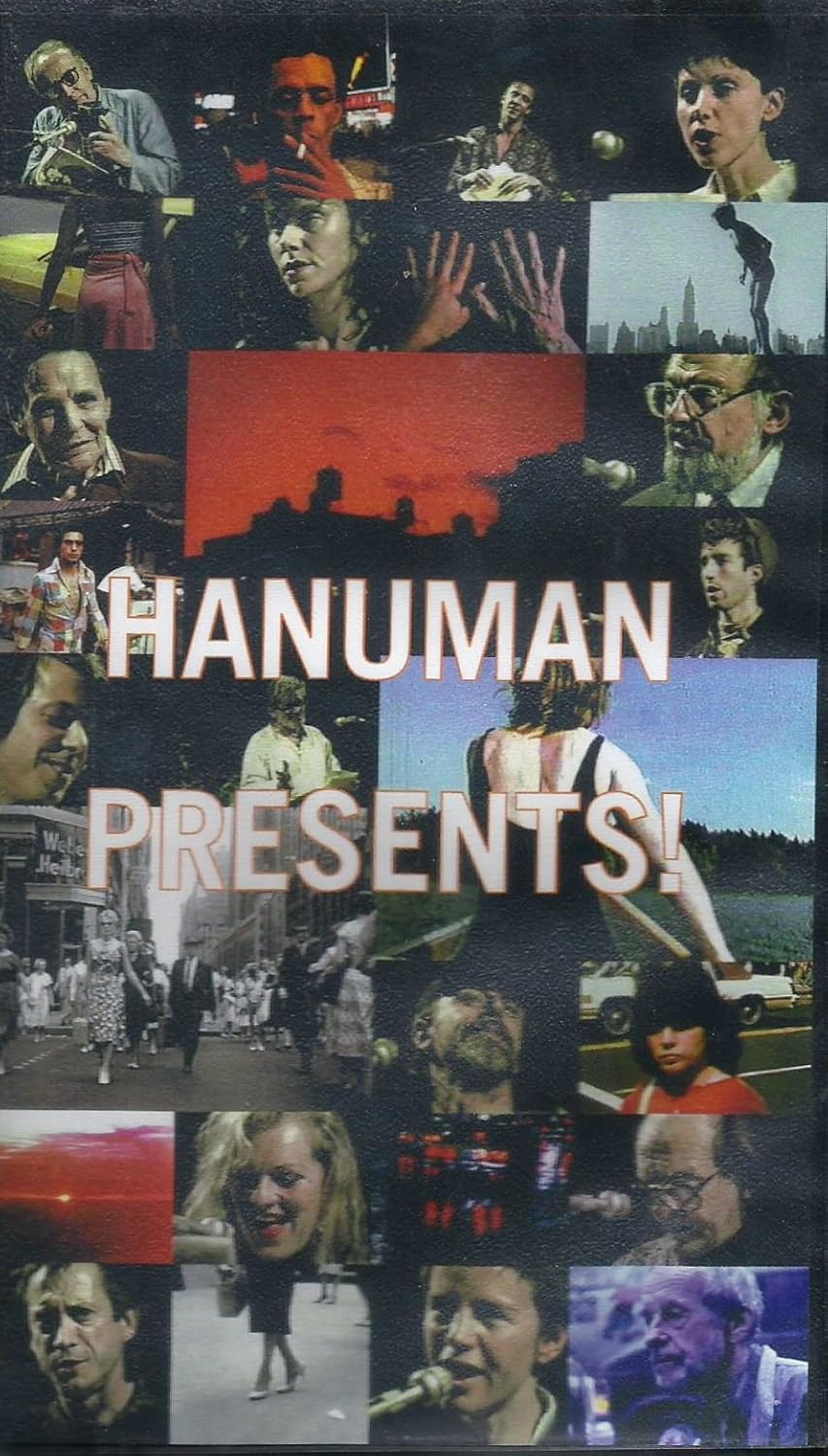
'Hanuman Presents!' dir. Vivien Bittencourt and Vincent Katz
Introduced by Foye, the film was edited by by David Dawkins and Henry Hills, and features an impressive line-up of poets spanning two generations — Gregory Corso, Elaine Equi, Bob Flanagan, Amy Gerstler, Allen Ginsberg, Richard Hell, Herbert Huncke, Katz, Taylor Mead, Cookie Mueller, Eileen Myles, Rene Ricard, David Trinidad, John Wieners — reading from their work. As Foye notes in his opening comments, all of Hanuman's living authors are included in the event. While the poets and the poems are wonderful enough on their own, the performances are cleverly accompanied by abstract images from the films of Rudy Burckhardt.
Running just shy of forty-three minutes, Bittencourt and Katz's film is both a stunning time capsule and testimony to the power of Foye and Clemente's innovative press. You can start watching by clicking here. Be sure you don't miss Bittencourt and Katz's tribute to Jack Kerouac's Mexico City Blues, filmed at the Knitting Factory in 1988, which is also available on the same page.
Saturday, June 21, 2025
Henry Hills, 'Plagiarism' (1981)
Begins jokingly proclaiming, "I'll make my Ernie Gehr film," a major preoccupation of my generation in the late 70s/early 80s, & then this very raw other thing proceeds to unfold, raw because I only had enough money (a loan from Abby Child) to do 4 shoots never having done sync & using outdated film stock from Rafik & an unfamiliar, undependable camera & trying to keep everything together & everything going wrong, yet determined to make concrete the ideas I had been abstractly developing over several years with whatever I got back from the lab no matter & so abandoning all caution to open a new area, I decided who could possibly talk better than poets? Edited in Times Square.
Fans of Hill's Money (1985) will recognize many familiar techniques at play here, with rapid-fire cuts creating a dense, rhythmic collage of sights and sounds punctuated by pregnant pauses, bursts of noise, and enigmatic, orphaned fragments of speech. It would be a mistake to judge it solely in its relationship to Money, however, since the two films differ radically in scope and spirit: while the latter is an expansive survey of the city and its scenes (including poets, dancers, and musicians), the feel here is much more intimate, between the smaller cast and the more limited visual vocabulary. At the same time it's fascinating to see hallmarks of Hills' style in a raw early state, particularly given the influence of the considerable technical challenges that Hills enumerates above. You can watch Plagiarism by clicking here.
Monday, June 9, 2025
Rudy Burckhardt: Two Short Films Featuring Kenneth Koch
Monday, May 12, 2025
Mimi Gross and Red Grooms: 'FAT FEET' (1966)
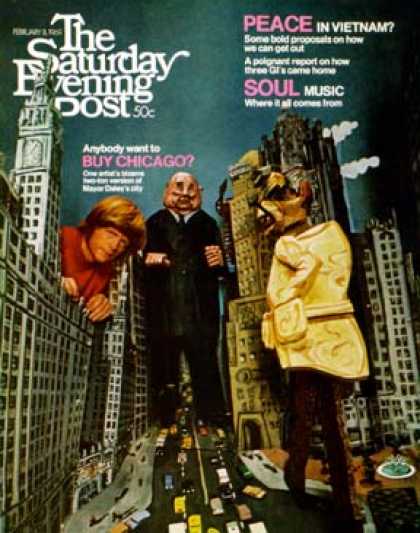
As I worked with Red at various intervals of time and projects, from 1960-1976, our collaborations became increasingly intense, and often lost the boundaries of ideas, aesthetics, and in the real time of making, craft and painting.FAT FEET (1965-66) was directly inspired by the early animated films of Georges Melies, Emil Kohl, and the marvelous movie, The Invisible Moving Co, all of which we saw from the collections of Joseph Cornell (via Robert Whitman and Rudy Burckhardt). In 1962-3, together with Rudy Burckhardt, we made a 16mm film called Shoot the Moon. It is a direct homage to Georges Melies. There are some brief scenes with stop-action animation. Red and I made little cut outs, and Rudy showed us how he filmed the scene. A few years later, we experimented with animating life-sized props with live actors (long before "green screens").When Yvonne Andersen and Dominic Falcone visited us in New York, we planned to make a film together the following summer where they lived near Boston. Red and I had just moved into lively "Little Italy" (1964), a neighborhood where daily fires, violence, and long term elderly residents lived near the Bowery, filled with bums, and (pre-immigration quota) Chinatown. I was busy drawing in the streets, and making objects based on street life, and Red was obsessively chasing fires, fire engines, street life, he was incorporating into his work.The explosion of making FAT FEET resulted from our excitement living in the new neighborhood. Later, we made an ad, and called FAT FEET: "A day in the life of 'nervous city'!"
Each morning the four of us along with Dominic and our two children Paul, 7 and Jean, 5 went to the studio to build the sets and props. We painted cartoonish black and white buildings on the paper walls of the set, painted and and constructed 3/4 size flat automobiles with movable wheels from heavy building cardboard. Red built a dog which could be animated to walk in front of a live person.Red was creating a cartoonish atmosphere depicting the types of city people who might be seen walking the street of a big city. For this reason the people wore giant shoes to connect them to the sidewalks. Those shoes were heavy! A normal shoe was screwed into a giant shoe manufactured by Red.In the beginning this was supposed to be a four person project, but people heard about it. Each night people came to be in the winter crowd scenes. Some were friends of Red and Mimi, some were my animation students and neighbors. We got old coats from Morgan Memorial and there was a large make up table. People could come in, put on a coat, do their own make up, and become who they wanted to be for the evening.
Friday, March 21, 2025
Henry Hills and Sally Silvers: 'Little Lieutenant,' 1994
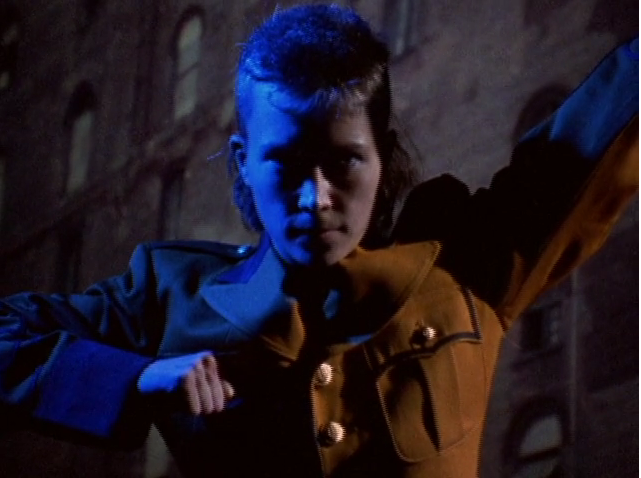
Little Lieutenant is a look back at the late Weimar era with its struggles and celebrations leading up to world war, a period piece. Scored to John Zorn's arrangement of the Kurt Weill song, "Little Lieutenant of the Loving God", and drawing its imagery both from the original song and its somewhat idiosyncratic rearrangement, the film presents an internal reading of Silvers' solo scored to the same musical piece, "Along the Skid Mark of Recorded History".
Closely following the Zorn arrangement, the film was storyboarded in 30 scenes (the arrangement changes approximately every 4 measures) and principally shot in a small studio employing rear screen projection, with foreground movement choreographed to interact with the projected imagery which reflects themes apparent in the song and its arrangement (Weimar cabaret scenes, labor footage, empty industrial landscapes, water, slides of moody photographs by James Casebere, a kinescope of Silvers' performance of the solo at the Joyce Theatre, battle newsreels, Walther Ruttmann's film Berlin: Symphony of a Great City, and a restructured animation, The Youth Machine). Scenes range through a Citizen Kane-esque pan up a forboding structure, idyllic lovers in both pastoral and industrial settings, labor marches, a lonely walk down a deserted alley, a bar brawl, a Motown-ish girl group, a dream sequence, and a giddy animation, up to the terrors of war and a bittersweet conclusion: an elaborate music video.
Silvers and Cydney Wilkes portray dual aspects of the Salvation Army Lieutenant who sang the song in the Brecht/Weill play “Happy End”, with Kumiko Kimoto and Leonard Cruz as the lovers and Pilar Alamo and Toby Vann filling out the group. The film was conceived by Zorn, Silvers, and Hills, co-directed by Silvers and Hills, choreographed by Silvers, shot and edited by Hills, and funded by a grant from the NEA Dance Program, with assistance from the Segue Foundation and the loan of a rear screen by Ken Jacobs.
Wednesday, February 12, 2025
PennSound Cinema: Ken Jacobs
Friday, December 20, 2024
Henry Hills, 'Plagiarism,' 1981
Begins jokingly proclaiming, "I'll make my Ernie Gehr film," a major preoccupation of my generation in the late 70s/early 80s, & then this very raw other thing proceeds to unfold, raw because I only had enough money (a loan from Abby Child) to do 4 shoots never having done sync & using outdated film stock from Rafik & an unfamiliar, undependable camera & trying to keep everything together & everything going wrong, yet determined to make concrete the ideas I had been abstractly developing over several years with whatever I got back from the lab no matter & so abandoning all caution to open a new area, I decided who could possibly talk better than poets? Edited in Times Square.
Fans of Hill's Money (1985) will recognize many familiar techniques at play here, with rapid-fire cuts creating a dense, rhythmic collage of sights and sounds punctuated by pregnant pauses, bursts of noise, and enigmatic, orphaned fragments of speech. It would be a mistake to judge it solely in its relationship to Money, however, since the two films differ radically in scope and spirit: while the latter is an expansive survey of the city and its scenes (including poets, dancers, and musicians), the feel here is much more intimate, between the smaller cast and the more limited visual vocabulary. At the same time it's fascinating to see hallmarks of Hills' style in a raw early state, particularly given the influence of the considerable technical challenges that Hills enumerates above. You can watch Plagiarism by clicking here.
Monday, August 26, 2024
'Hanuman Presents!' dir. Vivien Bittencourt and Vincent Katz
Introduced by Foye, the film was edited by by David Dawkins and Henry Hills, and features an impressive line-up of poets spanning two generations — Gregory Corso, Elaine Equi, Bob Flanagan, Amy Gerstler, Allen Ginsberg, Richard Hell, Herbert Huncke, Katz, Taylor Mead, Cookie Mueller, Eileen Myles, Rene Ricard, David Trinidad, John Wieners — reading from their work. As Foye notes in his opening comments, all of Hanuman's living authors are included in the event. While the poets and the poems are wonderful enough on their own, the performances are cleverly accompanied by abstract images from the films of Rudy Burckhardt.
Running just shy of forty-three minutes, Bittencourt and Katz's film is both a stunning time capsule and testimony to the power of Foye and Clemente's innovative press. You can start watching by clicking here. Be sure you don't miss Bittencourt and Katz's tribute to Jack Kerouac's Mexico City Blues, filmed at the Knitting Factory in 1988, which is also available on the same page.
Friday, July 5, 2024
'How to Be European' by Anya Lewin (2007)
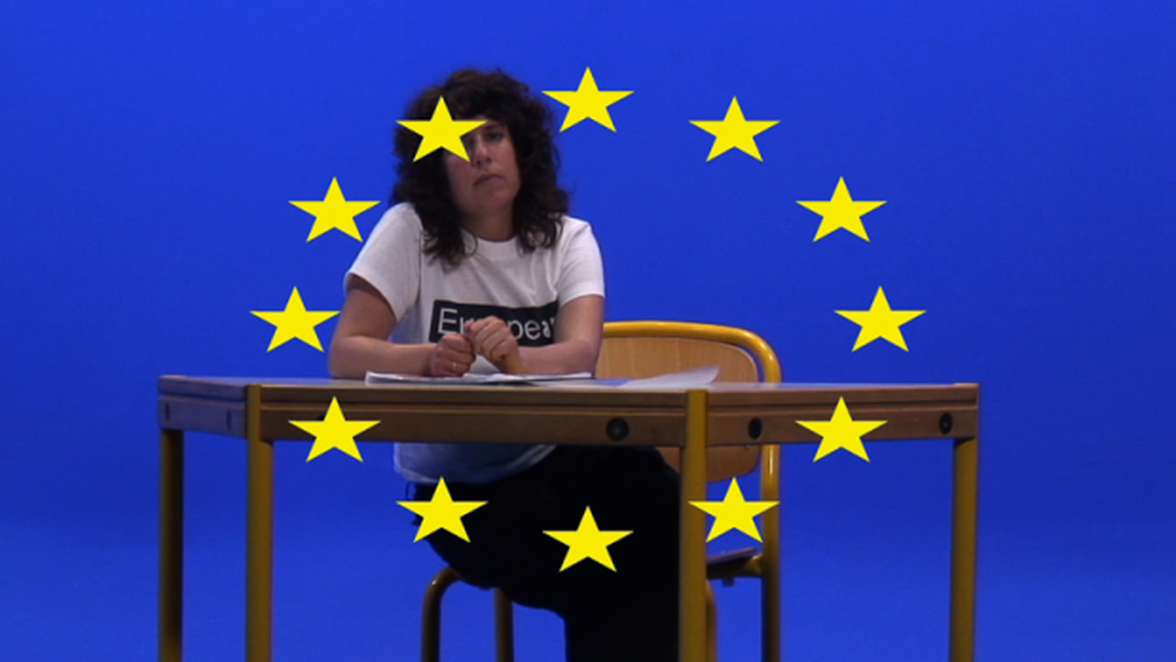
Created during a three-month residency at InterSpace in Sofia, Bulgaria (as part of 2007's At Home in Europe Project, which also included artists' residencies in Norway, Latvia, and the UK), How to Be European was inspired by Lewin's lessons in Bulgarian with Boris Angelov. "The lessons question who learns and who teaches and whether European identity exists for anyone but Americans?," she explains. "The work uses a mixed methodology of pre-written Socratic dialogues, bad acting, experimental visual techniques, educational television, obscure references and poetic news reading and covers concepts such as time, language, economics, flow and mobility, dog watching, and cultural presentation."
Wednesday, July 3, 2024
Rudy Burckhardt: Two Short Films Featuring Kenneth Koch
Monday, February 12, 2024
Short Films by Ted Roeder feat. Fagin, Foster, Godfrey, Patton, Szymaszek, Waldman
First up is a trio of films featuring Larry Fagin. In the first he speaks about writing while the second and third featuring his poetry: several new poems in the second and an excerpt from Ecology in the third. Tonya Foster (shown above) is next, reading from New Orleans Bibliography, then John Godfrey, who discusses writing in his first film and reads new work in the second. Julie Patton's two films come next, followed by Stacy Syzmaszek, who reads from Hart Island. Finally, Anne Waldman brings things to a close with three films of her reading various works. Shot in intimate settings and with glorious silvery black and white cinematography these films are as much a delight to watch as they are to listen to.
You can view all of the aforementioned films on the individual authors' pages or by clicking here for our Ted Roeder collection homepage.
Friday, November 10, 2023
Richard Foreman: 'Astronome: A Night at the Opera,' 2010
Monday, August 14, 2023
'Dome Poem NC,' a Film by Lee Ann Brown and Tony Torn, 2011
Monday, May 15, 2023
Robert Ashley: Music with Roots in the Aether (1974)
Music with Roots in the Aether is a music-theater piece in color video. It is the final version of an idea that I had thought about and worked on for a few years: to make a very large collaborative piece with other composers whose music I like. The collaborative aspect of Music with Roots in the Aether is in the theater of the interviews, at least primarily, and I am indebted to all of the composers involved for their generosity in allowing me to portray them in this manner.The piece turns out to be, in addition, a large-scale documentation of an important stylistic that came into American concert music in about 1960. These composers of the "post-serial" / "post-Cage" movement have all made international reputations for the originality of their work and for their contributions to this area of musical compositions.The style of the video presentation comes from the need I felt to find a new way to show music being performed. The idea of the visual style of Music with Roots in the Aether is plain: to watch as closely as possible the action of the performers and to not "cut" the seen material in any way — that is, to not editorialize on the time domain of the music through arbitrary space-time substitutions.The visual style for showing the music being made became the "theater" (the stage) for the interviews, and the portraits of the composers were designed to happen in that style.
Friday, May 12, 2023
Two Rudy Burckhardt Films Featuring Kenneth Koch
Friday, May 5, 2023
Mimi Gross and Red Grooms: 'FAT FEET' (1966)
As I worked with Red at various intervals of time and projects, from 1960-1976, our collaborations became increasingly intense, and often lost the boundaries of ideas, aesthetics, and in the real time of making, craft and painting.FAT FEET (1965-66) was directly inspired by the early animated films of Georges Melies, Emil Kohl, and the marvelous movie, The Invisible Moving Co, all of which we saw from the collections of Joseph Cornell (via Robert Whitman and Rudy Burckhardt). In 1962-3, together with Rudy Burckhardt, we made a 16mm film called Shoot the Moon. It is a direct homage to Georges Melies. There are some brief scenes with stop-action animation. Red and I made little cut outs, and Rudy showed us how he filmed the scene. A few years later, we experimented with animating life-sized props with live actors (long before "green screens").When Yvonne Andersen and Dominic Falcone visited us in New York, we planned to make a film together the following summer where they lived near Boston. Red and I had just moved into lively "Little Italy" (1964), a neighborhood where daily fires, violence, and long term elderly residents lived near the Bowery, filled with bums, and (pre-immigration quota) Chinatown. I was busy drawing in the streets, and making objects based on street life, and Red was obsessively chasing fires, fire engines, street life, he was incorporating into his work.The explosion of making FAT FEET resulted from our excitement living in the new neighborhood. Later, we made an ad, and called FAT FEET: "A day in the life of 'nervous city'!"
Each morning the four of us along with Dominic and our two children Paul, 7 and Jean, 5 went to the studio to build the sets and props. We painted cartoonish black and white buildings on the paper walls of the set, painted and and constructed 3/4 size flat automobiles with movable wheels from heavy building cardboard. Red built a dog which could be animated to walk in front of a live person.Red was creating a cartoonish atmosphere depicting the types of city people who might be seen walking the street of a big city. For this reason the people wore giant shoes to connect them to the sidewalks. Those shoes were heavy! A normal shoe was screwed into a giant shoe manufactured by Red.In the beginning this was supposed to be a four person project, but people heard about it. Each night people came to be in the winter crowd scenes. Some were friends of Red and Mimi, some were my animation students and neighbors. We got old coats from Morgan Memorial and there was a large make up table. People could come in, put on a coat, do their own make up, and become who they wanted to be for the evening.
/media/movies/covers/2018/06/music2.jpg)