Friday, March 29, 2024

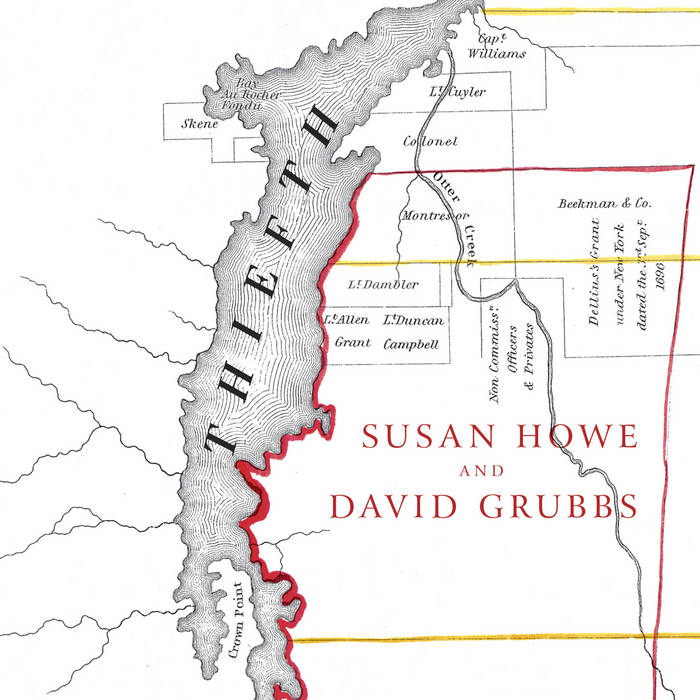
Susan Howe and David Grubbs, 'Thiefth' (2005)

With this week's exciting news of a forthcoming album from Gastr del Sol — We Have Dozens of Titles,  "an alternative view to their genre-melting 1993–1998 run" consisting of "previously uncollected studio recordings and beautifully captured unreleased live performances" — it's a great day to revisit Thiefth, one of band co-founder David Grubbs' groundbreaking collaborations with poet Susan Howe.

Originally released on the indie label Blue Chopsticks in 2005, Thiefth was the first album issued by Howe and Grubbs (they would work together on the 2007 album, Souls of the Labadie Tract and many live performances since). The project was proposed by the Fondation Cartier in 2003, and late in the year, the two began work on staging performance versions of two long-form Howe poems: "Thorow" and "Melville's Marginalia."

"Drawing from the journals of Sir William Johnson and Henry David Thoreau," we're told in the production notes, "'Thorow' both evokes the winter landscape that surrounds Lake George in upstate New York, and explores collisions and collusions of historical violence and national identity," creating "an act of second seeing in which Howe and Grubbs engage the lake's glittering, ice surface as well as the insistent voices that haunt an unseen world underneath. Presented in four parts, the piece features woodwinds from Mats Gustafsson and cello by Nikos Veliotis, which, along with Howe's voice, are woven together by Grubbs into a soundscape of sinister, reedy drones, celestial noise and dense, skittery montages of processed speech.
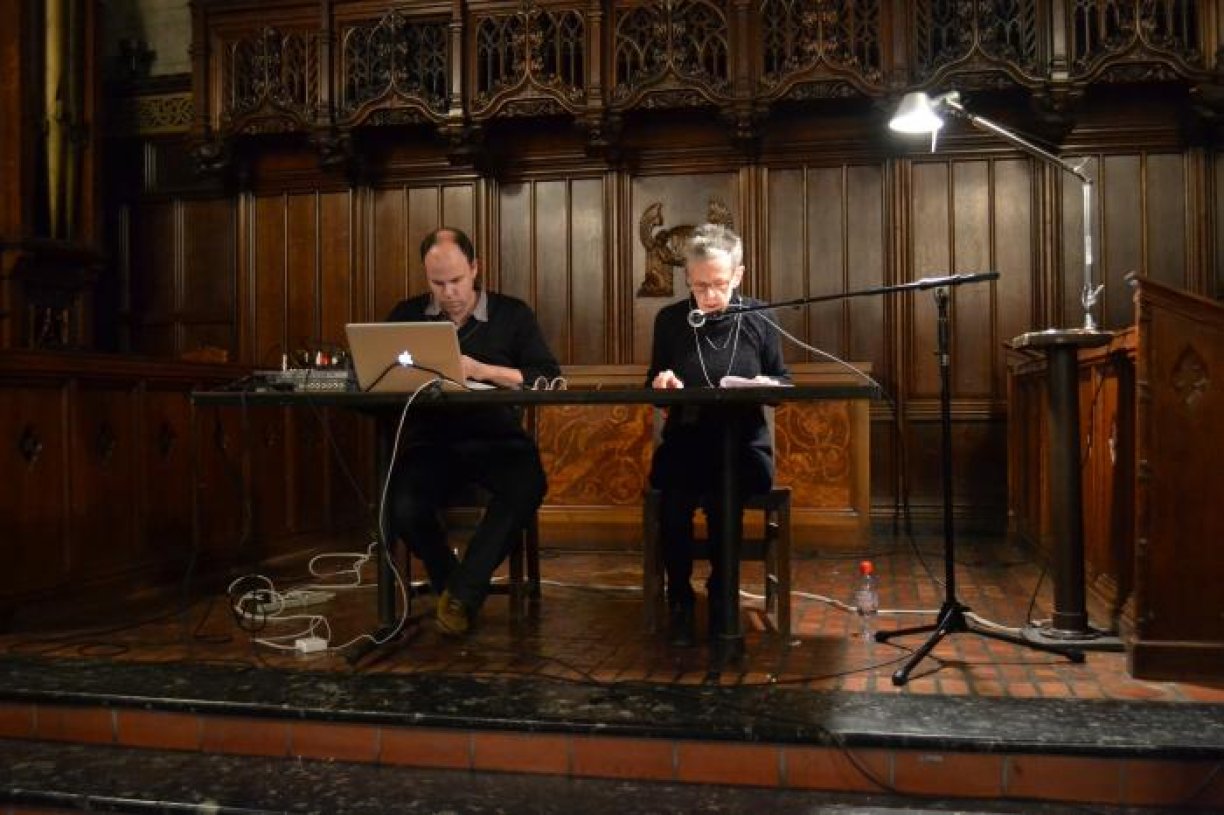
Thiefth's coda is "Melville's Marginalia," described in the notes as "an approach to an elusive and allusive mind through Herman Melville's own reading and the notations he made in some of the books he owned and loved. Undergirded by Grubbs' piano and laptop manipulations the soundtrack toys with listeners' emotions, shifting between striving strings and skewed piano figures set in motion by the percussive sounds of dripping water, while Howe's recitation creates a similarly multi-faceted dialogue between her perspective and Melville's. "The collaging and mirror-imaging of words and sounds," Grubbs writes, "are concretions of verbal static, visual mediations on what can and cannot be said."

We've put together a special page to house Howe and Grubbs' collaborations, where Thiefth is presented in lavish fashion, complete with photographs, liner notes and more. We're grateful to David Grubbs for passing along these supplementary materials, and to Blue Chopsticks (and its parent label, Drag City) for generously agreeing to make this album available through PennSound.

Wednesday, March 27, 2024

Remembering Adrienne Rich

Today we're remembering legendary poet and theorist Adrienne Rich, who passed away on this day in 2012. 

It would be difficult to list all of the accolades that Rich accumulated in the more than sixty years since her debut collection, A Change of World, was chosen by W.H. Auden for the Yale Younger Poets Award in 1950, but they include a Guggenheim Fellowship (1952), the National Institute of Arts and Letters Award (1960), the Poetry Society of America's Shelley Memorial Award (1970), the National Book Award (for Diving into the Wreck, 1974), the Poetry Foundation's Ruth Lilly Poetry Prize (1986), admission to the American Academy of Arts and Sciences (1991), the Lenore Marshall Poetry Prize (1992), the Frost Medal (1992), an Academy of American Poets Fellowship (1992), a MacArthur Fellowship (colloquially known as the "genius grant," 1994), the Wallace Stevens Award (1996), the National Medal of Arts (1997), and the Griffin Poetry Prize Lifetime Recognition Award (2010). Among these, it is perhaps the penultimate honor that is the most important, as Rich refused it, citing the government's hostile policies towards culture. "I could not accept such an award from President Clinton or this White House," she stated, "because the very meaning of art, as I understand it, is incompatible with the cynical politics of this administration . . . The radical disparities of wealth and power in America are widening at a devastating rate. A president cannot meaningfully honor certain token artists while the people at large are so dishonored"

This impassioned gesture serves as one very public and high-profile culmination of the process of radicalization that began in the early 1960s, as Rich, along with the nation at large, underwent tremendous cultural, political and social transformation. These preoccupations — the rights of women, the civil rights movement, stopping the war in Vietnam (and others since), ending poverty, and championing queer identity — were freely espoused in a number of celebrated volumes, including Leaflets, The Will to Change, Diving into the Wreck, A Wild Patience Has Taken Me This Far, and An Atlas of the Difficult World, and also in a prodigious body of non-fiction writing, where Rich found a second life as a groundbreaking feminist theorist. These deeply-held beliefs only grew stronger in the new millennium, where Rich faced troubling political times with a strong faith in poetry's remediative powers. Writing in The Guardian in 2006, she evoked Shelley's oft-quoted appraisal of poets as "the unacknowledged legislators of the world," observing "I'm both a poet and one of the 'everybodies' of my country. I live with manipulated fear, ignorance, cultural confusion and social antagonism huddling together on the faultline of an empire." These sentiments were explored masterfully in later volumes such as Fox, The School Among the Ruins, Telephone Ringing in the Labyrinth, and her latest collection, Tonight No Poetry Will Serve, and while Rich is often hailed as an exemplary feminist poet, or queer poet, or political poet, above all, she was an extraordinary (but otherwise adjective-less) poet.

You can listen to a variety of recordings spanning four decades on PennSound's Adrienne Rich author page, which is home to recording spanning from a 1951 set at Harvard's Woodberry Poetry Room all the way up to a 2006 reading at The Poetry Center at San Francisco State University. In them, and the twenty or so readings that come in-between, you'll find a thoroughgoing survey of almost her entire poetic career — from iconic poems to deep cuts — as well some representative prose. Of course, one of our favorite recordings is from Rich's 2005 visit to UPenn as a Kelly Writers House Fellow. Click here to start exploring.

Tuesday, March 26, 2024

In Memoriam: Marjorie Perloff (1931–2024)

This year's overwhelming procession of deaths within the poetry community continues with news that critic Marjorie Perloff passed away on March 24th at the age of 92.

Our own Al Filreis posted a remembrance today, noting "I spoke for a lively, *lively* hour with the late and already much-missed Marjorie Perloff just a week ago. I loved her energy always and even then — was and am inspired by her skills & daring as a careful reader of and talker about supposedly 'difficult' poetry." He continues,"From the moment we met in 1982 (at the Huntington Library, where we shared days together for a month), she showed interested in me and my work and was unfailingly supportive. Even last week, during our final conversation, she wanted to know what I was doing, how my family was, how my ideas were evolving, what I was reading." He also encouraged everyone "to have a look back at that array of comments and criticism" in his 2012 co-edited Jacket2 feature "Marjorie Perloff: A Celebration."

We also direct listeners towards Perloff's PennSound author page, which archives a wide array of recordings spanning 35 years, including talks, interviews, podcasts, and more. One key highlight is Perloff's epic, three-part 2009 Close Listening program hosted by Charles Bernstein, in which she reads from her 2004 memoir Vienna Paradox and discusses topics ranging from Kristallnacht and literary figures associated with Nazi Germany to her European outsider's perspective on American arts and culture, as well as several key "schisms that seem to divide 20th century poetry" — Yeats and the Futurists, O'Hara and Lowell, Pound and Stein/Stevens. Another is her 2011 visit to UPenn as one of that year's Kelly Writers House Fellows. You can browse all of these recordings and more on PennSound's Marjorie Perloff author page.

We send our condolences to Perloff's family and her friends and colleague worldwide.

Sunday, March 24, 2024

Happy Birthday to Lawrence Ferlinghetti

Today we celebrate the long and fruitful life of poet and publisher Lawrence Ferlinghetti, who was born 105 years ago today in Bronxville, NY. We first launched PennSound's Lawrence Ferlinghetti author page in March 2018 on the poet's 99th birthday and mourned his passing just shy of two years later by highlighting recordings from that collection.

The most recent recording you'll find there is an hour-long set from 1994 at Page Hall in Albany, which comes to us via Chris Funkhouser. Next we have a pair of recordings from the archives of George Drury and Lois Baum, including an appearance on the program Word of Mouth and a forty-minute reading of selected poems at the Art Institute of Chicago. Then there's Ferlinghetti's Watershed Tapes release Into the Deeper Pools, recorded in two sessions in Bethesda and Baltimore, Maryland in 1984 and 1983, respectively, and his 1981 S-Press cassette release, No Escape Except Peace. Jumping back a few decades, there's a set of poems recorded in 1969, including "Assassination Raga" and "Tyrannus Nix," which were digitized by Joel Kuszai for The Factory School, and the Ferlinghetti/Ginsberg episode of Richard O. Moore's Poetry USA series from 1966. Finally, along with a short recording from the Berkeley Poetry Conference and a few assorted recordings without dates. You can listen to any of the aforementioned recordings by clicking here.

Saturday, March 23, 2024

PoemTalk #194: Two by Veronica Forrest-Thomson

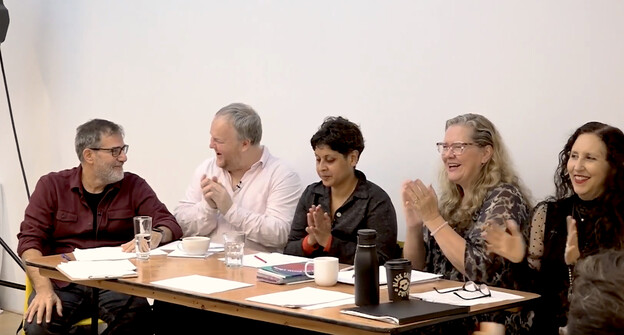
Earlier this week, we released the latest episode in the PoemTalk Podcast series — a special program recorded abroad at the Fruitmarket Arts Center in Edinburgh, Scotland — which focuses on two poems from Veronica Forrest-Thomson, "S/Z" and "Lemon and Rosemary." For this program, host Al Filreis was joined by a super-sized panel including host and co-organizer Iain Morrison, Laynie Browne, Lee Ann Brown, and Anthony Capildeo. 

After thanking Browne ("who chose the poems and curated this episode"), Filreis' write-up of this new episode on Jacket2, offers some provenance for the recordings under discussion here: "The audio you'll hear toward the beginning is from a recording made at the important Cambridge Poetry Festival of April 1975; we note that Forrest-Thomson's performance there preceded her death by just a few weeks." He continues, "If you follow the reading of 'Lemon and Rosemary' along with the final published text you'll notice that there are significant differences between that and the version she read at the festival." He concludes with thanks for Dr. Gareth Farmer and Forrest-Thomson's estate for permission to use these recordings.

You can listen to this latest program and learn more about the show here. PoemTalk is a joint production of PennSound and the Poetry Foundation, aided by the generous support of Nathan and Elizabeth Leight. Browse the full PoemTalk archives, spanning more than a decade, by clicking here.

Thursday, March 21, 2024

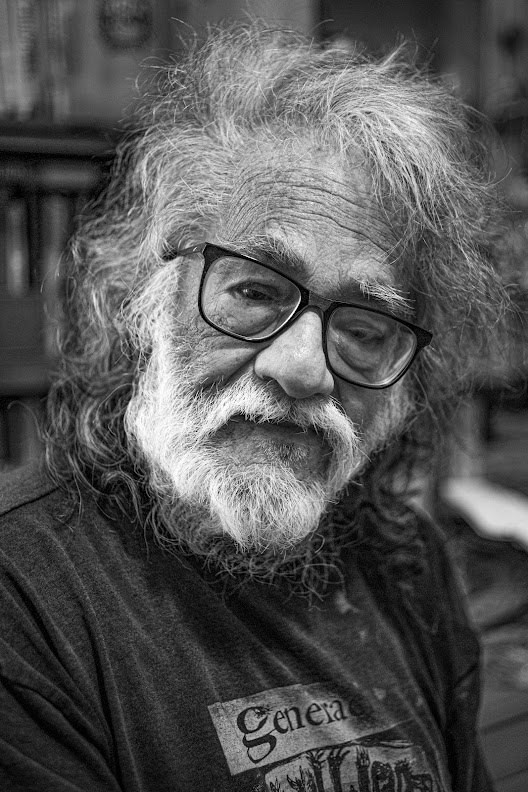
In Memoriam: Neeli Cherkovski (1945–2024)

Today we are sad to share news that poet, biographer, and memoirist Neeli Cherkovski passed away on March 19th at the age of 78. His death was announced by Garrett Caples on the City Lights Booksellers blog — a fitting tribute given his long, loving association with San Francisco. I was particularly struck by his summation of Cherkovski's dedication to poetry itself and its broader communities. While he was "occasionally exasperating, needy, desperate to be read and loved," Caples notes, "he was no less desperate for the poets he loved to be read and loved, and he loved a lot of poets." He continues:
And by this I mean not his pantheon or his peers, but generations of younger poets, whom he read with a discerning eye. Perpetually curious and voracious as a reader, he kept up with new poets to his dying day. There are poets who want to lord what they have over you and poets who want to share what they have with everyone they esteem, and Neeli was firmly in the latter camp. I don’t know how he kept up with so many poets, and I’m almost 30 years younger. It takes a generosity and largeness of spirit few possess and poets like Neeli are valuable for the continuity they impart to the vast and everchanging ocean that is poetry.

On PennSound's Neeli Cherkovski author page, you'll find a couple of vintage recordings from the poet — including a 1969 reading with Charles Bukowski and a 1980 set from San Francisco's Caffe Malvina — along with a number of videos from the last 15 years or so. These include readings, talks, conversations, and interviews and provide a wonderful sense of Cherkovski's diverse talents. We send our condolences to the poet's friends and fans worldwide.


Friday, March 15, 2024

Robert Frost on PennSound

It's now been eight years since the launch of PennSound's Robert Frost author page. PennSound director Chris Mustazza, who recovered the recordings, offered an encapsulation of his work in a post as part of his Jacket2 commentary series "Clipping":
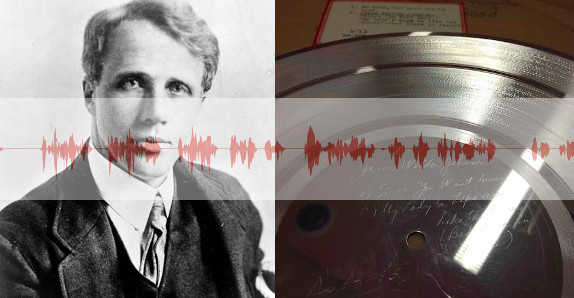
As part of my work to excavate, digitize, and contextualize one of the first poetry audio archives in US, The Speech Lab Recordings, I'm thrilled to announce a significant addition to the collection: new digitizations of previously unreleased Robert Frost recordings, made in the Speech Lab in 1933 and 1934.

These recordings, which may be the first recordings ever made of Frost, in one sense mark a departure from the aesthetic circumscription of the collection. Many of the poets who were recorded in Professors W. Cabell Greet and George W. Hibbitt's Columbia University lab built for the study of American dialects operated in a modernist tradition of formal innovation. From the collection's founding with the performance-forward, Dada-esque incantations of Vachel Lindsay through James Weldon Johnson's Afro-Modernist scoring of speech sounds and Gertrude Stein's proto-Language poetics, it's clear that the editors favored a particular strain of modernism.

But while Frost is known for his use of and variation upon traditional forms and rhyme schemes, his poetics do bear affinities to those of the more formally innovative poets recorded in the series, most especially his interest in the aural properties of the poem.
You can read more of his detailed intro here. The two sessions archived here were made in 1933 and 1934 and include iconic poems like "Stopping By the Woods on a Snowy Evening," "Mending Wall," and "The Road Not Taken" along with "Dust of Snow," "Once by the Pacific," "Mowing," "Spring Pools," "Birches," "The Grindstone," "The Runaway," and "An Old Man's Winter Night," along with two takes of "The Code," which Mustazza singles out in his notes. 

To start listening, click here to visit PennSound's Robert Frost author page.

Tuesday, March 12, 2024

In Memoriam: Tyrone Williams (1954–2024)

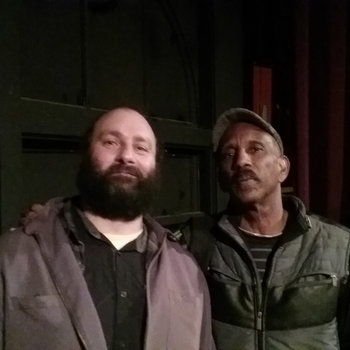
We at PennSound regretfully share the news that beloved poet and critic Tyrone Williams passed away on March 11th at the age of 70. The author of numerous books, including c.c. (2002), On Spec (2008), "the Hero Project of the Century" (2009), Adventures of Pi (2011), Howell (2011), As Iz (2018) and washpark (with Pat Clifford, 2021), Williams had recently joined the SUNY-Buffalo faculty as David Gray Professor of Poetry and Letters after a long teaching career at Xavier University in Cincinnati. Our own Charles Bernstein, shown with Williams at right, noted that both "had the honor" of leading the Buffalo Poetics Program as the David Gray Professor and offered this lament: "The pleasure of his company now so painfully the pleasure of his memory." 

Al Filreis shared this remembrance: "Now Tyrone Williams is gone. What an awful loss. We had a wonderful productive run of annual gatherings at the Writers House: Aldon Lynn Nielsen, Billy Joe Harris, Tyrone, and me — and always a special invited guest poet to join us." He concluded, "I'll never forget Tyrone's honest, wise contributions to these discussions." He also shared his favorite PoemTalk episode to come out of one of these visits: #126, on Amiri Baraka's "Something in the Way of Things (In Town)."

That's just one of many PoemTalk programs you'll find on PennSound's Tyrone Williams author page, along with a wide array of recordings from 2006 to the present. One of my favorites is Tyrone's brief intro set to a reading by Sueyeun Juliette Lee, whom he'd invited to Xavier University. It was early evening at the end of the semester, with an enthusiastic audience crowded into a classroom on a high floor, the sunset seeping in through the windows. As tired as I was that late in the semester, the experience was sublime. Not knowing about his illness, I had just reached out to Tyrone recently, with hopes that he'd be involved in a PennSound project that I was putting together, and had hoped I would see him at the upcoming Louisville Conference. Certainly, our city was already lessened by Tyrone's departure, but now the whole world knows that feeling just as well.

Monday, March 11, 2024

Happy Birthday, Joe Brainard!

Today we celebrate endlessly influential author and artist Joe Brainard, born on this day in 1942. Our Joe Brainard author page is anchored by four readings from the St. Mark's Poetry Project recorded between 1971 and 1981. They include copious excerpts from his magnum opus, I Remember, along with selections from his journals and numerous other pieces such as "Thanksgiving," "Insomnia," "Worry Wart," "The Zucchini Problem," "Today (Monday, February 23rd, 1981)," and "Sick Art." Additionally, you'll find excerpts from Train Ride read at SFSU in the mid-1970s and a stellar reading with Bill Berkson at Intersection for the Arts in 1971, plus more I Remember selections taken from a 1974 Giorno Poetry Systems session and a recording session at home in Calais, VT in 1970. 

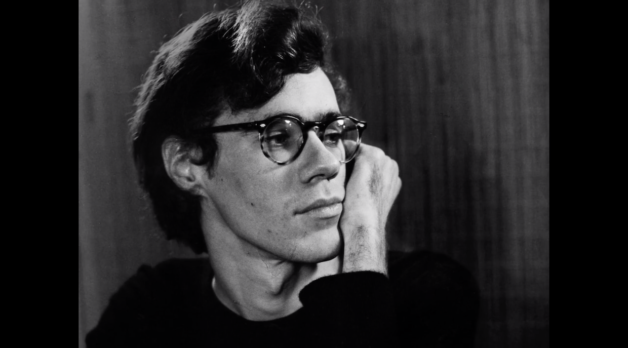
Filmmaker Matt Wolf (who directed the much-lauded Wild Combination, a documentary on the life of avant-pop cellist Arthur Russell) is back with an exciting new project — I Remember: A Film About Joe Brainard — a haunting and gorgeous meditation that deftly intertwines both imagery and audio to create a compelling tribute to the artist and author. We're very glad to see Brainard commemorated in such grand fashion, and happier still that Wolf was was kind enough to share an exclusive clip with PennSound. In it, longtime friend, collaborator and confidante Ron Padgett discusses Brainard's early development as a visual artist and his ability to work confidently in a wide variety of media and forms, never becoming complacent in one style.
You'll find all of the recordings mentioned above by clicking here. It's also worth checking out Andrew Epstein's 2014 Brainard birthday post on his New York School-focused blog, Locus Solus, which features excerpts from a tribute poem by James Schuyler, excerpts from I Remember "thinking about birthdays, and our frustrating efforts to understand 'time,'" and a few examples of his artwork. Brainard's birthday is also a wonderful reason to revisit the Make Your Own Brainard site, where you can make your own collages using fragments from his visual work.

Friday, March 8, 2024

For International Women's Day: Belladonna*

Today, in honor of International Women's Day, we're taking a look at the long-running and highly influential Belladonna* Readings Series, and the Belladonna* Collective, which will turn 24 in 2024. Here's how they define their mission:
Belladonna* Collaborative promotes the work of women and feminist writers who are adventurous, experimental, politically involved, multi-form, impossible to define, unpredictable, and dangerous with language. Belladonna* is committed to publishing and building literary community among women and LGBTQIA+ authors who write off-center, producing work that is political and critical; situational rather than plot-driven; inter-subjective, performative, or witnessing rather than personally revelatory; work that reaches across the boundaries and binaries of literary genre and artistic fields, and that questions the gender binary.
You'll find a vast archive of recordings on PennSound's series page for the collective, going all the way back to the summer of 1999. Recent Belladonna* events posted to our site have included performances by Erica HuntAnne WaldmanCarla HarrymanLaTasha N. Nevada DiggsRachel LevitskySawako NakayasuTonya FosterJulie PattonMarcella DurandLyn HejinianAnna MoschovakisGail ScottBernadette MayerStacy SzymaszekTina DarraghK. Lorraine GrahamMónica de la TorrePatricia Spears JonesRachel Blau DuPlessis, and Orchid Tierney among many others. Start exploring this groundbreaking series' quarter-century history by clicking here

Wednesday, March 6, 2024

Aural Monsoon: 'Live in the Haight' (2017)

Here's an opportunity to get to know another side of poet Will Alexander through his jazz duo, Aural Monsoon, where he plays piano alongside drummer Mark Pino. Today, we're proud to highlight Live at the Haight, an album recorded on August 13, 2017. Click here to listen to all nine tracks, including "Bamboo and Fire," "Calm and Furious Waters," "Verdigris Panorama," "Lyrical Jasmine Towers," "Aural Diamonds in Motion," and "Double Recognition."

Here's what Pino had to say about his their collaboration: "Los Angeles poet and musician Will Alexander's work been shaking my perceptions for several years now. I was happy to play with him on sets with Cloud Shepherd, and continue to love to read his writing. Hence, when Will contacted me to ask about my being available for a house show in San Francisco, with me on drums and he on piano, I jumped at the opportunity." Later, he says of the same gig, "Towards the end of the second set, I simply stopped playing my drums and listened to Will, more as a fan than a duo partner. I guess I kind of got lost in that for a few minutes. Will's Surreal Trance moves will have that effect!"

For those craving more of Alexander's work, click here to visit his PennSound author page, which is home to a variety of talks, readings, and interviews going back to 1994.

Monday, March 4, 2024

Kathy Acker, 'Redoing Childhood' (1999)

Today we're taking a dip into the PennSound archives to showcase Kathy Acker's album Redoing Childhood (Kill Rock Stars, 1999), which we first added to the site in December 2007. Here's what our original PennSound Daily announcement said about the record:
Produced by Hal Willner (William S. Burroughs, Allen Ginsberg, Lou Reed), the album features musical accompaniment by feminist punk band Tribe 8, as well as David Cunningham (keyboards), Ralph Carney (reeds), Joe Gore (guitar), Steve Bernstein (trumpet) and Kenny Wollesen (drums), who slip effortlessly between time signatures and genres, providing a roiling bed of sound which perfectly complements Acker's seething delivery. Willner originally recorded Acker's contribution in 1993 — a time in which the recurring references to President Bush were a not-yet-faded memory of a graceless political era — and though she worried about the timeliness of such allusions during the general political torpor of the Clinton era, they're eerily fitting now, a decade after her death.
Of course, our current political climate seemed practically unimaginable way back then, and Acker's strident and uncompromising perspectives are, no doubt, even more vital then than now. Hindsight also provides us with the opportunity to share these observations on the album and its origins, via Chris Kraus' After Kathy Acker: A Biography, which explains how Acker reframed large chunks of her recent book, My Mother: Demonology as "as an avant-operatic spoken-word CD":
Each take was done virtually nonstop, and Ralph Carney recalls Acker jumping up and down in the booth while Tribe 8 played. When it was finally released two years after her death, Redoing Childhood revealed a new dimension to Acker's work. "Her voice in general, there was something so lush and luscious and embracing and sexy," Ira Silverberg told the Seattle Weekly. "Kathy had rock star energy about her. [Her performance] had less to do with the punctuation of the actual sentences than with her almost reinterpreting her own work in a lyrical way … Kathy just got it."
You can listen to the complete album, along with a 1978 Segue Series reading (with selections from Blood and Guts in High School), recordings from SUNY-Buffalo in 1979 and 1995, and several recordings surrounding Acker's late novel, Pussy, King of the Pirates, including the 1995 album of the same name she recorded with the Mekons by clicking here. As always, we're grateful to Matias Viegener and the Acker estate for their permission to share these recordings with our listeners.

Friday, March 1, 2024

Remembering John Wieners

This March 1st marks twenty-two years since the passing of beloved poet John Wieners, whose long writing life took him from Black Mountain to San Francisco to New York City to Buffalo, and finally to Boston, where he spent the last three decades of his life. It's also a great opportunity for our listeners to reacquaint themselves with the recordings available on PennSound's Wieners author page.

Our earliest recordings include Wieners' participation in the Mad Monster Mammoth Poets Reading for Auerhahn Press in 1959 and a 1960s appearance on Paul Blackburn's radio program. That's followed by a trio of recordings from 1965: Wieners' July 14th set at the Berkeley Poetry Conference, another July reading possibly in Berkeley, and a brief recording from SUNY-Buffalo that September. Next, we have a October 1966 event from the 92nd Street Y's Unterberg Poetry Center and a pair of long recordings made at SUNY-Buffalo in 1967 and at the St. Mark's Poetry Project in 1968. Following that we have a wonderful conversation with Walter Lowenfels, Lillian Lowenfels, and Alan DeLoach in March 1969 and two recordings from Boston in 1972: two days' worth of visits to Robert Creeley's ENG-1670 class at Harvard and a short appearance on WBCN-FM.

Jumping forward to the 1980s, there are two tracks from The World Record: Readings at the St. Mark's Poetry Project, 1969-1980 and three poems recorded at Brooklyn College in 1988. The next decade starts in grand fashion with a pair of recordings from the spring of 1990: the first in San Francisco, followed by an appearance at the St. Mark's Poetry Project. There's another Poetry Project set from the fall of 1996, and an October 1999 reading at the Guggenheim to round things out, along with the recently-added film Hanuman Presents!

I also happily recommend that interested listeners check out the Wieners component of Jim Dunn and Kevin Gallagher's ambitious Jacket2 feature, Mass: Raw Poetry from the Commonwealth of Massachusetts," which we published in December 2012, as well as Wieners' page at the Electronic Poetry Center.