Friday, December 29, 2023

Paul Buck's Pressed Curtains Tape Project

In the 1970s, Paul Buck edited Curtains, a leading British avant-garde journal, whose amorphous identity was evidenced by its issue-by-issue name changes (Safety Curtain, Curtain-Raiser, A Range of Curtains, etc.) in the style of Tom Clark's Once and Kenward Elmslie's Z. "Curtains was not a poetry magazine either," Buck notes, "though it contained poetry and was viewed as part of the poetry world. Initially I was intent on researching an area of writing between poetry and prose, a writing that was more likely to be written by poets, though not exclusively." In time, the magazine would expand to become a multimedia endeavor:
Halfway through the 1970s, the notion of performing, whether relating to "performance art" or in terms of the oral tradition of poetry, was another factor that became part of the fabric. I was combining the two courses and exploring the oral in terms of poetry, music, art and ethnic traditions. It seemed natural to extend the boundaries of Curtains into a cassette tape series, even if no sophisticated equipment was available, either at home or nearby. 

In time, Buck would go on to release three cassettes under the series name Pressed Curtains: readings by Eric Mottram and Ulli McCarthy (then known as Ulli Freer) made at his own home, along with a recording of himself reading his piece xxxx7. Other recordings were made for potential release, but never saw the light of day. That ended in 2015, when Test Centre and Blank Editions put out a lavish limited-edition box set including a ten cassettes in total. With that edition of fifty now sold out, Buck has generously shared the complete archives with PennSound. In addition to the three original releases, you'll find recordings by Kathy Acker, cris cheek, Allen Fisher, Bill Griffiths, Pierre Joris, Robert Kelly, and Jean-Luc Parant. Buck's illuminating liner notes are also included. Click here to start exploring this fascinating time capsule.


Wednesday, December 27, 2023

Abigail Child: Selected Films 1986–2006

Today we're highlighting a series of short films by poet and filmmaker Abigail Child. Our new page for Child's Selected Films 1986-2006 — edited by PennSound Contributing Editor, Danny Snelson — showcases four short films from throughout her past two decades of work.

The most recent film present here is 2006's Mirror World, a collaboration with Gary Sullivan, which reworks material from Mehboob Khan's Bollywood film, AAN into a fascinating twelve-minute short that layers soundtrack, dialogue and subtitles, manipulates framing and fractures narrative to critique both gender and social roles within Indian cinema while simultaneously celebrating its bright spectacle.

Next, we have three selections from Child's ongoing series, Is This What You Were Born For?: Perils (1986), Mayhem (1987) and Mercy (1989). Each organized around a central abstract notion, and embracing a jarring montage aesthetic (that's wonderfully complemented by scores featuring Christian Marclay, Charles Noyes and Zeena Parkins, among others), these films navigate a broad array of source materials to create mesmerizing meditations on our relationship to film and the ways in which the everyday and the extraordinary are reflected through the medium.

In addition to these videos, you'll want to check out the extensive archive of recordings on Child's main PennSound author page. A perennial favorite of the Segue Series, you'll find no less than six readings taking place between 1985 and 2008, split equally between the Ear Inn and the Bowery Poetry Club. There's also a 2000 appearance on PhillyTalks (which includes four poems) and a wonderful Close Listening reading and conversation with Charles Bernstein in 2007 (the former show, featuring writing from Solids, A Motive for Mayhem and Post Industrials, among others, is also segmented into six individual files). An audio-visual introduction to Child's work is only a click away.

Saturday, December 23, 2023

John Richetti Reads Clement Clarke Moore's "A Visit from St. Nicholas"

We close out this week with one more beloved December tradition: our good friend John Richetti performing Clement Clarke Moore's poem, "A Visit from St. Nicholas," from his ever-growing anthology, "125 Favorite Poems, Good for Memorizing."

More frequently known by its opening phrase, "'Twas the night before Christmas ...," "A Visit from St. Nicholas" was first published in Troy, New York's Sentinel on this day in 1823 with no attribution. It became wildly popular, reprinted far and wide, and its author — a professor of literature and divinity at New York City's General Theological Seminary of the Episcopal Church, who initially sought to downplay his connection to the poem — would finally be credited in 1837, with Moore including it in a collection of his verse in 1844.

Click here to listen to Richetti's performance of the poem. You can read along on the Poetry Foundation's copy of the poem here. Many more recordings made by Richetti form the backbone of our PennSound Classics page, which is organized by author name. To start browsing, click here.


Friday, December 22, 2023

PoemTalk #191: on Two by Kenward Elmslie

Yesterday, we released the latest episode in the PoemTalk Podcast series, which focuses on two pieces — one poem ("Core Bonus") and one song ("One Night Stand") — by the multifariously talented Kenward Elmslie. A panel that included (from left to right) Henry Steinberg, Simone White, and Wayne Koestenbaum joined host Al Filreis for this program.

Filreis starts off his write-up of this new episode on Jacket2, with some fascinating backround information on the titles being discussed as well as the recordings: "As of the recording we had not located published/in-print version of 'Core Bonus' but Elsmlie's PennSound page includes a record of it. 'One Night Stand' was included in Routine Disruptions: Selected Poems and Lyrics (Coffee House Press, 1998)." He continues,"'Core Bonus' was performed during a Segue Series reading at the Bowery Poetry Club in New York on April 7, 2007. 'One Night Stand' was sung by Elmslie at the Kelly Writers House on November 12, 2003, for an event titled 'Snippets: A Gathering of Songs, Visual Collaborations, and Poems.'"

You can listen to this latest program and learn more about the show here. PoemTalk is a joint production of PennSound and the Poetry Foundation, aided by the generous support of Nathan and Elizabeth Leight. Browse the full PoemTalk archives, spanning more than a decade, by clicking here.

Thursday, December 21, 2023

Spending Midwinter Day with Bernadette Mayer

At 10:27PM EST this evening we will officially make the transition from autumn into winter, already five hours into the longest night of the year. For many of us, this day inevitably brings bittersweet remembrances of the late Bernadette Mayer, whose beloved Midwinter Day celebrates its forty-fifth birthday this year. While not published until 1982, Mayer famously wrote the book — hailed by Alice Notley as "an epic poem about a daily routine ... sedate, mundane, yet marvelous" — in its entirety while marking the the winter solstice at 100 Main Street in Lennox, Massachusetts on December 22, 1978. 

Celebrating Mayer and Midwinter Day on this day is an annual PennSound tradition, dating back to 2014. As Megan Burns notes in her Jacket Magazine essay on the book: "A long held tradition on Midwinter's Day was to let the hearth fire burn all night, literally keeping a light alive through the longest night of winter as a source of both heat and a symbol of inspiration to come out the other side of the long night closer to spring and rebirth. It is fitting that a poem about surviving death and the intimacy of the family would be centered around this particular day that traditionally has focused on both. The hearth is the center of the home where the family gathers, where the food is cooked and where warmth is provided. Metaphorically, the poem Midwinter Day stands in for the hearth gathering the family into its folds, detailing the preparation of food and sleep and taking care of the family's memories and dreams."

Mayer read a lengthy excerpt from the book at a Segue Series reading at the Ear Inn on May 26th of the following year, which you can listen to on her PennSound author page along with a wide array of audio and video recordings from the late 1960s to the present. 

Wednesday, December 20, 2023

Presenting an Updated PennSound Daily Archive

Isn't it amazing how time flies? Certainly, in the midst of this holiday season, most of us are feeling that swift passage of time for many different reasons, both happy and doleful. Today, in particular, we're thinking about PennSound Daily, which has come a long way since the first brief note posted on October 17, 2007. We estimate that there have been well over 2,000 entries in that time, but until now its archives been a little difficult to access, due largely to the technical issues that led to its hiatus over a span of months in 2017–2018.

That changes today with the introduction of a revamped PennSound Daily archive that assimilates our earlier month-by-month pages within the site for 2007 through 2017 entries with brand new links to monthly archives from 2018 forward hosted through Blogger, which is how we've generated new posts over the last five years. These newer pages also allow readers access to a brief but helpful set of tags (including PoemTalkIn Memoriam, and PennSound Cinema). 

This is but a stopgap measure, yet one that we wanted to make sure our listeners knew about. Stay tuned for a more thorough integration of both sets of archives and more tools to facilitate exploration in 2024 and beyond. If you told me in 2007 that I was going to write more than 2,000 of these things, I'd have probably stepped in front of the 42 bus, but on the other side of that process, it's quite lovely to look back at that body of work, which is still one of our primary ways of connecting with our listenership. Take a stroll through our newly revamped PennSound Daily archive today, and witness the site's evolution in a microcosm.


Monday, December 18, 2023

Purkinge, "Lollapalooza Soundtrack" (1994)

While Chris Funkhouser has been sending us tapes from his incredible archives from over a decade, they are more often than not recordings of other folks and not his own poetics and musical projects. Today we're taking a look at one such rare recording — a 1994 performance from the Lollapalooza festival's stop in Saratoga Springs, NY by Purkinge, a supergroup of sorts in which Funkhouser had taken part. Here's his description of the group's evolution and their triumphant appearance on the sidestage of the eclectic summer festival:
In 1992 made the unlikely move from Santa Cruz to Albany to pursue a Ph.D., partially because Katie Yates told me about a fascinating collaborative writing initiative Don Byrd spearheaded there. Too much technical & social back story to tell, but a performance group consisting of Sandy Baldwin, Belle Gironda, Eric Douglas, & I emerged named Purkinge (after brain fibers that conduct an electrical stimulus enabling the heart to contract in a coordinated fashion). Networked writing conducted across a series of computer terminals, sound, & stage were emphasized. We made hundreds of pages of poems, hours of multi-track recordings, played arts venues & theory conferences. Intent on re-defining expressive conventions, we weren't together to be popular or make money; we liked each other & did whatever we wanted given what we had ("being only possible because of gravity"). I was the only musician in the group, but our shows always featured soundtracks with everyone's input. 
We peaked in so many ways at the Saratoga Raceway stop of the 1994 Lollapalooza festival. People I knew were running a side stage, & various friends traveled show-to-show. I was invited to join & round up local talent. Purkinge worked on a set for a few weeks, mixing a 23 minute soundtrack combining ambient recordings, percussive segments, & language. We made several hundred 10 inch segments of dowels for the crowd. Voices on tape freed us from being bound to microphones, so we moved around a lot. We planned an interactive experience with the audience, & an almost unbelievable thing happened. Gorgeous afternoon: main-stage sets by the Breeders & Boredoms transpired under sunny skies. I wore a skirt, & a random party girl said, "I'm glad you're man enough to wear that." Shortly before Purkinge's show beneath a mini-circus tent on the infield, black clouds roll in & — simultaneous to thunder playing on our soundtrack — an intense thunderstorm hits. Suddenly five- or six-hundred people were in the tent, many of them hopped up, drumsticks in hand, performing. Boisterous & strident, beautiful within the larger event, we lashed folding metal chairs to ourselves, played & crashed into each other, setting a certain tone. As we finished, the rain stopped, then we danced with everyone else to George Clinton (P-Funk All Stars) & Beastie Boys in the mud.
Chris has done a wonderful production job here, creating a spacious mix that benefits those listening on headphones in particular, and leaving plenty of room for conversant dynamics to develop between noise, music and the sparring voices. You can hear this track, along with a wide array of readings, performances, interviews and lectures on PennSound's Chris Funkhouser author page.

Friday, December 15, 2023

Jena Osman: 'A Very Large Array' Book Launch, 2023

We close out this week by highlighting a recent addition to Jena Osman's PennSound author page: the October 21, 2023 launch event for her career-spanning collection, A Very Large Array (DABA, 2023), which was held at the Artbook @ MoMA PS1 Bookstore. Osman read from the book and joined in conversation with Adam Pendleton, artist and founder of the up-and-coming DABA Press.

Here's how DABA describes the new collection:
A Very Large Array is an extensive collection of poet Jena Osman's acclaimed work. Spanning more than thirty years, it gathers poems from her published books, as well as from journals and chapbooks long out of print. Osman's writing is relentlessly inventive, devising countless new formats that combine elements of the poem and the experimental essay. From her deep excavations of documentary materials, including maps from nineteenth-century New York and psy-ops leaflets dropped on Afghanistan after 9/11, her poems trace overlooked visual and linguistic incidents across centuries of American history. For Osman, vision and language are closely linked: both are anatomical, cognitive, and cultural processes — processes that are enlisted, as she repeatedly demonstrates, to exploit and entrench power. When she feeds streams of "official" language — from Supreme Court opinions to the procedural chatter of Predator drone pilots — through the filter of her poetic investigations, the verbal churn that issues forth is as chilling as it is comic.

One might consider our Osman author page as an aural accompaniment to A Very Large Array, with an encyclopedic assortment of readings, panel discussions, interviews, podcasts, talks, and more from 1990 to the present with over 100 individual files. Click here to start browsing.


Wednesday, December 13, 2023

Boise State University: 4 Fall 2023 Readings

Today we've got a new batch of recordings from the Boise State University MFA Reading Series from the fall semester that's just wrapped up. Recorded in September and October, these events all took place at the university's Hemingway Center.

First up, from September 22nd, we have an forty-four minute solo set by poet, editor, essayist, and teacher Peter Gizzi. Less than a week later on September 29th, Dan Beachy-Quick and Srikanth Reddy visited the campus for an event, each presenting half hour sets. Finally, the season closed out in grand fashion on October 27th with an hour-long set by Alice Notley.

Click here to visit PennSound's Boise State University MFA Reading Series homepage, where you can listen to all of the aforementioned readings. While you're there, check out our repository of recordings made between 2010–2013 under the curation of Martin Corless-Smith, including sets from Alan Halsey, Susan M. Schultz, Ben and Sandra Doller, Forrest Gander, Charles Bernstein, Michael Palmer, Jennifer Moxley, Bhanu Kapil, Myung Mi Kim, Renée Gladman, Tom Raworth, Lisa Robertson, Alice Notley, and Maggie Nelson. We thank current coordinator Sara Nicholson and grad student Adam Ray Wagner for their help in reviving the series page with recordings from Clyde Moneyhun, Gothataone Moeng, Alli Warren, and Brandon Brown last spring.


Monday, December 11, 2023

Happy Birthday Jerry Rothenberg

In our last post, we shared birthday greetings for a legendary poet, Emily Dickinson. Today, we'll do one better and salute a living legend: the one and only Jerry Rothenberg, who turns 92 on December 11th.

Our PennSound author page for Rothenberg, collecting recordings from 1969 to the present, is a wonderful way to interact with the Rothenberg's considerable legacy. There's a comprehensive survey of his own diverse poetic modes, spread across numerous recordings, from album releases via S Press and Optic Nerve's Rockdrill series to myriad readings and even some of his musical collaborations. There are a number of recordings related to his editorial and translation projects, including launch readings celebrating several different volumes in the Poems for the Millennium series and milestone events for Technicians of the Sacred (both its 40th and 50th anniversaries). There are lectures, class recordings, and interviews with Rothenberg, as well as commentaries on his own work, including several PoemTalk episodes. With nearly 300 MP3s alone — counting individual tracks and complete recordings — not to mention videos, it's a fittingly encyclopedic tribute to Rothenberg's influence, as well as a useful resource for all sorts of classroom settings. Listeners will also enjoy Rothenberg's ongoing Jacket2 commentary series, "Poems and Poetics," which we've been honored to host for the past eight years.

Pick any recording at random and you'll understand instantly why Rothenberg is so universally beloved: for someone who's published output might fill several shelves, he's truly at his best in a live environment. Having worked at PennSound for so long, I've been to a lot of poetry readings and have listened to many more beyond that, and for my money, there's no one as captivating, no voice as powerful, no poet who entertains as well as he moves us and teaches us. I cherish the three times I've seen Jerry read in person — at our own Kelly Writers House in 2008, at Xavier University here in Cincinnati in 2011, and at the University of Michigan in 2013 (all of which are available on PennSound) — and as he adds another year to a long and fruitful life, let's all hope there will be many more happy and healthy birthdays to come, because I won't be satisfied until I get to see him read at least one more time.

Sunday, December 10, 2023

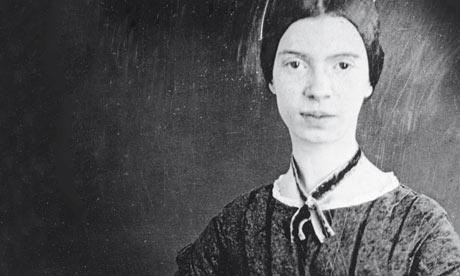
Happy Birthday Emily Dickinson

Today would have been the 192nd birthday of Emily Dickinson. For many years, a treasure trove of Dickinson materials was scattered throughout our site, but a few years ago we pulled together a proper PennSound author page for the poet, gathering selected resources from throughout our archives.

It should come as no surprise that Susan Howe would be prominent featured, and here you'll find complete talks on the poet from 1984 (from the New York Talk series) and 1990 (from SUNY-Buffalo) in addition to several smaller excerpts from larger talks pertaining to the poet. There's also a link to PoemTalk #32, which discusses Howe's interpretation of Dickinson's "My Life had stood - a Loaded Gun."

Full series of lectures on Dickinson are also available from Robert Duncan and Robert Creeley, both at the New College and dating from 1981 and 1985, respectively. Among other substantial contributions, there's also the 1979 Dickinson Birthday Celebration at the St. Mark's Poetry Project (featuring Jan Heller Levi, Charles Bernstein, Susan Leites, Charles Doria, Virginia Terrace, Barbara Guest, Madeleine Keller and Vicki Hudspith, Armand Schwerner, Karen Edwards, Jackson Mac LowMaureen Owen, and Howe) and Rae Armantrout's 2000 presentation on Dickinson from "Nine Contemporary Poets Read Themselves Through Modernism."

You'll also find performances of individual Dickinson poems from John Richetti and Jeffery Robinson as well as brief excerpts of radio interviews — with John Ashbery, Guest, and Elizabeth Bishop — pertaining to the poet.

Our hope is that this page, which brings together disparate resources already available in our archives, will be a useful tool for teachers, students, and casual readers, as well as serious scholars. Click here to start exploring.

Friday, December 8, 2023

George Quasha Reads 'gnostalgia for the present,' 2023

It has been a very productive year for the dynamic duo of Chris Funkhouser and George Quasha, who have already published five lengthy installments documenting the many sections of Quasha's waking from myself on Quasha's PennSound author page over the past year, part of a much longer project the friends and neighbors have carried out since at least 2017.

Today we shift gears with gnostalgia for the present, a collaboration with photographer Susan Quasha that was recently published in its entirety at Caesura. Listeners can follow along with the complete text and delight at Susah Quasha's frosty urban abstractions. Click here to listen along on PennSound.

You'll find these and many more recordings on PennSound's George Quasha author page, along with lengthy selections from many of his books including Not Even Rabbits Go Down This Hole, Dowsing Axis, Hearing Other, The Ghost In Between, Verbal Paradise, Glossodelia Attract: Preverbs, The Daimon of Moment: Preverbs, Scorned Beauty Comes Up Behind: Preverbs, Things Done for Themselves: Preverbs, and Polypoikilos: Matrix in Variance: Preverbs, among others. Click here to start listening.

Wednesday, December 6, 2023

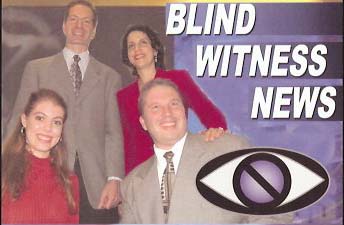
Bernstein and Yarmolinsky's 'Blind Witness: Three American Operas'

Today we're highlighting Charles Bernstein and Ben Yarmolinsky's multimedia operatic collaborations, collected in the 2008 volume Blind Witness: Three American Operas (Factory School). 

In conjunction with the publication of Blind Witness, PennSound launched a new author page for Yarmolinsky, hosting complete recordings of all three operas, as well as videos from the Blind Witness book launch at Medicine Show, in the spring of 2008.

Originally written and performed over three decades ago, this trio of vernacular operas — Blind Witness News (1990), The Subject (1991) and The Lenny Paschen Show (1992) — are perhaps even more pointed critiques of American society in the present: we still a nation obsessed with the news, violence, celebrity, and our own inner workings. However, in these works, we discover a memento of simpler times, before our slipping headlong down a postmodern precipice, and through that trace we are capable of marking tremendous differences. The nightly newscast so wonderfully parodied in Blind Witness News (with its anonymized news team of Jill Johns, Jack James, Jane Jones and John Jacks) seems quaint in comparison to myriad channels of 24-hour news, yet the same hollow tropes remain. Likewise, Jenny Midnight's psychoanalysis has a human (if sometimes sinister) touch in the age of a faceless psycho-pharmaceutical industry. And, to paraphrase Jean Baudrillard, the Morton Downey Jr-esque Lenny Paschen exists to distract us from the fact that most contemporary television is equally outrageous, equally offensive, equally artificed.

Social commentary notwithstanding, the operas also provide immeasurable pleasures, starting with the uncanny juxtaposition between Yarmolinsky's lush classical melodies and accompaniments, and Bernstein's oft-hilarious libretti. Writing about his contributions in the preface to Blind Witness, Yarmolinsky observes that "These three operas (if they are operas) from the early 1990s represent my ideas about how contemporary American English ought to be sung. There is a consistent attempt in the text-setting to follow the rhythms and cadences of our language as it is spoken." He continues, "Although I collaborated on the scenarios, suggested some verse forms, occasionally asked for slight changes to the original text, and sometimes asked for a second verse or a refrain, ultimately, the music was evoked by the words."

As for what Bernstein brings to the table, we have the poet's continued fascination with "authentic" speech (as delivered through television, advertisements, etc.) and common mythologies, seen in contemporaneous collections such as 1994's Dark City. In passages such as Lenny's abrasive monologue, Jack and Jane's opening fugue of news-speak, or John Jack's rendering of abstract sports arcana, we witness Bernstein's great joy in manipulating the conventions of everyday language and, can't help but enjoy it. At the same time, amidst this savage lampooning of a candy-colored culture, we also find sympathetic and world-weary characters — particularly Jenny Midnight — and this touch of empathy makes our experience that much richer.

PennSound's Ben Yarmolinsky author page also includes the composer's 1995 appearance on LINEbreak, where he discusses his opera Anita, inspired by the Clarence Thomas-Anita Hill Hearings. Click here for a truly unique listening experience.

Monday, December 4, 2023

Paul Dutton: 'Oralizations' (2005)

Today we're highlighting a recent addition to the PennSound author page of Canadian author and sound artist Paul DuttonOralizations, a 2005 CD release on Montréal-based label Ambiances Magnétiques. Running nearly seventy minutes, this album presents"works spanning Dutton's more than thirty years of bursting the bonds of convention, testing the extremes of voice and verbalization, and blurring the borders between literature and music," neatly summarized as "richly textured multiphonic vocal virtuosity, laced with rasps, rumbles, honks, howls, and wheezes, featured in freely improvised and formally structured solos, with flights of verbal invention added into the mix."

Reviewing the album in Vital, Dolf Mulder emphasizes the hybrid nature of the work: "The pieces on his new CD range from english spoken poems to pieces mixed of speech and sound, to pure soundpoetry. Verbal, non-verbal or anything in between, Dutton in all pieces is interested in the sound qualities of his voice performance." He continues, "Dutton himself defines the spectrum he covers as ranging from speech to music. So in his vision the border between literature and music is a gradual one," before concluding that Oralizations is "music that has to be seen to be believed!"

PennSound's Paul Dutton author page, houses solo recordings from 1979–2001, as well as links to our Four Horsemen page and other collaborations, and a series of useful links to external resources. First created in 2005, our Dutton page was one of our earliest author pages, but its materials continue to surprise us. Click here to start exploring Oralizations.

Friday, December 1, 2023

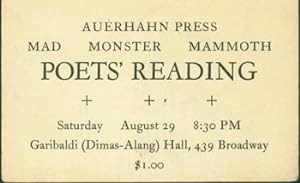
Mad Mammoth Monster Poetry Readings: Ginsberg, Lamantia, McClure, Meltzer, Welch, Wieners, Whalen

Today we revisit a collection of recordings from the Mad Mammoth Monster Poetry Readings, which were convened by Auerhann Press in San Francisco on August 29, 1963. They include brief but very exciting sets by a total of seven noteworthy Bay Area poets, many of whom had been published by the press. Because we have no context clues to establish the reading order we're presenting these tracks in alphabetical order. Clicking on each poet's name will take you directly to their poem(s).

First up we have Allen Ginsberg, who read "Patna-Benares Express" and "May 22 [1962] Calcutta," followed by Philip Lamantia, who read "Rest in Peace, Al Capone" and "All Hail Pope John XXIII." Michael McClure read from Dark Brown and Ghost Tantras, while David Meltzer read several short pieces: "Baby's Hands," "Rain Poems," "Nerve Root Poem," "Two Poems to My Wife," and "Poem for Lew Welch." For his own set, Welch  read from Hermit Poems, while John Wieners read "A Poem for Cocksuckers" and "A Poem for the Old Man." Finally, we have Philip Whalen bringing our new recordings to a close with an excerpt from "The Art of Literature."

It's a fascinating snapshot of the Bay Area's poetry scene at that time as the late Beat Generation heyday slowly started to give way to the burgeoning Summer of Love ethos. To listen to any of the individual poets listed above, just click their names to be taken to their PennSound author pages.