Monday, December 24, 2018

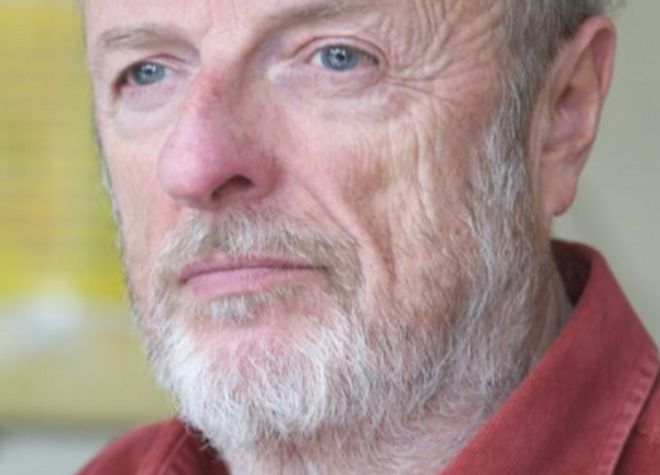
In Memoriam: Tom Leonard (1944–2018)

photo by Dominic Charlton (via BBC News)
We're very sad to report the death of poet Tom Leonard, hailed by no less an authority than the BBC as "a giant of Scottish literature," both in his homeland and abroad. 

In their obituary, Asif Khan (director of the Scottish Poetry Library) offered unstinting praise for the late poet, calling him "a pioneer committed to representing the language and concerns of his west of Scotland working-class community at a time when such representations were scant to non-existent," and noting that "The attitudes he exposed in his ground-breaking poem Six O'Clock News remain relevant decades after its publication; his analysis of the way in which accent, grammar, spelling and pronunciation are used to sustain power structures is as penetrating today as it was the day it was written." Khan finishes his encomium as follows: "His humour, his experimentalism, his commitment to his craft and untameable intelligence will be much missed by readers and the many writers he continues to influence."

Elsewhere, in The Scotsman, publisher and poet Kevin Williamson called Leonard "an inspiration who changed Scottish poetry forever and even how we think about our own language." The same tribute offers Leonard's explanation of the origins of his fascination with the Scots language:
"I was aware that my mother spoke using a lot of words that were Scottish, but then she would tell me to speak 'properly,' as she called it," he said. "I think it's a very common phenomenon, and not just in Scotland: you get it in different cities where the urban accent is looked down on, and there are parents who worry about their children not getting on in jobs or to university if they speak like that. So although they speak with a vernacular accent themselves, they tell their children to speak differently, and sometimes they might even punish their children for speaking the same way as they do themselves."
PennSound is proud to have hosted a Tom Leonard author page for many years, starting with the album Selected Poems, recorded at the Scottish Trades Union Congress Centre in Glasgow in April 2011. Working backwards chronologically, there's a 2006 home recording of "Unrelated Incidents," an undated recording of "Jist ti let yi no," his response to Williams' "This Is Just to Say," and a 2005 reading at Oran Mor in Glasgow. Next there's a 1997 recording of selections from Nora's Place and Other Poems 1965-1995, and mid-90s recordings of the individual poems "A Priest Came on at Merkland Street" and "Nora's Place." From there we jump back to 1978 for a home recording of "Shelley's Revolt of Islam (Canto 8 Stanza 2)," one of "Three Texts for Tape" made with the poet's Teac A-3340S recorder — this recording would be the subject of PoemTalk Podcast #80, with panelists Jenn McCreary, Joe Milutis, and Leonard Schwartz. The archive closes out with a pair of multitrack home recordings from the early 1970s: "nor shall death brag" and "kierkegaard either/or."

Friday, December 21, 2018

Bernadette Mayer's 'Midwinter Day' at Forty

Winter will officially begin at 5:23PM EST today, four minutes after sunset on the darkest day of the year. The winter solstice has long been a source of cultural inspiration and poetic inspiration as well, with one of the most notable recent manifestations being Bernadette Mayer's iconic Midwinter Day, which turns forty this year. While not published until 1982, Mayer famously wrote the book — hailed by Alice Notley as "an epic poem about a daily routine ... sedate, mundane, yet marvelous" — in its entirety while marking the the winter solstice at 100 Main Street in Lennox, Massachusetts on December 22, 1978.

As Megan Burns notes in her Jacket Magazine essay on the book: "A long held tradition on Midwinter's Day was to let the hearth fire burn all night, literally keeping a light alive through the longest night of winter as a source of both heat and a symbol of inspiration to come out the other side of the long night closer to spring and rebirth. It is fitting that a poem about surviving death and the intimacy of the family would be centered around this particular day that traditionally has focused on both. The hearth is the center of the home where the family gathers, where the food is cooked and where warmth is provided. Metaphorically, the poem Midwinter Day stands in for the hearth gathering the family into its folds, detailing the preparation of food and sleep and taking care of the family's memories and dreams."

Mayer read a lengthy excerpt from the book at a Segue Series reading at the Ear Inn on May 26th of the following year, which you can listen to on her PennSound author page along with a wide array of audio and video recordings from the late 1960s to the present. Better still, this year celebrations are being held all over the US as well as in Canada and Scotland to honor this "literary holiday." You can read more about these events and find one near you by clicking here.

Wednesday, December 19, 2018

Rachel Zolf: Wexler Studio Session, 2018

We recently added a new Wexler Studio session with poet Rachel Zolf, who stopped by last May to record a selection of new work.  In total there are sixteen pieces, all short vignettes running from sixteen to fifty-three seconds, which are identified by their opening lines. Titles include "Ingredients of a winning visual identity...," "Trapped in this high performance culture...," "You know the drill...," "Reading and gleaning from the same German root...," "Albino Lucille...," and "What's the use of Jews writing limericks..." 

You can listen in by clicking here, and don't forget to browse through nearly thirteen years' worth of recordings of every stripe imaginable, which you can find on PennSound's Rachel Zolf author page.

Monday, December 17, 2018

Whenever We Feel Like It: Laynie Browne, Bianca Stone, and Connie Yu

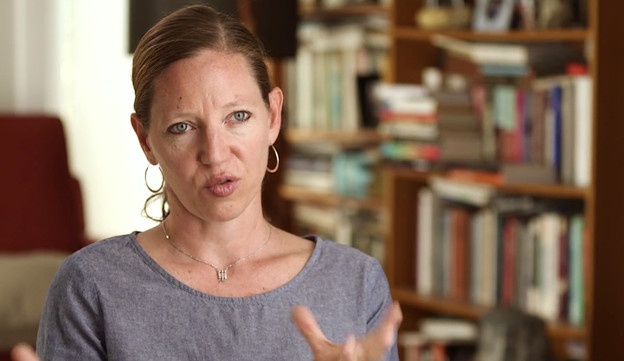
It's been a while since we checked in with the Whenever We Feel Like It reading series, but its most recently-added event is a good opportunity to do so. Recorded on November 27, 2018, this reading features an impressive triple-bill including Laynie Browne, Bianca Stone, and Connie Yu (shown at right). Here are brief bios of each of the authors:

Laynie Browne is a poet, prose writer, teacher and editor. She is author of thirteen collections of poems and three novels. Her most recent collections include a book of poems You Envelop Me (Omnidawn 2017), a novel Periodic Companions (Tinderbox 2018) and short fiction in two editions, one French, and one English in The Book of Moments (Presses universitaires de rouen et du havre, 2018). Her honors include a 2014 Pew Fellowship, the National Poetry Series Award (2007) for her collection The Scented Fox, and the Contemporary Poetry Series Award (2005) for her collection Drawing of a Swan Before Memory. Her poetry has been translated into French, Spanish, Chinese and Catalan. Forthcoming books of poetry include: Amulet: New & Selected Poems,Amulet SonnetsIn Garments Worn by Lindens, and Translation of the Lilies Back into Lists. Current projects include editing an anthology on The Poet’s Novel, and a collaboration with visual artist Brent Wahl on a public art project in Philadelphia, an installation including sculpture and poetry inscribed in thirteen languages in the new Railpark in Callow Hill. She teaches at University of Pennsylvania and at Swarthmore College.

Bianca Stone is a writer and visual artist. She was born and raised in Vermont and moved to New York City in 2007 where she received her MFA from NYU. She collaborated with Anne Carson on Antigonick, a book pairing Carson’s translation of Antigone with Stone’s illustration and comics (New Directions, 2012). Stone is the author of the poetry collection Someone Else’s Wedding Vows, (Tin House Books and Octopus Books, 2014), Poetry Comics From the Book of Hours (Pleiades Press, 2016) and The Mobius Strip Club of Grief (Tin House, 2018). Her poems, poetry comics, and nonfiction have appeared in a variety of magazines including Poetry, jubilat, and Georgia Review. She has returned to Vermont with her husband and collaborator, the poet Ben Pease, and their daughter Odette, where they run the Ruth Stone Foundation, a writing collective, letterpress studio, and artist residency.

Connie Yu is a writer and performer living in Philadelphia, attending to queer Asian worry, meetingplaces for this, that body and what it wears, alternate and constricted transmissions of information. Their poetry and essays have been published in ApiarySupplement, and Jacket2. Recently, they have worked as an educator at Center for Creative Works; and as a curator of gallery shows and contingent programs at the Kelly Writers House.

Also, though it goes without saying, we're proud to remind you that The Whenever We Feel Like It reading series is put on by Committee of Vigilance members Michelle Taransky and Emily Pettit. The Committee of Vigilance is a subdivision of Sleepy Lemur Quality Enterprises, which is the production division of The Meeteetzee Institute. You can browse through the series' history — it will celebrate its tenth anniversary at the Kelly Writers House next March — by clicking here.

Friday, December 14, 2018

Maggie Nelson: Newly Segmented Readings from "Bluets"

As Maggie Nelson's dazzling Bluets nears its tenth birthday it has clearly lost none of its power, and while later works like The Argonauts have perhaps garnered more cultural cache — with good very reason, I might add — Bluets will always be an important transitional work in Nelson's oeuvre. Today, we're highlighting two newly-segmented readings from Bluets, cut by PennSound staff editor Louisa Healey, which Al Filreis recently announced in a recent Jacket2 commentary post.

The earlier of these is from a 2007 appearance on LA-Lit, which is well worth checking out in its entirety for her discussion with hosts Mathew Timmons and Stephanie Rioux, along with generous selections from her earlier books, The Red Parts, Jane: A Murder, and Something Bright, Then Holes, along a then in-progress Bluets. Her readings here encompass sections (or propositions) 52–59, which addresses the science of color along with vision, particularly as a religious phenomenon.

Then, from a 2013 reading as part of the MFA Reading Series at Boise State University, we have a larger excerpt from the book — which takes up the majority of her half-hour set — starting at proposition #204 and continuing through to the book's conclusion with proposition #240. Here's how that segment starts:
Lately I have been trying to learn something about "the fundamental impermanence of all things" from my collection of blue amulets, which I have placed on a ledge in my house that is, for a good half of the day, drenched in sunlight. The placement is intentional — I like to see the sun pass through the blue glass, the bottle of blue ink, the translucent blue stones. But the light is clearly destroying some of the objects, or at least bleaching out their blues. Daily I think about moving the most vulnerable objects to a "cool, dark place," but the truth is that I have little to no instinct for protection. Out of laziness, curiosity, or cru­elty — if one can be cruel to objects — I have given them up to their diminishment.
You can listen to both of these sets, along with many more — including a terrific 2015 appearance on David Naimon's always-amazing radio program, Between the Covers — by clicking here.

Wednesday, December 12, 2018

Douglas Kearney: New Author Page

Our newest author page is for poet, performer, and librettist Douglas Kearney. The majority of the recordings you'll find there come from Kearney's recent two-day visit to our own Kelly Writers House, which included a two-part Close Listening reading and conversation with Charles Bernstein recorded on October 22nd, along with an appearance alongside Brian Goldstein for a "City Planning Poetics" event. This sixth installment in the series, organized by Davy Knittle, was titled "Urban Revitalization" and took place the following day.

In addition to these recordings, which are available in MP3 format or streaming video, we also have video from a trio of recent readings, including a September 2017 reading at the Poetry Center at the San Francisco State University, and a pair of undated recordings from Los Angeles' Museum of Contemporary Art and Harvard University's Vocarium Reading Series.

You can check out all of the aforementioned recordings on our brand new Douglas Kearney author page. Click here to start listening.


Monday, December 10, 2018

Happy Birthday, Emily Dickinson!

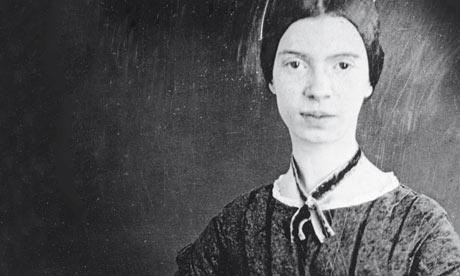
December 10th would have been Emily Dickinson's 188th birthday, and we're celebrating the Belle of Amherst by highlighting a dazzling array of recordings related to the poet that are available throughout the PennSound archive.

While, of course, it would be impossible for us to have recordings of Dickinson reading her own poems, we do have a number of talented readers offering up their best renditions of her work, including Naomi Replansky, John Richetti, Susan Howe, Robert Creeley, and Jeffrey Robinson. Howe, of course, is well-known for her iconic text, My Emily Dickinson, and we have a number of recordings of her reading from and/or discussing that project, from the Radio Readings Project, LINEbreak, and the New York Talk Series, along with excerpts from her 2010 Kelly Writers House Fellows visit, and a complete 1990 lecture on the poet from SUNY-Buffalo. Also from Buffalo in 1990, we have a short recording of Creeley reading and discussing "My Life had stood -- a Loaded Gun," and from 1985 we have a complete trio of lectures on Dickinson recorded at the New College. We can thank David Levi Strauss for those recordings, along with a trio of New College lectures on Dickinson by Robert Duncan delivered in 1981.

Rounding out the collection, there are short excerpts from longer radio programs featuring Elizabeth Bishop (on Howe's Pacifica-FM show) and John Ashbery and Barbara Guest (on WNYC's PEN Portraits) discussing the poet, along with Rae Armantrout's comments on Dickinson from the wonderful Nine Contemporary Poets Read Themselves Through Modernism event at our own Kelly Writers House in 2000. Jumping back to 1979, we have an amazing Dickinson Birthday Celebration from the St. Mark's Poetry Project, which features Jan Heller Levi, Charles Bernstein, Susan Leites, Charles Doria, Virginia Terrace, Madeleine Keller and Vicki Hudspith, Armand Schwerner, Karen Edwards, Jackson Mac Low, and Maureen Owen, along with Guest and Howe. Last but certainly not least, we have a pair of PoemTalk podcasts related to the poet: from 2010, episode #32 discussing Howe's interpretation of Dickinson's "My Life had stood -- a Loaded Gun," while episode #87, from 2015, addresses Dickinson's "She rose to His Requirement," and "Wild Nights -- Wild Nights!."

While these wonderful resources are scattered throughout our site, you can find them all in one convenient place on our Emily Dickinson author page. Head on over there now and honor Dickinson's life and work in your own way.


Friday, December 7, 2018

Michael Lally: "Another Way to Play" Launch Reading, 2018

We're closing this week out with a short recording that serves as a gateway to much more: specifically, it's Charles Bernstein's short mobile video of Michael Lally reading from his recently-released Another Way to Play: Poems 1960–2017 at a launch event held at New York's Howl on April 26th of this year. While the video is only a little less than six minutes, it serves as a fine example of the poet and actor at his very best, starting in medias res with selections from "The Village Sonnets," written between 1959 and 1962, a memoir peppered with cameos by Nina Simone, Bob Kaufman, Allen Ginsberg, Bob Dylan, and more. From there he speaks about his gratitude for his children and their frequent presence in his poems, offering up "Before You Were Born," from Swing Theory, which is dedicated to his youngest son, Finn. The clip ends with the final, and most recent poem in the volume, titled "Love Is the Ultimate Resistance."


While that's just a brief taste of Lally's work, you'll find a number of vintage recordings on his PennSound author page, starting with a 1977 appearance on Public Access Poetry and a set from the Ear Inn, along with a 1978 reading at the West End Bar and another Ear Inn reading with John Ashbery that inaugurated the venerable Segue Reading Series. There's also Lally's 1994 New Alliance Records album, What You Find There, and a 2011 appearance at the Readings in Contemporary Poetry series at Dia Art Foundation, New York:Chelsea. You can listen to all of the aforementioned recordings by clicking here.


Wednesday, December 5, 2018

Charles Bernstein: "Near/Miss" Launch Readings

We couldn't be more excited about PennSound co-director Charles Bernstein's newest book, from University of Chicago Press, Near/Miss. Today, we're proud to be able to present audio and video from four recent launch events for the collection.

The first reading took place on November 7th at  McNally Jackson Books, and featured Amy Sillman, Tracie Morris, and Felix Bernstein, along with the author. Those special guests read selections from the book, including "Pinky's Rule," "Intaglio," "Apoplexie," and "Our United Fates," while Bernstein read "In Utopia," "Drambuie," "Seldom Splendor," and "Fare Thee Well," among others.

Five days later, Bernstein gave a solo reading at Washington, D.C.'s Bridge Street Books on November 12th, which is available in both MP3 and streaming video formats. His set consisted of the poems "Thank You for Saying You're Welcome," "Nowhere Is Just around the Corner," “S'i' Fosse," "Corrections," "Bluebird of Happiness," "I Used to be a Plastic Bottle," and "Also Rises the Sun."

Next, from November 14th at the Penn Book Center in Philadelphia, we have another solo reading that included these titles: "Me and My Pharaoh," "Ballad Stripped Bare," "Our United Fates," "Ring Song," and "Don’t Say I Passed." Finally, there's an hour-long conversation between Bernstein and Peter Straub, which was recorded on November 29th at Books Are Magic in Brooklyn.

Bernstein has conveniently gathered all of these recordings in a Jacket2 commentary post, which you'll find here. These and many, many more readings can be found on Bernstein's PennSound author page.

Monday, December 3, 2018

The Poetics List at 25

This weekend, PennSound co-director Charles Bernstein took note of the fact that this December marks the twenty-fifth anniversary of the venerable Poetics List, which he founded at the Poetics Program at SUNY-Buffalo. While the listserv closed almost five years ago, it's wonderful to be reminded of the wonderful discourse — often illuminating, occasionally contentious — that was a big part of the world of contemporary poetry and poetics for a great many of us. 

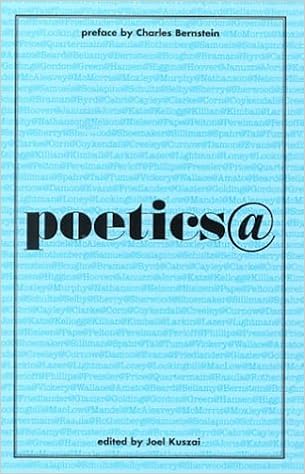
You can still browse a complete archive of the list, now housed at UPenn, here, along with POETICS@, an anthology of early highlights, edited by Joel Kuszai, which Roof Books published in 1999. To mark the occasion, Bernstein posted his introduction to that volume, which begins as follows:
Above the world-weary horizons
New obstacles for exchange arise
Or unfold, O ye postmasters! 
The Poetics List was founded in late 1993 with this epigraph serving as its first message. I had been on email for only about a year at that time, but from the first was fascinated by the possibilities for group exchange made available by the listserve format. I remember endless conversations with friends explaining the mechanism: you send out one message to the list address and everyone subscribed gets the message almost instantaneously. And to reply, you simply hit "R" on the keypad and write your new message. My friends listened in something as close to astonishment as poets doing hard-time ever can. It was as if I were explaining the marvels of xerography to letterpress printers. 
In 1993, most of the poets I knew who had email had those accounts provided by universities and the history of the Poetics List is marked by the change, within a few years, from the dominance of ".edu" (university) email addresses to ".com" (commercial) addresses. At that time, writing email was far more cumbersome than it is today. For the first several years of the Poetics List, most of the messages were written on-line using early versions of Pine or more primitive mail programs, with very limited editing tools available. Typing could be slow and the possibility of revision was limited - especially for those who chose to engage in the spirit of improvised list exchange by spontaneously typing their messages and immediately sending them out. Indeed, it is worth noting that a number of people on the list, working with email systems that had no text buffers, could not retype the lines prior to the one they were typing – making a post to Poetics more like a telegram than a letter. And indeed it was the telegraphic immediacy of this new writing genre that was so electrifying. Group exchange of texts had never been faster or easier.
You can read his complete introduction here, and for those of you still craving an inbox full of poetry every morning, don't forget that The Chicago School of Poetics maintains The Poetics List 2.0, which started one month after the original Buffalo listserv closed down.