Wednesday, July 30, 2025

Tuli Kupferberg: "No Deposit, No Return" (1966)

We begin this week with one of my favorite recordings from our archives and one I'm very proud that we can share with our listeners: Tuli Kupferberg's 1966 ESP-Disk release, No Deposit, No Return. While many know the late Kupferberg for his inimitable contributions to poetry-rock mavericks, the Fugs, this ambitious solo album is far more obscure, though not without its dedicated fans.

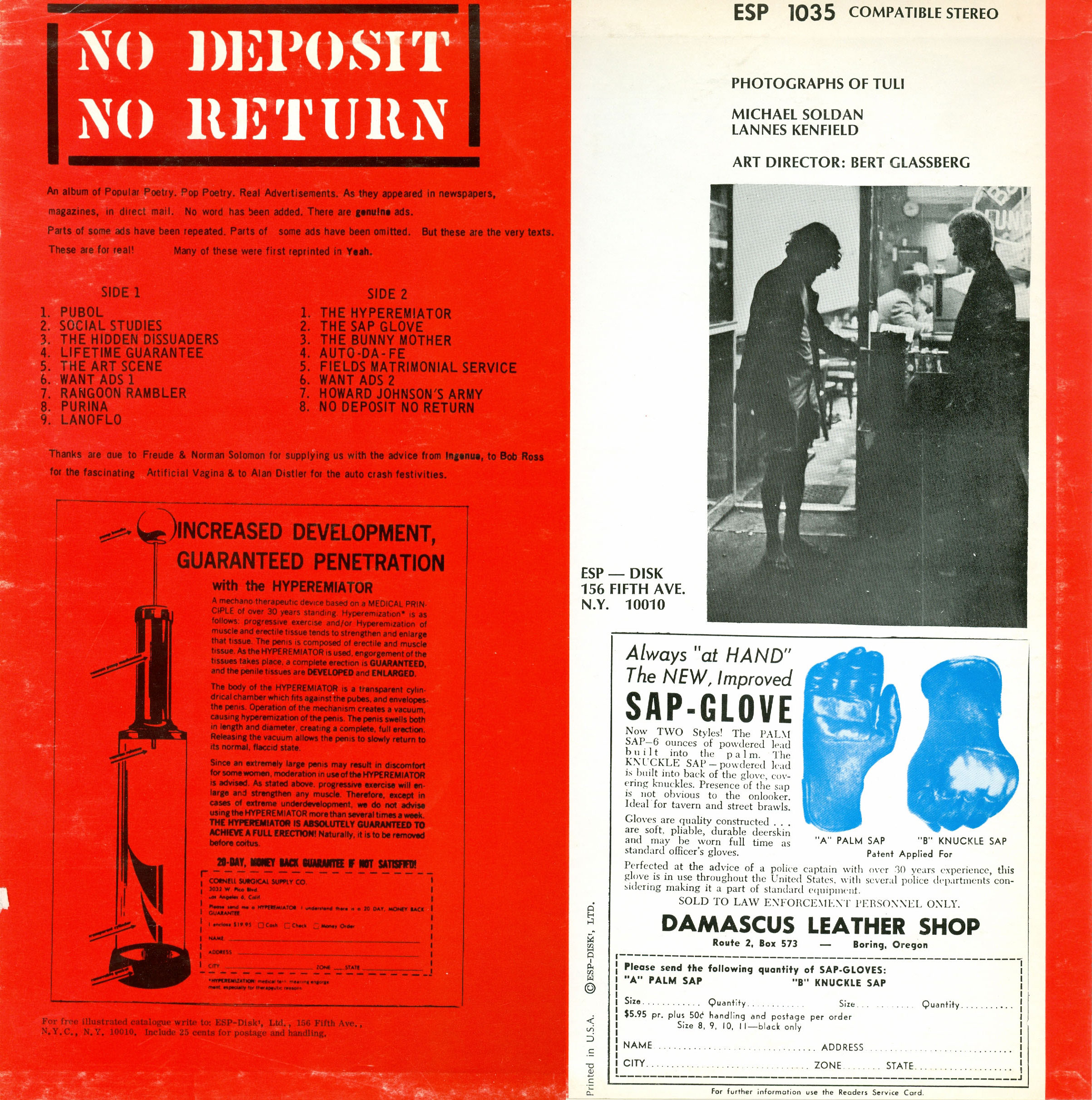
Subtitled "an evening of pop poetry" on the record sleeve, which devolves into "a nightmare of popular poetry" in Kupferberg's opening track, No Deposit, No Return is comprised exclusively of found texts performed with musical accompaniment "by Gary Elton on the various": "Real Advertisements," as the back cover explains, "As they appeared in newspapers, magazines, in direct mail. No word has been added. There are genuine ads. Parts of some ads have been repeated. Parts of some ads have been omitted. But these are the very texts. These are for real!" The end result is quite poetic, yet also drifts into the realm of pure comedy — albeit a comedy rooted in social critique — along with the golden age of radio, thanks to Elton's musical backings and sound effects. The invocation of sixties pop sensibilities and appropriative aesthetic also adds an element of the visual arts, creating a truly hybrid electric form that neatly parallels the contemporaneous sound poetry of John Giorno in building upon the foundational work of Charles Reznikoff.

"Everyone I suppose has always wanted to write his own commercial." Kupferberg notes in the introductory track, explaining the album's origins. "I have resisted this temptation strenuously, especially for this album, but when a certain well-known shampoo company came to the Fugs last summer, proposing that we do our own commercial for their new summer product, I countered with my own suggestion for a new product" — namely, Pubol, a pubic hair shampoo — and thus the project was born.

Aside from consumerism and America's culture of violence, No Deposit, No Return's major preoccupation is sex and sexuality, as Kupferberg performs advertisements for timid swingers, not-so-timid swingers, fetish photos, an erotic novel (Violations of the Child Marilyn Monroe, attributed to "Her Psychiatrist Friend") and a scary-looking penis pump,"the Hyperemiator," whose ad is one of two reproduced on the record's back cover. In a Foucauldian sense, particularly in the midst of a period of revolutionary sexual exploration, the poet reminds us that societal curiosity about sex and atypical sexual interest are nothing new. Regardless, there's a startling difference between the hidden, repressed and clinical nature of the poems on No Deposit, No Return, and the joyous and liberated carnality celebrated in Fugs' songs like "Supergirl" and "Coca Cola Douche." Thus, the album serves as both a strident cross-generational critique and a statement of shared beliefs, targeted at young audiences through one of their most popular media. In a fashion not dissimilar from what Kupferberg parodies in tracks like the heartbreaking "Social Studies," or the Fugs' "Kill for Peace," No Deposit, No Return is very effective propaganda.

We're grateful to Kupferberg's daughter, Samara, for her permission to share this groundbreaking record, which you can listen to in its entirety here. By clicking on the thumbnail images you can view large-format scans of the album covers and liner notes as well.

Monday, July 28, 2025

Melvin B. Tolson on PennSound

Today we're taking a look at the recordings you can find on PennSound's Melvin B. Tolson author page.

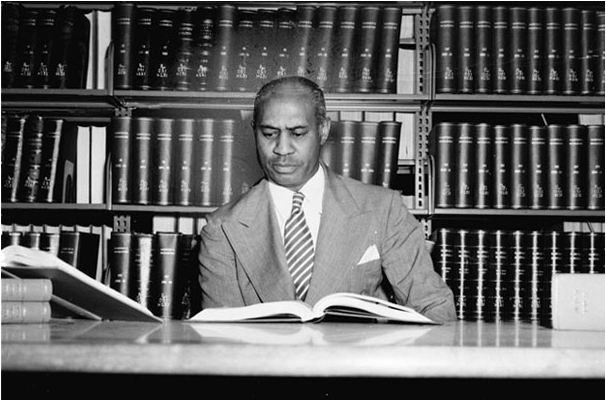
The heart of this collection is a two-part career-spanning reading at Washington, D.C.'s Coolidge Auditorium, on October 18, 1965 — an event held in coordination with the Library of Congress — which serves as a fitting tribute to the influential poet, politician, and pedagogue, who'd pass away less than one year later. After a lavish introduction, Tolson starts with his debut collection, Rendezvous with America and hits many of the high points of his prestigious career, including his magnum opusDark Symphony, and Libretto for the Republic of Liberia, written during his time as that nation's poet laureate. Running just short of eighty minutes, Tolson's reading includes the poems "Sometimes," "The Gallows," "If You Should Lie to Me," "The Primer for Today," "The Dictionary of the Wolf," "Harlem Gallery," "The Birth of John Henry," "Ballad on Old Satchmo," and "The Sea Turtle and the Shark," among others, with commentary provided along the way.

This retrospective performance is nicely complemented by a second recording of excerpts from Dark Symphony, for which, unfortunately, we have no information regarding its recording date and location. Nevertheless we're grateful to be Tolson's estate and the Library of Congress for the opportunity to present these materials to our listeners. Click here to visit PennSound's Melvin B. Tolson author page.

Friday, July 25, 2025

Sophia Naz: Wexner Studio Session, 2024

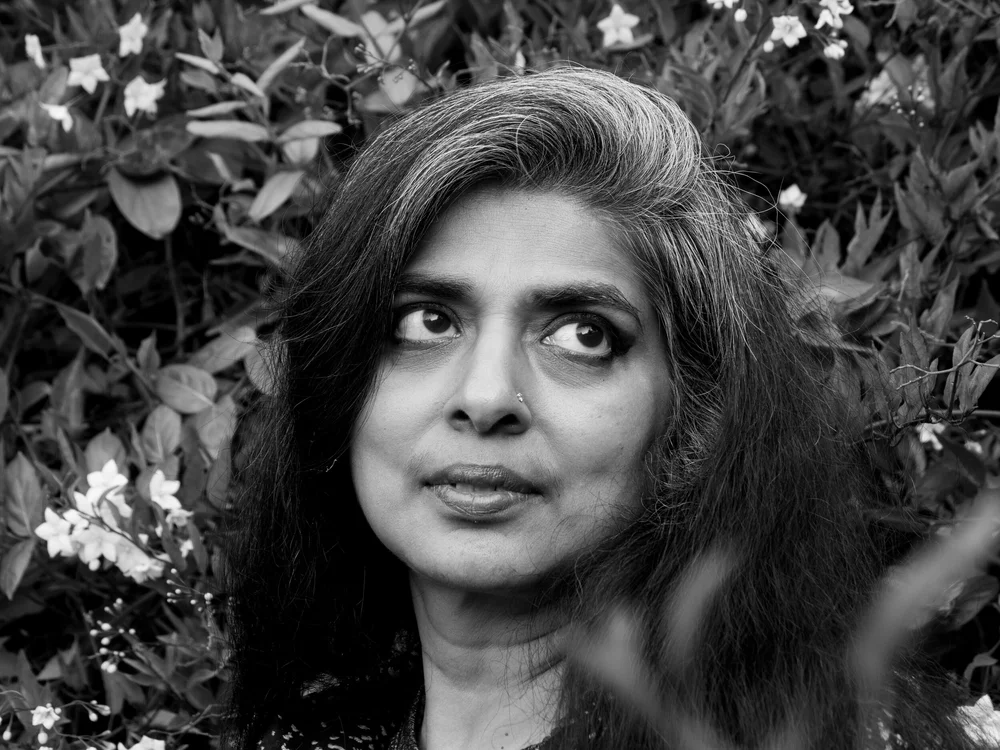
We close out this week by taking a look at our holdings from bilingual poet, essayist, author, editor and translator Sophia Naz. Naz has published four poetry collections in total — Peripheries (Cyberhex 2015), Pointillism (Copper Coin 2017), Date Palms (City Press 2017), and Open Zero (Yoda Press 2021) — as well as a biography of her mother, titled Shehnaz; A Tragic True Tale of Royalty, Glamour and Heartbreak  (Penguin Random House 2019). On her PennSound author page you'll find a pair of sessions recorded at the Kelly Writers House's Wexler Studios in 2019 and 2021.

Naz's April 3, 2019 session consists of sixteen titles in total, including "Black Butterflies," "Eye of the Labyrinth," "The Heart of the Matter," "Habeas Corpus," "If You Spoke, Firefly," "Odysseys of an Onion Moon," "Chappan Churi," "Ode to a Scar," "In the Margins," "Atomic Nocta," and "The Department of Wronged Rights." Jumping forward to September 8, 2021, Naz's second session for PennSound included five short poems: "The Lesson," "Thumbnail," "Split Ends," "Nakhuda," and "The Dance." 

You can listen in to both sets of recordings on PennSound's Sophia Naz author page.

Wednesday, July 23, 2025

Kathy Acker: SUNY-Buffalo Talk and Creeley Interview, 1979

Today we're highlighting a fascinating meeting of two seemingly incongruous minds: on December 12–13, 1979, Kathy Acker was a guest of Robert Creeley's at SUNY-Buffalo. Over those two days she read from her own work, delivered a talk on French novelists, and was interviewed by Creeley. Both events have been segmented, and are available on our Kathy Acker author page.

After introductory comments by Creeley, Acker begins with "Tangier," a long chapter (the recording is forty-six minutes long) from Blood and Guts in High School about meeting Jean Genet in Tangiers. She and Creeley then talk briefly about Erica Jong before the first day's event ends. 

The second day begins with Acker offering introductory comments on the pair of French novelists "whose work I'm absolutely fascinated with" that she'll be discussing in this session: Pierre Guyotat and Laure (the pen name of Colette Peignot). "You can't get these books in this country. Don't even try," Acker warns, however she explains that "I wanted to present what I'm doing with their work to you" — even though her translations are rough first drafts and "my French is very bad," ("I knew it enough to know I didn't know it," she later tells the audience) — because of how captivated she became with these authors on a recent trip to France. Specifically, this interest ties into language: both her experience of their language and mediation inherent to encountering a foreign language of which one only has a basic knowledge, but also concerns that have followed her for much longer: "It seemed to me that more and more — I've lived in New York for the last seven years — [that] language is almost impossible now. It's as if ... to have a language, to be able to really speak to someone, seems to be almost like total freedom, in my mind."

She then reads brief translations from each author's work: an excerpt from Guyotat's novel, Eden, Eden, Eden, followed by a piece by Laure about her childhood.  A half-hour lecture on the two authors comes next, with a discussion session of about the same length wrapping up the event. That conversation has been segmented into five thematic parts: "on self-expression," "on self-reflection," "on subjectivity and perception," "on the writer's perspective," and "on the divided self." You can listen in by clicking here

Monday, July 21, 2025

Robert Ashley: Music with Roots in the Aether (1974)

Today we revisit on of the gems of our PennSound Cinema pageRobert Ashley's seven-part "opera for television," Music with Roots in the Aether. We've hosted a copy of this series for many years, and replaced our original lo-fi copies with new remasters in January 2011. Here is Ashley's description of his sprawling project, first released in 1974:
Music with Roots in the Aether is a music-theater piece in color video. It is the final version of an idea that I had thought about and worked on for a few years: to make a very large collaborative piece with other composers whose music I like. The collaborative aspect of Music with Roots in the Aether is in the theater of the interviews, at least primarily, and I am indebted to all of the composers involved for their generosity in allowing me to portray them in this manner.

The piece turns out to be, in addition, a large-scale documentation of an important stylistic that came into American concert music in about 1960. These composers of the "post-serial" / "post-Cage" movement have all made international reputations for the originality of their work and for their contributions to this area of musical compositions.

The style of the video presentation comes from the need I felt to find a new way to show music being performed. The idea of the visual style of Music with Roots in the Aether is plain: to watch as closely as possible the action of the performers and to not "cut" the seen material in any way — that is, to not editorialize on the time domain of the music through arbitrary space-time substitutions.

The visual style for showing the music being made became the "theater" (the stage) for the interviews, and the portraits of the composers were designed to happen in that style.
The seven installments focus on the work of (in order) David Behrman, Philip Glass, Alvin Lucier, Gordon Mumma, Pauline Oliveros, Terry Riley and Ashley himself — representing the vanguard of contemporary composers — and include both lengthy interviews as well as performances. We've also included a link to a 2004 essay in The Brooklyn Rail by Kenneth Goldsmith: in it, Goldsmith appraises Music with Roots in the Aether as "a great snapshot of the period," and observes that "we're lucky that someone went through all this trouble to preserve a very valuable piece of musical history."

Friday, July 18, 2025

Yusef Komunyakaa on PennSound

Today we're taking a closer look at PennSound's author page for Yusef Komunyakaa, which was created not long after our official launch in 2005. While it houses a modest set of recordings, it nevertheless has many of this much-anthologized poet's most iconic work.

The heart of our Komunyakaa page is a March 1998 reading at our own Kelly Writers House. This  segmented recording consists of twenty-four in total, including favorite poems like "Facing It," "The Smokehouse," "Ode to the Maggot," "The God of Land Mines," "You and I Are Disappearing," and "Ode to a Drum," along with "Rhythm Method," "Letter to Bob Kaufman," "Camouflage in the Chimera," "We Never Know," and "Thanks," which has been a cherished part of PennSound's "Poems of Thanks and Thanksgiving" playlist for more than a decade. There's also a July 1999 appearance with Deborah Garrison on BBC Radio 3's Contemporary American Poetry Program, and the single poem "Slam, Dunk & Hook," published as part of the 2005 anthology Rattapallax.

We're grateful and proud to have Yusef Komunyakaa as part of the diverse array of voices found within PennSound's vast archives. You can listen to all of the poems mentioned above my clicking here.

Wednesday, July 16, 2025

Etheridge Knight Reads 'Prison Poems,' c. 1968

Today we're shining the spotlight on a historic recording of Etheridge Knight reading from Prison Poems at the Indiana State Prison. While we don't have precise info regarding the date of this event we believe that it took place towards the end of his incarceration, which ended in 1968. Of the eight years Knight served for armed robbery, he has said, "I died in 1960 from a prison sentence, and poetry brought me back to life."

When these segmented tracks were first introduced, our own Al Filreis commented that the "recording is marred by — or indeed perhaps enhanced and positively complicated by — the loud music playing in the background." You can judge for yourself. 

Altogether, there are twenty-eight tracks, including an introduction and the following titles among many others: "Cell Song," "Hard Rock Returns to Prison from the Hospital for the Criminal Insane," "To the Man Who Sidled Up to Me and Asked: How Long You In Fer, Buddy?," "Poems for Black Relocation Centers," "For Malcolm, A Year After," and "Apology for Apostasy." You'll find these tracks, along with Watershed Tapes' album, So My Soul Can Sing and video footage of a 1980 reading for the Friends of the Scranton Public Library Poetry Series on our Etheridge Knight author page.

Monday, July 14, 2025

Jim Dine on PennSound

You probably know Jim Dine as an important early Pop Artist whose aesthetic has since evolved to encompass other styles and modes. You could be forgiven for not knowing that Dine has also been a poet across the breadth of his prodigious career, from an early collaboration with Ron Padgett presenting Guillaume Apollinaire's The Poet Assassinated through to the 2015 publication of Poems to Work On: The Collected Poems of Jim Dine (Cuneiform). Today, we take a look at the contents of his PennSound author page.

The earliest recording you'll find there comes from Robert Creeley's 70th birthday celebration, held at SUNY-Buffalo on October 11, 1996. This all-day event concluded with an hour-long conversation between Creeley, Dine, and Charles Bernstein. Next up, we have a September 2005 Segue Series reading from the Bowery Poetry Club, containing seventeen poems in total, including "From the Diary of a Non-Deflector," "I Wish All My Flowers Were Named Jesse Horowitz," "My Nose Goes Vibrating Down the Street," "Silver Printing: The Dance of Photography," "George Bush Poem," and "When Creeley Met Pep." That's followed by a December 2013 performance of Jewish Fate with accompaniment by Marc Marder on double bass, and a February 2014 reading in Paris that features eight titles, including "I Ran Into Him," "The Downfall of Your Eyes," "Peroxide," and "The Bartok Poem," among others.

When we first announced our Dine author page, Cuneiform publisher Kyle Schlesinger wrote a lovely note on his own relationship to Dine's work, which ends with a link back to PennSound, along with the recommendation that his readers "log out of facebook, and kick back by the stereo with a tall glass of something or other, and check out Jim's poems." If that ringing endorsement doesn't convince you then nothing will!

Friday, July 11, 2025

Revamped Resources for Helen Adam's 'San Francisco's Burning' from Warner Jepson

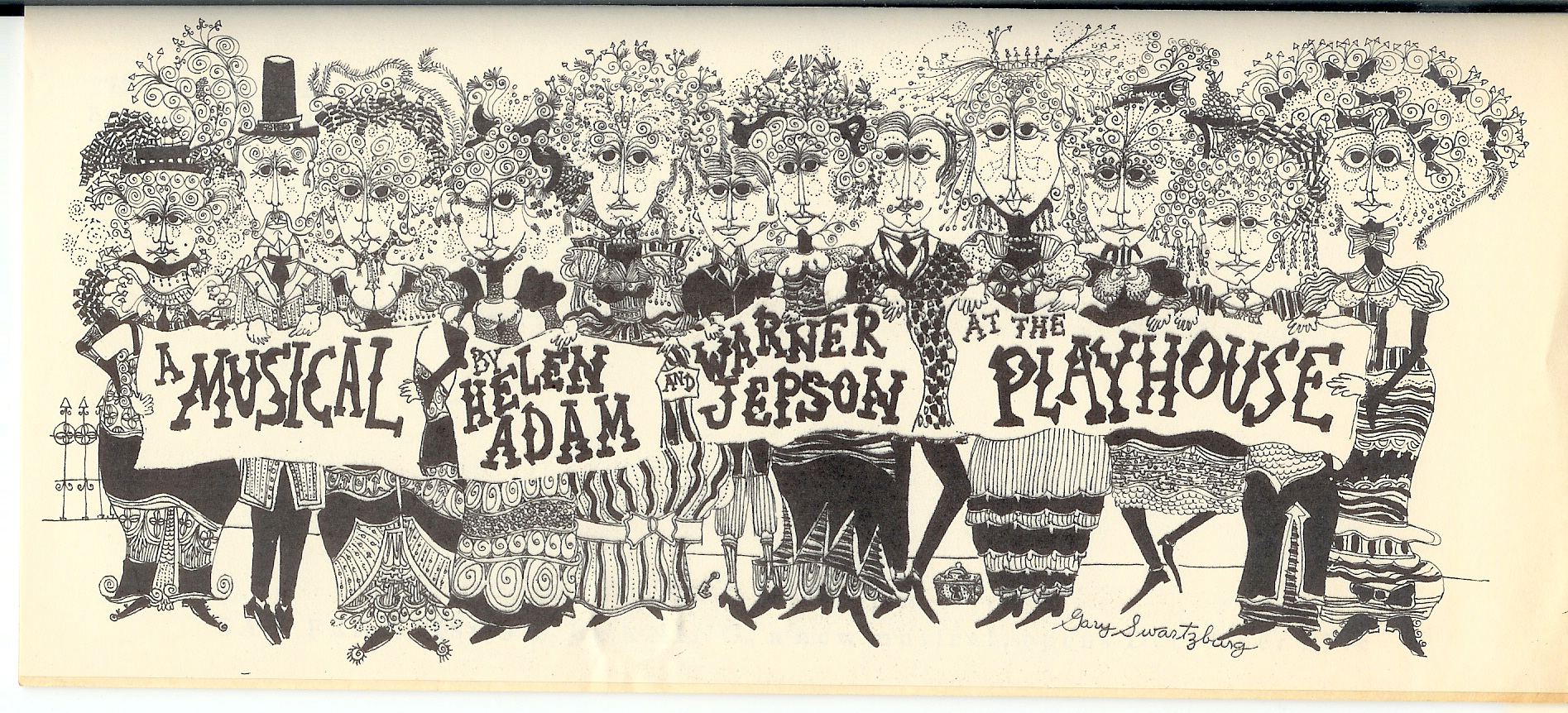
Today we spotlight the substantial body of materials from composer Warner Jepson related to the initial production of Helen Adam's play San Francisco's Burning, which we first announced last summer.

We've long been proud to host Charles Ruas's production of the radio play for the Audio Experimental Theatre, which was first broadcast on New York City's WBAI FM on July 17th, 1977. In addition to the two Adam sisters, the radio play's cast also included Marilyn Hacker, Robert Hershon, and Barbara Wise in major roles. Those recordings have long been augmented by Kristin Prevallet's "Notes on San Francisco's Burning" taken from her excellent A Helen Adam Reader (2007), which features some charming anecdotes about the drama's production, including this recollection from musical director Rob Wynne regarding the "structured chaos" of the recording process: "It took a few months to pull it all together, often ending up after a session at Helen & Pat's apartment, surrounded by her collection of agates and stones, in which she saw images and stories. She always served celery filled with peanut butter, a bizarre but oddly delicious combination."

That latter staging is now paired with another: a 1962 recording adapted from a 1961 production directed by Kermit Sheets for the San Francisco Playhouse, which features the drama's original electronic soundtrack, composed by Warner Jepson. Jepson, a wizard on the difficult-to-master Buchla synthesizer and a prominent figure in San Francisco's avant garde music scene, was kind enough to share these original recordings with us prior to his death in 2011. While we've only posted the production itself on Adam's page, there's also a link to additional photographs, press clippings, and other ephemera from the production on Jepson's PennSound author page. Finally, we've also added a link to Norman MacAffee's "Sixteen Drawings for Helen Adam's San Francisco's Burning" at Jacket2, which we mentioned in last week's tribute to the late artist. 

Taken together, these provide listeners the potential to truly immerse themselves in the Adam sisters' iconic and iconoclastic oddball drama. You can find all of the aforementioned resources, as well as more work from the poet on PennSound's Helen Adam author page.

Wednesday, July 9, 2025

Robert and Bobbie Creeley Perform 'Listen' (1972)

Our PennSound author page for Robert Creeley (edited by Steve McLaughlin) can be daunting for listeners to navigate, given that it has well over a thousand individual files spanning a half-century. Today we're highlighting one of the more interesting tracks you'll find there: Listen, a radio play performed by the poet and his then-wife, Bobbie Creeley. Originally broadcast by West Germany's Westdeutscher Rundfunk on December 1, 1971 (in a translation by Klaus Reichert), it was later released by Black Sparrow in 1972, both in book and cassette formats, the latter serving as the source for PennSound's recording.

In text-form, Listen is comprised of an extended back-and-forth between two narrators: a HE and a SHE. While listeners are likely to read the dialogue through the frame of the Creeleys' marriage — and here their words embody a broad range of nupital emotions, from acrimony to romance, new love and old love — the two occupy a number of varied discursive relationships, from mother to child, suitor to quarry, interrogator to interrogator, writer to actress. In his essay, "Meaning: I Hear You" (linked on Creeley's page), Kyle Schlesinger notes, "it quickly becomes evident that this conversation can't converge. It isn't quite like two ships passing in the night, but more like a submarine passing below the Mayflower; two vessels vacillating between irreconcilable pasts. Where the constitution of one was once affirmed by its ability to address the other, they now share shards of a language they can never reinhabit together." This disjointed effect is augmented by HE's extended meta-notations on the performance at hand — some of the radio play's most enjoyable moments — which range from suggestions as to sound effects to be (but not to be) added later, to questions (posed to the audience-as-producer) regarding how much of a given song should be shared with the listeners (another delight: Bob Creeley's tender and vulnerable croon).

Schlesinger concludes his essay by noting, "It is here, in the atmosphere of Listen that the reader watches it all through a transparent revolving door; "listening out" for the signal, "listening in" on another conversation as it continues to turn. Tune in. Turn on. You hear." This eliptical effect is one of the radio play's most lasting sensations — in the abrupt aftermath of Creeley's final words, listeners will most certainly want to push "play" again to take another spin. Click here to start listening.

Monday, July 7, 2025

A New Disability Poetics Symposium, 2018

Today we're highlighting A New Disability Poetics Symposium, which was recorded at the LGBT Center at UPenn on October 18, 2018. This ambitious, multi-part gathering was organized by Jennifer BartlettAriel Resnikoff, Adam Sax, and Orchid Tierney, in collaboration with Knar Gavin, Declan Gould, Davy Knittle, and Michael Northen.

The proceedings began with the panel "Larry Eigner's Disability Poetics," moderated by Charles Bernstein, with talks by George Hart, Michael Davidson, and Jennifer Bartlett. That's followed by "Disability and Performance," moderated by Declan Gould, with contributions by torin a. greathouse and Camisha Jones; and "Poetic Experiment and Disability," moderated by Orchid Tierney, with panelists Sharon Mesmer and Gaia Thomas.

These talks are complemented by a number of readings, the first taking place as part of the symposium itself, with sets by Bartlett, Jim Ferris, Ona Gritz, Anne Kaier, Dan Simpson, and Brian Teare. There's a second set recorded at our own Wexler Studios with Kaier, Simpson, Ferris, Gritz, and Michael Northen reading their work. Finally, poet Kathi Wolfe was unable to take part in the symposium, but made home recordings of the pieces she would have read at the event, which we've made available to listeners as well. To start listening, click here.

Friday, July 4, 2025

PennSound Italiana

Today we shine the spotlight on our PennSound Italiana anthology page, lovingly edited by Jennifer Scappettone, which offers our listeners a stellar survey of contemporary Italian poetry. When we launched the page many years ago, Scappettone offered an introduction to the collection in an essay published at Jacket2. Here's how she starts off:
We seek over the course of this ongoing project to offer a broad sense of the field, filling in the substantive gaps in global access to Italian poetry (as both written and sonic text — even within Italian borders), and expanding awareness of its range of practitioners, with an emphasis on marginalized and experimental voices of the twentieth and twenty-first centuries. It is an effort — a unique one, in our reckoning — to "liberate" the spectrum of Italian poetry for as broad a public as possible through audio and video recordings, given that the publishing industry and the translation market are endangered and/or blinkered enough to condemn a significant swath of both historical and contemporary innovation to oblivion. As such, this live archive extends the task of PennSound writ large. 
Regular updates have been made to the page over the intervening years and we're always eager to have more work from Scappettone to share with our listeners. At present, the page has recordings from Gian Maria Annovi, Mariasole Ariot, Maria Attanasio, Luigi Ballerini, Gherardo Bortolotti, Franco Buffoni, Maria Grazia Calandrone, Alessandra Cava, Laura Cingolani, Corrado Costa, Elisa Davoglio, Milo De Angelis, Alessandro De Francesco, Antonella Doria, Giovanna Frene, Florinda Fusco, Samir Galal Mohamed, Marco Giovenale, Milli Graffi, Mariangela Guatteri, Giulio Marzaioli, Andrea Inglese, Eva Macali, Enzo Minarelli, Tommaso Ottonieri, Angela Passarello, Jonida Prifti / Stefano Di Trapani (a.k.a. Acchiappashpirt), Laura Pugno, Andrea Raos, Marilena Renda, Lidia Riviello, Amelia Rosselli, Rosaria Lo Russo, and Andrea Zanzotto. Click here to start browsing PennSound Italiana, and don't forget that Scappettone's Jacket2 intro includes some of her highlights from the collection, including background information on the historical nature of each recording.

Wednesday, July 2, 2025

'Mark Van Doren: Portrait of a Poet' (1994)

Today we are highlighting Mark Van Doren: Portrait of a Poet, a remarkable 1994 short film produced by Adam Van Doren, the poet's grandson. Running just over a half hour, the documentary offers up marvelous photo and video footage of Van Doren in conversation and reading his work, along with interviews with friends and contemporaries including Robert Giroux, Allen Ginsberg, Alfred Kazin, John Hollander, Louis Simpson, Daniel Hoffman, Richard Howard, and more.


You can watch this documentary on PennSound's Mark Van Doren author page, alongside recordings from several sources, including a 1935 set of three poems for Columbia University's Speech Lab, a 1960 set of four titles for the Spoken Arts Treasury and the 1967 Smithsonian Folkways album, Mark Van Doren Reads from His Collected and New Poems, whose twelve tracks encompass thirty-two poems in total. Listen in to any and all of these recordings by clicking here.