Monday, November 22, 2021

Régis Bonvicino: In His Own Words

Charles Bernstein's latest Jacket2 commentary post showcases a recent interview with Brazilian poet Régis Bonvicino, conducted by Indian poet Runa Bandyopadhyay with Aurora Fornoni Bernardini, which was organized by Ekhon Bangla Kobitar Kagaj. Both the script of the exchange and a video are available, along with a recent review in Rialta by Ricardo Alberto Pérez of Bonvicino's latest, Deus devolve o revólver.

Here's an excerpt from a brief biographical statement by Bonvicino that starts off the conversation:

I started very young to write what I called poetry. My first book is composed of fifteen poems (Bicho Papel, 1975), the second Régis Hotel (20 poems, 1978). I didn't see myself as a poet then. In 1983 I published Sósia da Cópia and then I started to see myself more as an author. When I was 14 years old Frei Tito (tortured by the dictatorship, he killed himself in France in 1974) was my teacher. If I said that Bicho Papel was related to him, I exaggerated. I am agnostic. But the military dictatorship here was from 1964 to 1985 and marked us all. I believe that art without a critical spirit is a decorative art. Poetry now that is not questioning itself is not exactly poetry, as I see it.  Life is becoming more vulnerable: this is very much present in my poems. 

You can read or watch the full interview by clicking here. Check out the recordings housed on PennSound's Régis Bonvicino author page by clicking here.

Friday, November 19, 2021

Dawn Lundy Martin on PennSound

Today we're showcasing the recordings available on our Dawn Lundy Martin author page, which offers listeners the opportunity to check out readings and talks from 2006 to 2016.

The earliest pair of recordings come from an April 2006 visit to New York City, which yielded sets for both Belladonna* and the Segue Series; Martin would return for another Segue reading at the Bowery Poetry Club in December 2008. Our first recording from A. L. Nielsen's Heatstrings Theory archives is an October 2009 reading at Penn State University, and Nielsen was also kind enough to share a March 2016 appearance by the poet as part of a reading celebrating What I Say: Innovative Poetry by Black Writers in America, held in Brooklyn for that year's National Black Writers Conference at AWP. Then, from Andrew Kenower's A Voice Box archives, we have a pair of Bay Area readings: a 2010 reading at David Buuck's house and a 2013 reading at Tender Oracle held as part of the East Bay Poetry Summit. Finally, we have "On Discomfort and Creativity," the 2016 Leslie Scalapino Lecture in Innovative Poetics, held at Naropa University’s Jack Kerouac School of Disembodied Poetics. Video of that event is available, along with a link to the text in Something on Paper.

Four of the earlier readings mentioned above have been segmented into individual MP3s, providing listeners the unique opportunity to listen to multiple iterations of the same poems — including "The Undress," "The Morning Hour," "Bearer of Arms 1775-1783," and "The Symbolic Nature of Chaos" — read at separate events. Taken together, they also provide an interesting document of Martin's evolving style from her first publications up to just before her most recent collection, Good Stock, Strange Blood (Coffee House Press, 2017), which earned Martin the Kingsley Tufts Poetry Award in 2019 for "creating 'fascinating, mysterious, formidable, and sublime' explorations of the meaning of identity, the body, and the burdens of history along with one’s own private traumas." You can experience Dawn Lundy Martin's formidable voice by clicking here.


Wednesday, November 17, 2021

Bob Perelman on William Carlos Williams' "The Sea-Elephant"

It's entirely possible that you missed out on English Studies in Canada's special issue "On Discreetness: Event and Sound in Poetry," coedited by Louis Cabri and Peter Quartermain, which came out in the summer of 2009. Today, we're highlighting one of that issue's most exciting pieces — Bob Perelman's "A Williams Soundscript: Listening to 'The Sea-Elephant'" — which was subsequently republished in Jacket2 in 2013.

I first met Bob at John Ashbery's reading at Haverford College in February 2008, not long after I started working here at PennSound, and one of the first topics we discussed was his piece for the forthcoming ESC special issue and his desire for the essay to be accompanied by a number of brief excerpts and composite tracks from William Carlos Williams' two readings of "The Sea-Elephant." Eventually, I'd step in at the last minute as sound editor for the issue and put together a CD of tracks to complement the various articles, but even with footnote-esque prompts in the text to indicate when readers should listen to a particular track, this was not the ideal presentation we'd imagined. That's why, jumping forward four years, we're very glad that the essay can finally be read as it was originally intended. The Jacket2 reprint includes 50 embedded streamable MP3s, which allow readers to hear illustrative snippets of Williams without having to leave the document. It's a truly marvelous piece, and even more so when made available in this fashion, so head on over to Jacket2 right now (by clicking here) to start reading and listening.

Monday, November 15, 2021

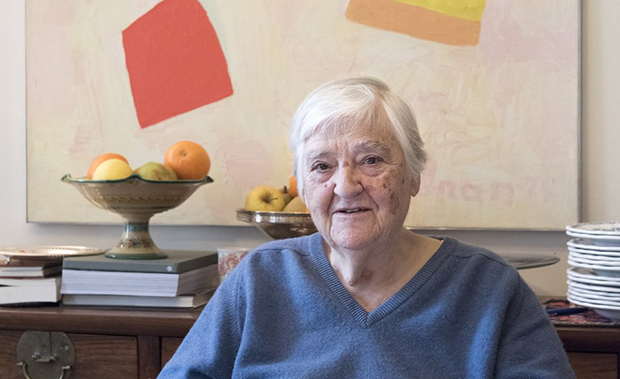
In Memoriam: Etel Adnan (1925–2021)

We start this week out with devastating news for the world of contemporary poetry: Lebanese-American poet and painter Etel Adnan has passed away at the age of 96 in Paris.

Our own Charles Bernstein posted a tribute to Adnan on Jacket2, hailing her as "a beacon of thought in a dirempt world." He continues, "In her writing I sense her hovering just beyond, in view but ungraspable, yet grounding me in ever-changing realizations. Luminous company, trusted guide, necessary source of immediate information, Adnan is a visionary of the meteoric and diasporic. Oscillating between the ecstatic and the unbearable, she finds home in the evasive emplacements of each moment."

PennSound's Etel Adnan author page is home to a modest archive of recordings that nevertheless give a sense of her diverse talents. That collection begins with Adnan's 2006 appearance on episode #118 of Leonard Schwartz's program, Cross-Cultural Poetics, titled "Forms of Violence." Via phone from Paris, she "reads from her book In the Heart of A Heart Of Another Country (City Lights), and meditates on her mother city of Beirut and American violence, inner and outer."

From 2010, we have a Serpentine Gallery reading showcasing The Arab Apocalypse and a 2012 reading commemorating the release of Homage to Etel Adnan (Post-Apollo), which was held at The Green Arcade Books Ideas Goods and co-sponsored by The Poetry Center and Small Press Traffic. Adnan returned to the Serpentine Sackler Gallery in London for a conversation with poet Robert Grenier a few weeks later. This chat between two hybrid artists was the inaugural event for the exhibition, "Etel Adnan: the Weight of the World."

Next we have a marvelous longform discussion with Jennifer Scappettone, recorded September 23–24, 2017, which has been segmented into individual tracks by theme, including "Home Life and School in Beirut," "Education in Philosophy and Beginnings in Painting," "English-Language Poetry and US Politics from the Vietnam War through Today," and "Cultural Identity, Multilingualism, and Translation." Finally, from December 2020, we have a reading and conversation with Bernstein hosted by the Brooklyn Rail’s New Social Environment, which also featured Sarah Riggs, Omar Berrada, and Susan Bee.

We're grateful to be able to share Adnan's work with our audience, and likewise send our thanks to those who've shared resources with us. You can listen to any of the aforementioned recordings by clicking here.

Friday, November 12, 2021

David Antin Discusses Kathy Acker, 2002

Here's another stunning vintage recording from our archives to bring our week to a close: a half-hour video of David Antin discussing Kathy Acker — who he calls "a dazzlingly charming and funny and brilliantly powerful writer, whose work I've always felt very close to" — as part of a symposium on her work held at New York University on November 8, 2002.

"Let me point out I knew Kathy before she was the Kathy Acker you all know," Antin begins, discussing his first meeting her at UC San Diego in 1968, when she was working as a teaching assistant and associating with other "refugees from Brandeis," along with her husband Robert (nominally a student of Marcuse). He goes on to discuss "the climate in which Kathy came to be a poet" — specifically "the proclaimed sexual revolution" and "the year of the assassinations" (Antin's arrival in the city coincided with Robert Kennedy's murder and Valerie Solanas' shooting of Andy Warhol) — then recalls the guidance that he provided to young and aspiring writers like Acker, Mel Freilicher, and others from their social circle, the conceptual art projects he worked closely with (including a Fluxus retrospective), and associations with figures like his wife, Eleanor, Jerry and Diane Rothenberg, Lenny Neufeld, George Quasha, et al., all of which proved to be very influential. "She was exposed to all of these people in various ways that were useful to her," he observes. 

He goes on to talk about her compositional use of constraint ("Her engagement was with so many things but she had to restrain herself to not be all over the place all at once."), her means of getting her work out to wider audiences, and the qualities that made her a singular talent: "Kathy had both intelligence and energy, and she had desire [...] It was the intensity of her desire for life." It's a gossipy, raucous recollection that also reveals deeper truths about how Acker came into her own. You can watch it here.

Wednesday, November 10, 2021

A New Disability Poetics Symposium, 2018

Today we're highlighting A New Disability Poetics Symposium, which was recorded at the LGBT Center at UPenn on October 18, 2018. This ambitious, multi-part gathering was organized by Jennifer Bartlett, Ariel Resnikoff, Adam Sax, and Orchid Tierney, in collaboration with Knar Gavin, Declan Gould, Davy Knittle, and Michael Northen.

The proceedings began with the panel "Larry Eigner's Disability Poetics," moderated by Charles Bernstein, with talks by George Hart, Michael Davidson, and Jennifer Bartlett. That's followed by "Disability and Performance," moderated by Declan Gould, with contributions by torin a. greathouse and Camisha Jones; and "Poetic Experiment and Disability," moderated by Orchid Tierney, with panelists Sharon Mesmer and Gaia Thomas.

These talks are complemented by a number of readings, the first taking place as part of the symposium itself, with sets by Bartlett, Jim Ferris, Ona Gritz, Anne Kaier, Dan Simpson, and Brian Teare. There's a second set recorded at our own Wexler Studios with Kaier, Simpson, Ferris, Gritz, and Michael Northen reading their work. Finally, poet Kathi Wolfe was unable to take part in the symposium, but made home recordings of the pieces she would have read at the event, which we've made available to listeners as well.

Given both the significance of Disability Studies and the growing attention it's receiving from more mainstream audiences, this is a particularly important event, and one that we are very proud to be able to share with a wider audience. To start listening, click here.

Monday, November 8, 2021

Susan Howe and David Grubbs: "Frolic Architecture," 2011

Over the years, we've been able to bring you a wide variety of audio and video from the fruitful and long-running collaboration of poet Susan Howe and musician/composer David Grubbs (Squirrel Bait, Bastro, Gastr del Sol) and today we're happy to present footage of a recent performance of their piece, Frolic Architecture, recorded at Harvard University on November 1, 2011.

The stunning center section of Howe's 2010 book, That This (New Directions), Frolic Architecture was "inspired by Susan Howe's experience of viewing various manuscripts, sermon notebooks, books, and pamphlets of the eighteenth century American Calvinist theologian Jonathan Edwards in the vast collection of Edwards family papers at the Beinecke Rare Book and Manuscript Library in New Haven, Connecticut. Especially by the folder in Box 24 titled 'Wetmore, Hannah Edwards, 1713–1773, Diary, 1736–39, copy in the hand of Lucy Wetmore Whittelsey, with commentary/n.d.'" The texts were composed "using multi-purpose copy paper, scissors, 'invisible' scotch tape, and a Canon copier PC170 [to] collage fragments of this 'private writing' with a mix of sources from other conductors and revealers in the thick of things — before." Howe and Grubbs released a studio version of Frolic Architecture on Drag City subsidiary Blue Chopsticks (home to their previous albums, 2008's Souls of the Labadie Tract and 2005's Theifth) in 2011, which further develops the collaborative nature of the piece — aside from Howe's appropriation of Hannah Edwards Wetmore's diary, Frolic Architecture was originally published as a limited-edition artist's book by Grenfell Press, featuring ten photograms by James Welling (also reproduced in That This).

Working in a similar mode to their earlier collaborations, Grubbs creates an airy and haunting bed of sound, consisting of laptop manipulations of Howe's pre-recorded voice — rhythmic and chaotically scattered phonemes that mimic the poem's collaged scraps and flutter around the poet's live performance — wed to modulated Hammond organ drones. Much like Souls of the Labadie Tract, the two artists' interaction on Frolic Architecture began at a very early and unpublished stage in the text's development, and as Howe acknowledges in the Q&A session that follows the performance, her association with Grubbs has shaped her approach to writing and language in general. While, at first, she deemed Frolic Arcitecture to be an "unperformable poem," Grubbs' efforts to "match [his] fragmentation to [her] fragmentation" yield fantastic results once again.