Wednesday, October 7, 2020

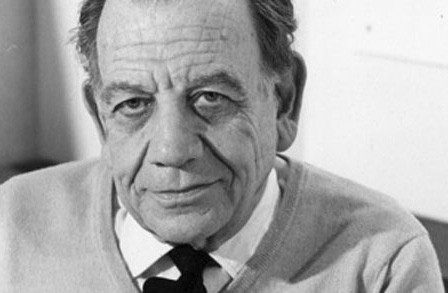
Congratulations to 2020 MacArthur Foundation Fellow Fred Moten

It's been an auspicious week for PennSound poets, and it's only Wednesday! Yesterday we celebrated the news that Mei-mei Berssenbrugge and Don Mee Choi were finalists for the National Book Award in Poetry, and today brings the astounding news that Fred Moten has been named a 2020 MacArthur Foundation Fellow. His citation merits reproduction in full:

Fred Moten is a cultural theorist and poet creating new conceptual spaces that accommodate emergent forms of Black cultural production, aesthetics, and social life. In his theoretical and critical writing on visual culture, poetics, music, and performance, Moten seeks to move beyond normative categories of analysis, grounded in Western philosophical traditions, that do not account for the Black experience. He is developing a new mode of aesthetic inquiry wherein the conditions of being Black play a central role.

Moten's diverse body of work coheres around a relentless exploration of sound and its importance as a medium of Black resistance and creativity. His first book, In the Break: The Aesthetics of the Black Radical Tradition (2003), offers seminal insights that emerge from taking sound, as opposed to visual or textual imagery, as the point of departure for interpretation. For example, in considering Frederick Douglass's famous account of the 'terrible spectacle' of slavery, Moten identifies the screams of Douglass's Aunt Hester as the materialization in sound of Black resistance, thus opening onto a new way of understanding the trauma of slavery as something not just seen but emphatically heard as well. Moten's recently completed three-volume theoretical treatise, collectively called consent not to be a single being (2017–2018), includes essays written over the course of fifteen years. The breadth of his theoretical insights in these volumes extends across the arts and humanities — from the music of Curtis Mayfield and Billie Holiday to the critical philosophy of Immanuel Kant and Theodor Adorno — as he explores notions of performance and freedom and formations of Black identity.

Moten continues the project of his theoretical work in his poetry. In his 2014 collection, The Feel Trio, for instance, language hovers at the edge of sense so that sound rises to the fore and the reading of the poem approaches musical performance. Through his writing and lectures, Moten is demonstrating the power of critical thinking to establish new forms of social actualization and reconfiguring the contours of the cultural field broadly.
We are immensely proud to be able to share Moten's work as part of our archive. His PennSound author page is home to a wide array of recordings from the past two decades, including readings, talks, and conversations, which demonstrate Moten's prodigious and multifarious talents. We congratulate Moten heartily for this life-changing honor, and will continue to track the trajectory of his career with great excitement.

Tuesday, October 6, 2020

Congratulations to National Book Award Finalists Berssenbrugge and Choi

A few weeks back, we celebrated the news that Mei-mei Berssenbrugge and Don Mee Choi were included on the longlist for the 2020 National Book Award in Poetry. Today brought the exciting news that both poets had made it through as finalists as the field shrank from ten to five.

Berssenbrugge is up for consideration for her most recent book, A Treatise on Stars, which, in the words of the judges, "extends Berssenbrugge's intensely phenomenological poetics to the fiery bodies in a 'field of heaven…outside spacetime.'" "These are poems of deep listening and patient waiting, open to the cosmic loom, the channeling of daily experience and conversation, gestalt and angels, dolphins and a star-visitor beneath a tree," the citation continues,"Family, too, becomes a type of constellation, a thought 'a form of organized light.'" They conclude: "All of our senses are activated by Berssenbrugge's radiant lines, giving us a poetry of keen perception grounded in the physical world, where 'days fill with splendor, and earth offers its pristine beauty to an expanding present.'" As we noted in our last post, Berssenbrugge was one of our Kelly Writers House Fellows in 2019, and during her visit she read a number of poems from A Treatise on Stars, including "Star Beings," "Lux," and "Chaco and Olivia." You'll find audio and video from that visit here, while our PennSound author page for Berssenbrugge houses more than two dozen individual recordings going back as far as 1986, including interviews, radio programs, and many, many readings.

Choi was nominated for her latest, DMZ Colony, which the judges hailed as "a tour de force of personal and political reckoning set over eight acts." "Evincing the power of translation as a poetic device to navigate historical and linguistic borders," they continue, "it explores Edward Said's notion of 'the intertwined and overlapping histories' in regards to South Korea and the United States through innovative deployments of voice, story, and poetics." "Like its sister book, Hardly War," the judges conclude, "it holds history accountable, its very presence a resistance to empire and a hope in humankind." While we don't have a PennSound author page for Don Mee Choi, you can also hear her reading her work as part of Poetry Politic and as part of the 2012 MLA Offsite Reading

We offer our congratulations to Berssenbrugge, Choi, and all of this year's worthy nominees. This year's panel, which will announce its final decision on November 18th, is chaired by Layli Long Soldier, and also includes Rigoberto González, John Hennessy, Diana Khoi Nguyen, and Elizabeth Willis.


Monday, October 5, 2020

Edmond Jabès on PennSound

We're starting the week off by taking a dive back into our archives for a remarkable document that only some of our listeners will be able to enjoy fully. We created our Edmond Jabès author page back in February 2017 to house one recording: a 1974 documentary on the Egypt-born French author made by Jean-Pierre Prevost.

Originally broadcast on French television, the film features Jabès in conversation with Claude Royet-Journoud and Lars Fredrikson. As our own Charles Bernstein noted at the time of its addition, the film had gone unseen for more than four decades. It's presented as it originally aired, i.e. in French and without subtitles, so if you are a native speaker or your quarantine hobby was trying to work on bettering your rusty high school French, you're in luck. In any case, this film is too important a document not to share with our listeners. Click here to start watching.

Friday, October 2, 2020

More Whitman Read by John Richetti

About a month ago we announced new renditions of two beloved Walt Whitman poems (specifically, "O Captain! My Captain!," and "When Lilacs Last in the Dooryard Bloom'd") read by UPenn emeritus professor John Richetti. Today were back with more recordings from the same session, including "Crossing Brooklyn Ferry," "The Sleepers," "Goodbye My Fancy," and sections 1 and 2 of "Calumus." You'll find these tracks on a special page containing all of Richetti's renditions of Whitman's work, which also includes "Song of Myself" in its entirety, "I Sing the Body Electric," and "I Hear America Singing," among other titles.

We last heard from Richetti this past spring, when he delivered a set of five poems by Alfred, Lord Tennyson.  Numerous previous sessions with Richetti are available on PennSound Classics, spanning more than a decade. They include his prodigious "111 Favorite Poems for Memorizing," "The PennSound Anthology of Restoration & 18th-Century Poetry," and his audio anthology of English Renaissance Verse. Richetti has additionally recorded selections from Matthew Arnold, W.H. Auden, William Blake, Elizabeth Barrett Browning, Robert Browning, Lord Byron, Samuel Taylor Coleridge, Emily Dickinson, John Donne, John Dryden, George Herbert, Ben Jonson, John Keats, Andrew Marvell, John Milton, Edgar Allan Poe, William Shakespeare, Percy Bysshe Shelley, Algernon Charles Swinburne, William Wordsworth, and William Butler Yeats. These lovingly-made recordings, rendered in Richetti's distinctive tenor, are a tremendous resource for the classroom or for any lover of poetry. 

With the exception of the aforementioned anthologies, PennSound Classics is divided by author, so you can see Richetti's ample contributions alongside those of many other poets and scholars. To start browsing, click here.


Thursday, October 1, 2020

Jacket2 Reissues: O Books

It's been a little while since we've heard from Jacket2's Reissues section, but they're back with a very exciting new collection of materials related to O Books to share with eager readers. We'll let Reissues editor Danny Snelson make the announcment himself:

Breaking with standard Reissues format, this release celebrates an extraordinary set of editorial projects by a single editor over three related initiatives. Spanning twenty-one years from 1988 until 2009, Leslie Scalapino produced four O Books Anthologies, a single-issue magazine coedited with Rick London called enough, and a four-issue run of a magazine called War and Peace (coedited with Judith Goldman for issues 2–4). From O/One: An Anthology's focus on "writing that questions and transgresses genre lines between forms of poetic and critical discourse" to the final issue of War and Peace, Scalapino's editorial project continuously blurs categorical lines while challenging dominant discourses in both politics and poetics. Each collection gathers what Bernadette Mayer might call a "plural dream of social life."

"Each publication takes a particular focus or theme as its organizing principle," he continues. "Tracking these publications, an editorial through-line emerges: a focused bead on poetry's capacity to speak to the politics of the present. War is ever-present in these pages. From the Gulf War to the post-9/11 global war that continues to this day, the on-the-ground responses of poets in these collections presciently address our ongoing situation." "Proper names may have changed," he concludes, "but the news stays new. To read these pages is to see differently. As Scalapino contends in enough: 'Seeing what's happening is a form of change.'"

You'll find the O Books archives in Jacket2's Reissues section, alongside M/E/A/N/I/N/G, Chain, Secession, Alcheringa, Combo, ZukRoof, New Wilderness Letter, Reality Studios, Infolio, Big Allis, Aufgabe, and Calque. Click here to start browsing.

Monday, September 28, 2020

Remembering Michael Gizzi, Ten Years Later

Today is the tenth anniversary of the passing of Michael Gizzi. When we originally broke the news on PennSound Daily, we acknowledged that Gizzi's work was widely praised by some of the most respected names in the world of contemporary poetics, including John Ashbery, who hailed his poetry as "[r]azor sharp but also rich and generously compelling . . . [it] lambastes as it celebrates, bringing us finally to a place of poignant irresolution." Similarly, reviewing his final collection New Depths of Deadpan for the Brooklyn Rail, John Yau praised Gizzi's ear for "American vernacular," insisting that readers interested in knowing "how weird, interesting, scary, and odd America is" acquaint themselves with Gizzi's poetry, while Ron Silliman cited Gizzi's "genius" as "not just the degree to which [he] can make great complexity appear breath-takingly simple, but rather the great sense of humanity in whose service he does this."

In 2010, we already had a compelling collection of recordings available on our Michael Gizzi author page, including a pair of Segue Series readings (a 1999 set at the Ear Inn and a 2004 recording from the Bowery Poetry Club) and a pair of recordings made by Steve Evans in Providence in 1997 (reading No Both and "We See" in their entirety), plus four tracks made in collaboration with pianist Dave McKenna in 2004 and the full-length album Cured in the Going Bebop from 2000. We also had the beloved 1994 recording of Gizzi and Clark Coolidge reading Jack Kerouac's Old Angel Midnight, which was the subject of PoemTalk #124 in 2018. Since then, we've added two new recordings of Gizzi — a 2001 Wednesdays @ 4-Plus reading at SUNY-Buffalo and a 2009 Chapter & Verse Series reading in Philadelphia. 

In our original tribute post, we also pointed listeners towards "another marvelous and revealing resource": Stan Mir's lengthy 2006 interview with Gizzi and Craig Watson, which had recently been published in the final issue of Jacket Magazine. While that's still a wonderful document, we are happy to also add a 2017 retrospective honoring Gizzi at our own Kelly Writers House, hosted by Davy Knittle and featuring Mir and William Corbett, which is given prominence of place at the head of our Michael Gizzi author page. Click here to reconnect with these marvelous poems and Gizzi's memorable voice, which are every bit as potent a decade later.

Friday, September 25, 2020

PoemTalk #152: on Wallace Stevens' "The Poem That Took the Place of a Mountain"

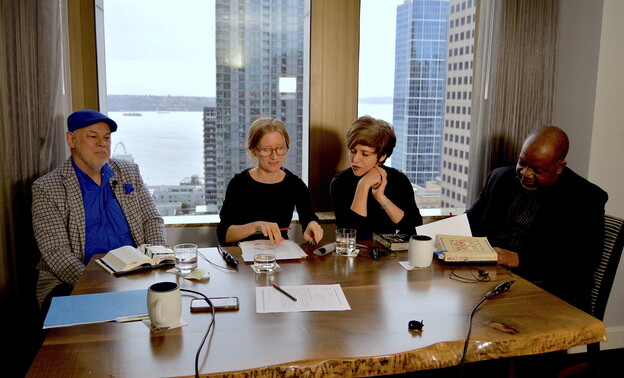
Today we release the newest episode in the PoemTalk Podcast series, its 152nd program in total, which addresses Wallace Stevens' "The Poem That Took the Place of a Mountain." This show is doubly special in that a) it's the second PoemTalk episode dedicated to "this gnarly poem" (as host Al Filreis describes it) and b) it was recorded in conjunction with a panel at last year's MLA conference on contemporary poetic responses to Stevens' work, with the same formidable panel — Kate Colby, Tyrone Wiilliams, Mónica de la Torre, and Aldon Nielsen — participating in both conversations.

Filreis' PoemTalk blog post on this new program starts with a summation of what's at stake in Stevens' poem and how the panelists approach it: "The group collaborates on an enumeration of possibilities for understanding the poet's current ruminative state as a retrospective view of his previous poems and old ideas about poetry. Past perfect and conditional language — had needed, would be right, would discover, could lie — make us doubt that there is or ever was such a thing as a 'there' in 'There it was.' There what was? The words? The new words of this poem? The old words on previous poems about the uphill climb of poetic career? The new poem about such old poems re-presents the word-for-word mountain and never really means, it seems, to stand in for the thing itself." "This isn't mere exhaustion," he concludes, "It's a final development of theory."

You can read more about this latest show, read Stevens poem, and choose between unedited video footage of the conversation or the polished podcast version here. Filreis has also made arrangements with the MLA to present video of the aforementioned conference panel available on our site. The full PoemTalk archives, spanning more than a decade, can be found here.