Friday, September 5, 2025

Seattle Subtext Series Collection

Today’s massive new entry comes to us by way of series organizer Robert Mittenthal, who has generously supplied us with a vast collection of recordings from the Seattle-based Subtext Series. Our selection ranges from 1996 to 2009, during which the Subtext Series called three Seattle venues home: Speakeasy Cafe, Richard Hugo House, and the Chapel Performance Space at Good Shepherd Center.

Mittenthal writes:

We came up with what turned out to be a sustainable format for the series. Two person readings, once per month, on the same day, for example, the 3rd Thursday, at the same venue. One local writer, and one from out of town. Regardless of what was raised via donations at the door, we would pay the readers a nominal fixed amount, plus a small travel stipend for the visitor. We had no budget and no funding, so we focused primarily on the west coast, & tried to coordinate with writers who were traveling thru the Northwest.

Mittenthal’s “we” refers to series curators Laynie Browne, Jeanne Heuving, Herb Levy, Ezra Mark, Bryant Mason, C.E. Putnam, and Nico Vassilakis, with guest curators including Curtis Bonney, Daniel Comiskey, Joseph Donahue, Kreg Hasegawa, Drew Kunz, Will Owen, and Lou Rowan. Recordings were created for roughly half of the readings over the course of the fifteen years of the Subtext Series by Herby Levy and Bryant Mason.

You can explore the whole collection, which features 93 of the readings, split into sections based on performer, here.

Friday, August 29, 2025

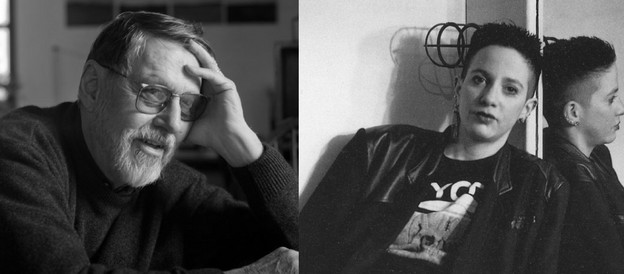
Eric Mottram (1924–1995) Centennial Collection


Image courtesy of King's College London.

We at PennSound are pleased to announce the launch of the new Eric Mottram Centennial Collection. Courtesy of Geoff Browell, Manuela Pallotto Strickland, and the Archives at King’s College London’s Libraries and Collections, the Mottram Collection comprises hundreds of recordings from Eric Mottram’s personal collection, including interviews he conducted, his own readings and lectures, readings by others, and several BBC recordings (of which we’ve only selected the most relevant).

The publication of the Mottram Collection culminates a nearly three-year process which began with the rather tedious digital transfer of about 330 GB of WAV files from the King’s College London collection to PennSound, a huge sum of data which was then sorted, labeled, converted, and posted over two summers by PennSound interns Madeleine Song and Madeline Chun.

The new collection is truly a treasure trove of newly public recordings, with too many names to list here—but highlights include Charles Olson, Jerome Rothenberg, Muriel Rukeyser, Wallace Stevens, Anne Waldman, and Louis Zukofsky, to name just a few. And thanks to Hannah Judd, many of the recordings in the Mottram Collection already have segmented versions available on their individual author pages.

Labor Day Weekend is upon us, and there's no better time to start digging in!

Wednesday, July 30, 2025

Tuli Kupferberg: "No Deposit, No Return" (1966)

We begin this week with one of my favorite recordings from our archives and one I'm very proud that we can share with our listeners: Tuli Kupferberg's 1966 ESP-Disk release, No Deposit, No Return. While many know the late Kupferberg for his inimitable contributions to poetry-rock mavericks, the Fugs, this ambitious solo album is far more obscure, though not without its dedicated fans.

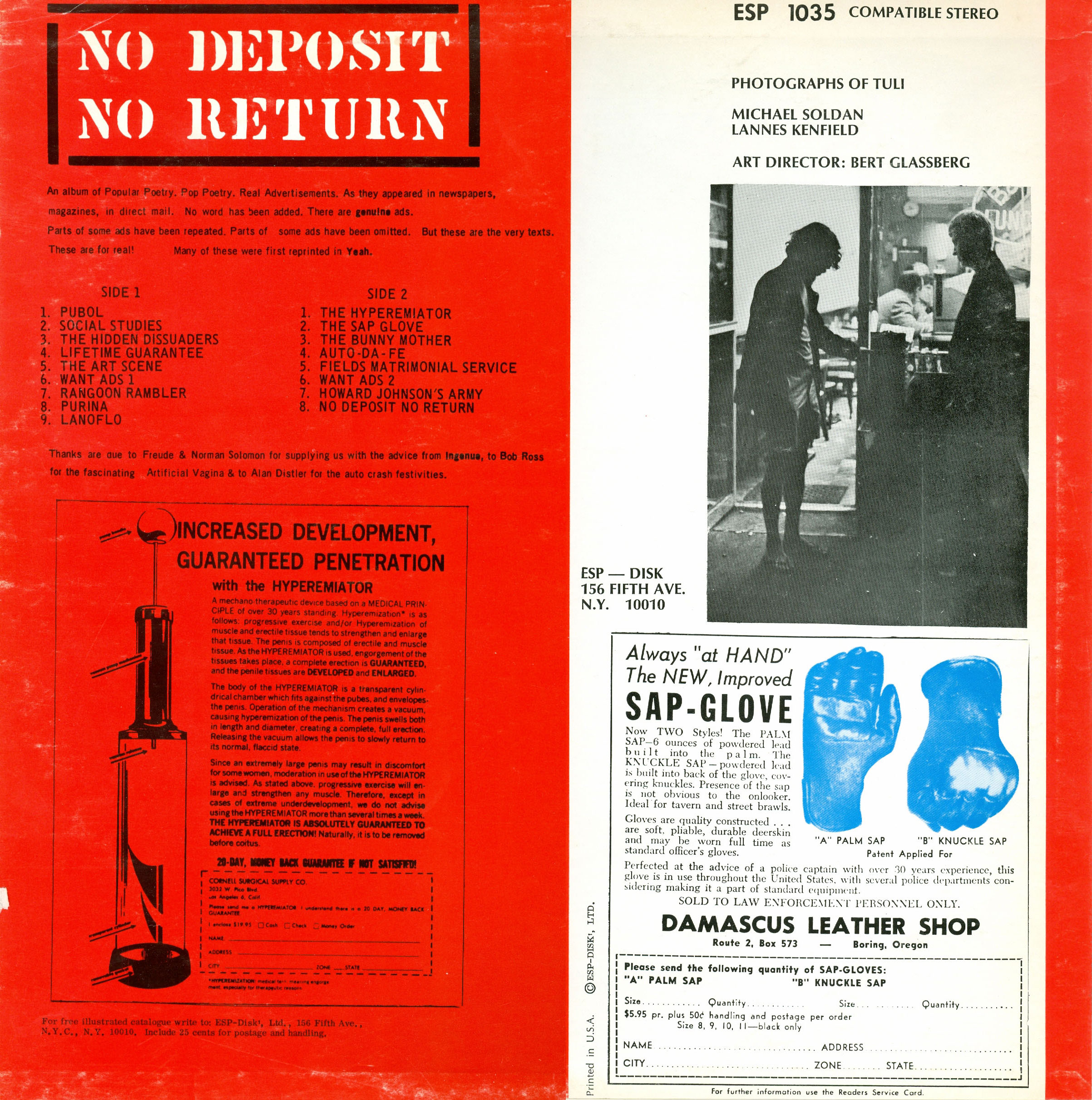
Subtitled "an evening of pop poetry" on the record sleeve, which devolves into "a nightmare of popular poetry" in Kupferberg's opening track, No Deposit, No Return is comprised exclusively of found texts performed with musical accompaniment "by Gary Elton on the various": "Real Advertisements," as the back cover explains, "As they appeared in newspapers, magazines, in direct mail. No word has been added. There are genuine ads. Parts of some ads have been repeated. Parts of some ads have been omitted. But these are the very texts. These are for real!" The end result is quite poetic, yet also drifts into the realm of pure comedy — albeit a comedy rooted in social critique — along with the golden age of radio, thanks to Elton's musical backings and sound effects. The invocation of sixties pop sensibilities and appropriative aesthetic also adds an element of the visual arts, creating a truly hybrid electric form that neatly parallels the contemporaneous sound poetry of John Giorno in building upon the foundational work of Charles Reznikoff.

"Everyone I suppose has always wanted to write his own commercial." Kupferberg notes in the introductory track, explaining the album's origins. "I have resisted this temptation strenuously, especially for this album, but when a certain well-known shampoo company came to the Fugs last summer, proposing that we do our own commercial for their new summer product, I countered with my own suggestion for a new product" — namely, Pubol, a pubic hair shampoo — and thus the project was born.

Aside from consumerism and America's culture of violence, No Deposit, No Return's major preoccupation is sex and sexuality, as Kupferberg performs advertisements for timid swingers, not-so-timid swingers, fetish photos, an erotic novel (Violations of the Child Marilyn Monroe, attributed to "Her Psychiatrist Friend") and a scary-looking penis pump,"the Hyperemiator," whose ad is one of two reproduced on the record's back cover. In a Foucauldian sense, particularly in the midst of a period of revolutionary sexual exploration, the poet reminds us that societal curiosity about sex and atypical sexual interest are nothing new. Regardless, there's a startling difference between the hidden, repressed and clinical nature of the poems on No Deposit, No Return, and the joyous and liberated carnality celebrated in Fugs' songs like "Supergirl" and "Coca Cola Douche." Thus, the album serves as both a strident cross-generational critique and a statement of shared beliefs, targeted at young audiences through one of their most popular media. In a fashion not dissimilar from what Kupferberg parodies in tracks like the heartbreaking "Social Studies," or the Fugs' "Kill for Peace," No Deposit, No Return is very effective propaganda.

We're grateful to Kupferberg's daughter, Samara, for her permission to share this groundbreaking record, which you can listen to in its entirety here. By clicking on the thumbnail images you can view large-format scans of the album covers and liner notes as well.

Monday, July 28, 2025

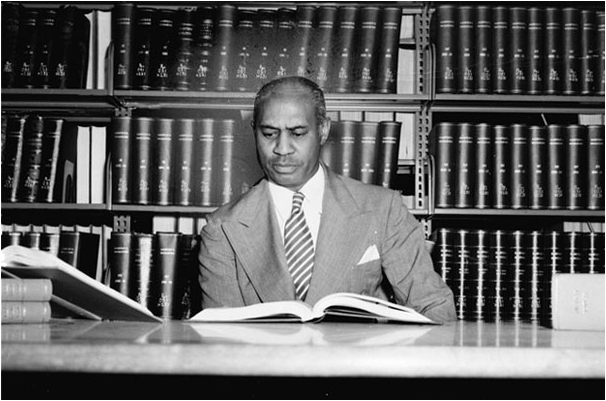
Melvin B. Tolson on PennSound

Today we're taking a look at the recordings you can find on PennSound's Melvin B. Tolson author page.

The heart of this collection is a two-part career-spanning reading at Washington, D.C.'s Coolidge Auditorium, on October 18, 1965 — an event held in coordination with the Library of Congress — which serves as a fitting tribute to the influential poet, politician, and pedagogue, who'd pass away less than one year later. After a lavish introduction, Tolson starts with his debut collection, Rendezvous with America and hits many of the high points of his prestigious career, including his magnum opus, Dark Symphony, and Libretto for the Republic of Liberia, written during his time as that nation's poet laureate. Running just short of eighty minutes, Tolson's reading includes the poems "Sometimes," "The Gallows," "If You Should Lie to Me," "The Primer for Today," "The Dictionary of the Wolf," "Harlem Gallery," "The Birth of John Henry," "Ballad on Old Satchmo," and "The Sea Turtle and the Shark," among others, with commentary provided along the way.

This retrospective performance is nicely complemented by a second recording of excerpts from Dark Symphony, for which, unfortunately, we have no information regarding its recording date and location. Nevertheless we're grateful to be Tolson's estate and the Library of Congress for the opportunity to present these materials to our listeners. Click here to visit PennSound's Melvin B. Tolson author page.

Friday, July 25, 2025

Sophia Naz: Wexner Studio Session, 2024

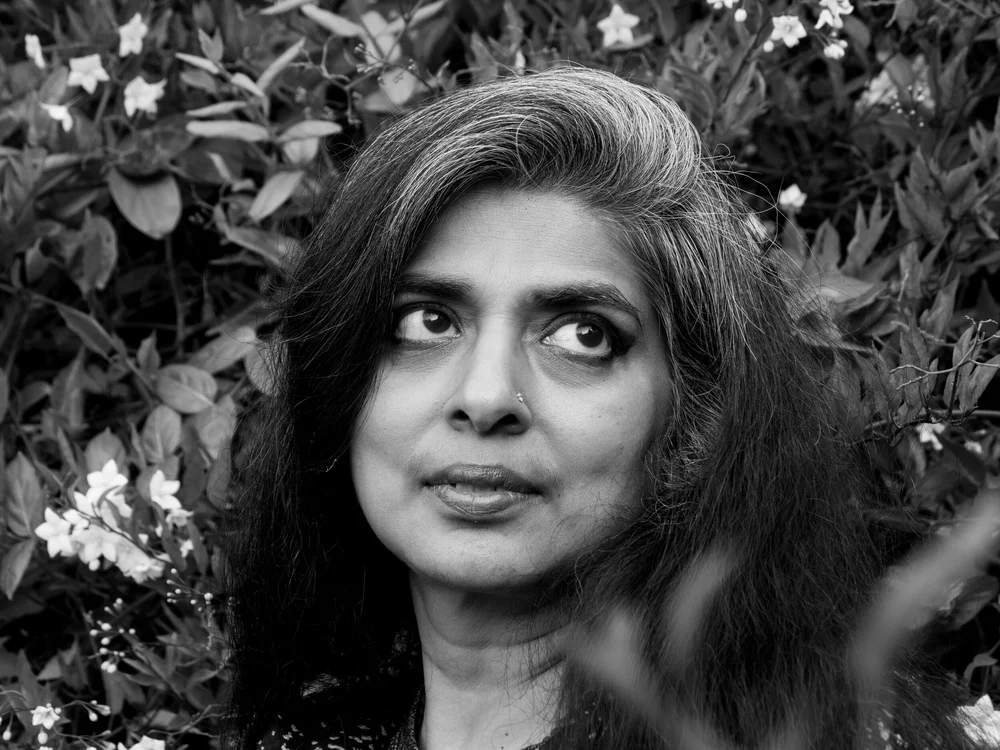
We close out this week by taking a look at our holdings from bilingual poet, essayist, author, editor and translator Sophia Naz. Naz has published four poetry collections in total — Peripheries (Cyberhex 2015), Pointillism (Copper Coin 2017), Date Palms (City Press 2017), and Open Zero (Yoda Press 2021) — as well as a biography of her mother, titled Shehnaz; A Tragic True Tale of Royalty, Glamour and Heartbreak  (Penguin Random House 2019). On her PennSound author page you'll find a pair of sessions recorded at the Kelly Writers House's Wexler Studios in 2019 and 2021.

Naz's April 3, 2019 session consists of sixteen titles in total, including "Black Butterflies," "Eye of the Labyrinth," "The Heart of the Matter," "Habeas Corpus," "If You Spoke, Firefly," "Odysseys of an Onion Moon," "Chappan Churi," "Ode to a Scar," "In the Margins," "Atomic Nocta," and "The Department of Wronged Rights." Jumping forward to September 8, 2021, Naz's second session for PennSound included five short poems: "The Lesson," "Thumbnail," "Split Ends," "Nakhuda," and "The Dance." 

You can listen in to both sets of recordings on PennSound's Sophia Naz author page.

Wednesday, July 23, 2025

Kathy Acker: SUNY-Buffalo Talk and Creeley Interview, 1979

Today we're highlighting a fascinating meeting of two seemingly incongruous minds: on December 12–13, 1979, Kathy Acker was a guest of Robert Creeley's at SUNY-Buffalo. Over those two days she read from her own work, delivered a talk on French novelists, and was interviewed by Creeley. Both events have been segmented, and are available on our Kathy Acker author page.

After introductory comments by Creeley, Acker begins with "Tangier," a long chapter (the recording is forty-six minutes long) from Blood and Guts in High School about meeting Jean Genet in Tangiers. She and Creeley then talk briefly about Erica Jong before the first day's event ends. 

The second day begins with Acker offering introductory comments on the pair of French novelists "whose work I'm absolutely fascinated with" that she'll be discussing in this session: Pierre Guyotat and Laure (the pen name of Colette Peignot). "You can't get these books in this country. Don't even try," Acker warns, however she explains that "I wanted to present what I'm doing with their work to you" — even though her translations are rough first drafts and "my French is very bad," ("I knew it enough to know I didn't know it," she later tells the audience) — because of how captivated she became with these authors on a recent trip to France. Specifically, this interest ties into language: both her experience of their language and mediation inherent to encountering a foreign language of which one only has a basic knowledge, but also concerns that have followed her for much longer: "It seemed to me that more and more — I've lived in New York for the last seven years — [that] language is almost impossible now. It's as if ... to have a language, to be able to really speak to someone, seems to be almost like total freedom, in my mind."

She then reads brief translations from each author's work: an excerpt from Guyotat's novel, Eden, Eden, Eden, followed by a piece by Laure about her childhood.  A half-hour lecture on the two authors comes next, with a discussion session of about the same length wrapping up the event. That conversation has been segmented into five thematic parts: "on self-expression," "on self-reflection," "on subjectivity and perception," "on the writer's perspective," and "on the divided self." You can listen in by clicking here. 

Monday, July 21, 2025

Robert Ashley: Music with Roots in the Aether (1974)

Today we revisit on of the gems of our PennSound Cinema page: Robert Ashley's seven-part "opera for television," Music with Roots in the Aether. We've hosted a copy of this series for many years, and replaced our original lo-fi copies with new remasters in January 2011. Here is Ashley's description of his sprawling project, first released in 1974:
Music with Roots in the Aether is a music-theater piece in color video. It is the final version of an idea that I had thought about and worked on for a few years: to make a very large collaborative piece with other composers whose music I like. The collaborative aspect of Music with Roots in the Aether is in the theater of the interviews, at least primarily, and I am indebted to all of the composers involved for their generosity in allowing me to portray them in this manner.

The piece turns out to be, in addition, a large-scale documentation of an important stylistic that came into American concert music in about 1960. These composers of the "post-serial" / "post-Cage" movement have all made international reputations for the originality of their work and for their contributions to this area of musical compositions.

The style of the video presentation comes from the need I felt to find a new way to show music being performed. The idea of the visual style of Music with Roots in the Aether is plain: to watch as closely as possible the action of the performers and to not "cut" the seen material in any way — that is, to not editorialize on the time domain of the music through arbitrary space-time substitutions.

The visual style for showing the music being made became the "theater" (the stage) for the interviews, and the portraits of the composers were designed to happen in that style.
The seven installments focus on the work of (in order) David Behrman, Philip Glass, Alvin Lucier, Gordon Mumma, Pauline Oliveros, Terry Riley and Ashley himself — representing the vanguard of contemporary composers — and include both lengthy interviews as well as performances. We've also included a link to a 2004 essay in The Brooklyn Rail by Kenneth Goldsmith: in it, Goldsmith appraises Music with Roots in the Aether as "a great snapshot of the period," and observes that "we're lucky that someone went through all this trouble to preserve a very valuable piece of musical history."