
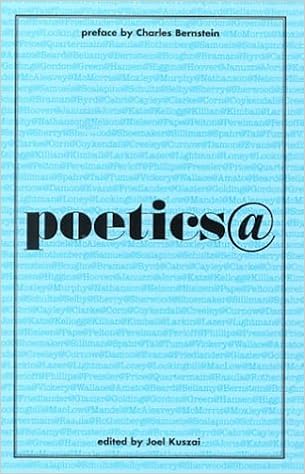
This weekend, PennSound co-director Charles Bernstein took note of the fact that this December marks the twenty-fifth anniversary of the venerable Poetics List, which he founded at the Poetics Program at SUNY-Buffalo. While the listserv closed almost five years ago, it's wonderful to be reminded of the wonderful discourse — often illuminating, occasionally contentious — that was a big part of the world of contemporary poetry and poetics for a great many of us.
You can still browse a complete archive of the list, now housed at UPenn, here, along with POETICS@, an anthology of early highlights, edited by Joel Kuszai, which Roof Books published in 1999. To mark the occasion, Bernstein posted his introduction to that volume, which begins as follows:
Above the world-weary horizons
New obstacles for exchange arise
Or unfold, O ye postmasters!
The Poetics List was founded in late 1993 with this epigraph serving as its first message. I had been on email for only about a year at that time, but from the first was fascinated by the possibilities for group exchange made available by the listserve format. I remember endless conversations with friends explaining the mechanism: you send out one message to the list address and everyone subscribed gets the message almost instantaneously. And to reply, you simply hit "R" on the keypad and write your new message. My friends listened in something as close to astonishment as poets doing hard-time ever can. It was as if I were explaining the marvels of xerography to letterpress printers.
In 1993, most of the poets I knew who had email had those accounts provided by universities and the history of the Poetics List is marked by the change, within a few years, from the dominance of ".edu" (university) email addresses to ".com" (commercial) addresses. At that time, writing email was far more cumbersome than it is today. For the first several years of the Poetics List, most of the messages were written on-line using early versions of Pine or more primitive mail programs, with very limited editing tools available. Typing could be slow and the possibility of revision was limited - especially for those who chose to engage in the spirit of improvised list exchange by spontaneously typing their messages and immediately sending them out. Indeed, it is worth noting that a number of people on the list, working with email systems that had no text buffers, could not retype the lines prior to the one they were typing – making a post to Poetics more like a telegram than a letter. And indeed it was the telegraphic immediacy of this new writing genre that was so electrifying. Group exchange of texts had never been faster or easier.
You can read his complete introduction here, and for those of you still craving an inbox full of poetry every morning, don't forget that The Chicago School of Poetics maintains The Poetics List 2.0, which started one month after the original Buffalo listserv closed down.
