
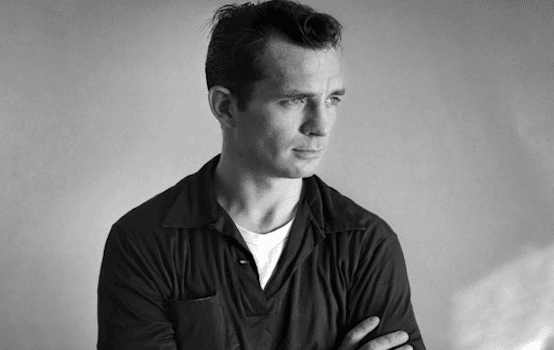
While we don't have permission from the Kerouac estate to share recordings of the poet's work — multiple albums, including collaborations with Al Cohn and Zoot Sims, along with polymath Steve Allen, are widely available — we do have a truly astounding document of Clark Coolidge and Michael Gizzi reading Kerouac's iconic spontaneous prose piece, "Old Angel Midnight." This session took place at the studio of Steve Schwartz in West Stockbridge, MA in 1994, and served as the basis of PoemTalk #124, first released in May 2018, where Coolidge was joined by J.C. Cloutier and Michelle Taransky to discuss the piece.
Coolidge is, of course, well-known for, as Al Filreis phrases it, "his advocacy for Kerouac as properly belonging to the field of experimental poetry and poetics." Here's how he lays out his sense of what he refers to as Kerouac's "babble flow":
[S]ound is movement. It interests me that the words "momentary" and "moments" come from the same Latin: "moveo, to move. Every statement exists in time and vanishes in time, like in alto saxophonist Eric Dolphy's famous statement about music: "When you hear music, after it's over it's gone in the air, you can never capture it again." That has gradually become more of a positive value to me, because one of the great things about the moment is that if you were there in that moment, you received that moment and there's an intensity to a moment that can never be gone back to that is somehow more memorable. Like they used to say, "Was you there, Charlie?"
Kerouac said, "Nothing is muddy that runs in time and to laws of time." And I can’t resist putting next to that my favorite statement by Maurice Blanchot: "One can only write if one arrives at the instant towards which one can only move through space opened up by the movement of writing." And that’s not a paradox.
Here's how Kerouac himself described the project (which famously appeared in the premier issue of Big Table, along with excerpts from William S. Burroughs' Naked Lunch — content liberated from the suppressed Winter 1958 issue of The Chicago Review):
"Old Angel Midnight" is only the beginning of a lifelong work in multilingual sound, representing the haddalada-babra of babbling world tongues coming in thru my window at midnight no matter where I live or what I'm doing, in Mexico, Morocco, New York, India or Pakistan, in Spanish, French, Aztec, Gaelic, Keltic, Kurd or Dravidian, the sounds of people yakking and of myself yakking among, ending finally in great intuitions of the sounds of tongues throughout the entire universe in all directions in and out forever. And it is the only book I've ever written in which I allow myself the right to say anything I want, absolutely and positively anything, since that's what you hear coming in that window... God in his Infinity wouldn't have had a world otherwise — Amen."
You can listen to Coolidge and Gizzi's rendition of this classic here.
