
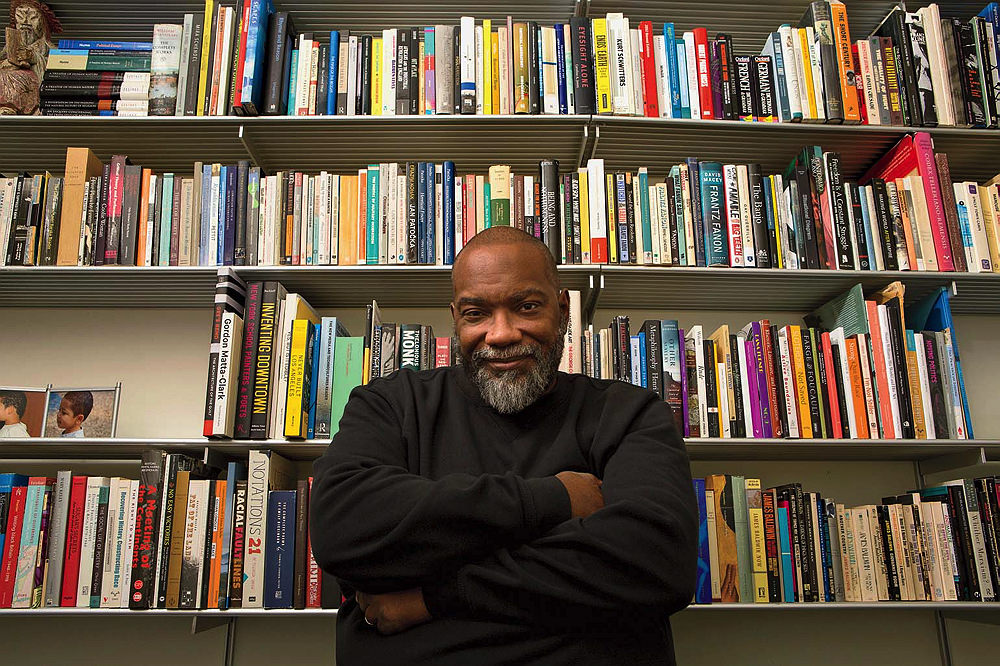
First up, we have Moten's September 20, 2018 reading as part of the Mackey Sessions — a.k.a. the 2018 Blackburn Literary Festival at Duke University — a three-celebration of the poet's life and work. Moten's set here consists almost exclusively of selections from the sequence "come on, get it!," sections 13–17, concluding (appropriately enough) with the poem "Nathaniel Mackey."
Then, jumping back six months to a March 10, 2018 Segue Series reading at New York City's Zinc Bar, we find Moten unintentionally continuing his future set, reading sections 18–23 from the same series, some of which you can read along with at The New Inquiry.
Tyrone Williams wrote about "come on, get it!" — which was published as part of Moten's book The Feel Trio (Letter Machine Editions, 2014) and was a finalist for the National Book Award — as part of his 2014 Jacket2 commentary series, "Hunches, Hedges, Etc.," noting that "like the novelist Charles Johnson, Moten is himself philosophically inclined, and so the Heideggerean echoes of the opening of the second section, 'come on, get it,' are very much on point: 'Performers feel each other differently,/ as material things that never happen,/ in persistent substance and their risen cities.'" Williams continues:
The impasse here, a different kind of blockage, rests on the thing/event, material/substance, distinctions, and so "even if there’s no escape, their training in certain clinical tendencies,/or in the general structure of being a problem,//because of the pivot they never disavowed/in thrown-ness, begins the world where we are fallen…" And though this state of having fallen is our "falling down together in an accident we dream," the accident of race neither relieves the West of responsibility ("welcome to what we took from is the state.") nor justifies "our" slavish commitments to race (not the same as a "free" commitment to culture). Nowhere does Moten make this more clear than near the end of the middle section: "I mean to make something else all the time./the harder you look inside/the easier it is to forget about gary. black youth has/always been a project of sonic youth in the/everyday distortion. we clear? sharper? my/plan is based on human nature, from tutu/to biko, with a continental burst in my/gig bag, which is keene-toed, sharp as a tack…"
You can read more here. You can listen to the two readings mentioned above, along with many more decades spanning two decades, on PennSound's Fred Moten author page.
