
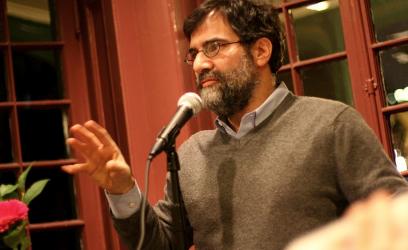
"Someone at my university who edits and publishes a newsletter asked me if I would write 500 words on what makes poetry distinctive," PennSound co-founder Al Filreis writes in a new Jacket2 commentary post. "I balked at such a task. But then decided to produce the statement." Particularly at the end of this week, when poetry was given a prominent and inspiring place in the midst of one of our nation's most significant political rituals (which, as one might expect, subsequently elicited a lot of petty griping) this sort of perspective — even if offered begrudgingly ("for or better or worse, here it is") — might be exactly what we all need.
"Whenever poetry becomes a topic movingly discussed by many people for whom it is not a daily — indeed, not even a monthly — thing," Filreis begins, "I realize once again what draws me to it ever and always. In a poem, how you say what you say is as important as, sometimes more important than, what you say. Is that a radical view? After all, content is central to communicating. But what about times when communication has broken down?" He then turns to the example of Allen Ginsberg's iconic poem "Howl," and specifically, "the riveting performance Ginsberg gave before a huge, engaged, at times ecstatic audience in Chicago in 1959" that you can hear here. "How Ginsberg says 'Howl' is as important as what he says, for sure. Words about crying out can themselves cry out." "So that is poetry," he affirms. "A form of saying. Not so much the things being said."
Later, he turns to the example of Erica Hunt, who'll be joining us shortly as the first of this year's Kelly Writers House Fellows: "Whenever I read — or, better, hear recited — [Hunt's] poem 'Reader we were meant to meet,' I think about how and why I cannot help but listen, cannot turn away from hearing, must attend. Because the poet is not just talking to me, but about me — about why I am necessary 'even in the failure to communicate.'" "Poems I admire require my involvement in the project of 'toppl[ing] distinctions' between who gets to talk and who is being asked to listen," Filreis tells us, "And that and only that kind of engagement — the convergence of writer and reader, of speech-maker and audience, of the talker and the silent, of the poet as subject and the reader normally supposed to be an object — will 'ease doubt.'"
Certainly, this feels pertinent to our present moment; however what we've offered here is just a small taste of Filreis' mini-essay, which merits reading in full. You can do so by clicking here.
