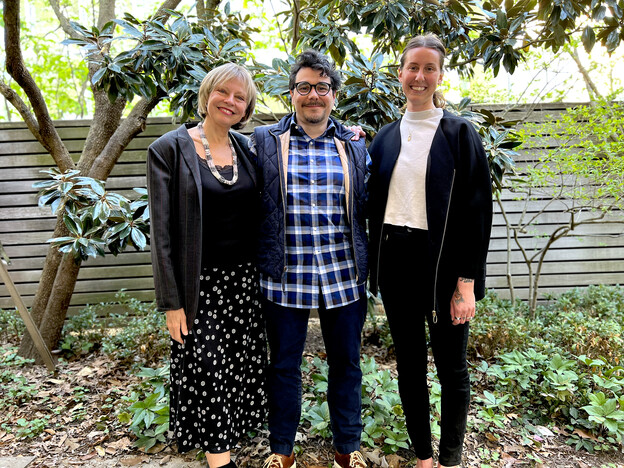
We recently released the latest episode in the PoemTalk Podcast series, which focuses on "Vision of Rotterdam" from Gregory Corso's collection Gasoline. For this program, host Al Filreis is joined by a panel including (from left to right) Rita Barnard, J.C. Cloutier, and M.C. Kinniburgh.
Filreis begins his write-up of this new episode on Jacket2 with some provenance for both the poem itself and the recording under discussion: "The poem records or remembers a moment of encounter and geo-historical reflection that took place in September 1957; the reflection casts the poet's visionary eye upon the German bombings of cities in the Netherlands of 1940. Corso performed and recorded the poem in 1969 — at Fantasy Studios on Natoma Street in San Francisco, 1969." "Thus the PoemTalk group decided," he continues, "that we are dealing with a convergence of three crucially distinct times: wartime 1940; Cold War-time (and Beat time) 1957; anti-war (post-)Beat 1969. It's eventually the consensus of the group, as it associationally emerges, that Corso's visionary romanticism, and his detailed, contextual awareness of that tradition, is an apt mode and motivation for this devastating contemplation of cycles of destruction and reconstruction."
