Friday, January 17, 2025

Remembering Gregory Corso

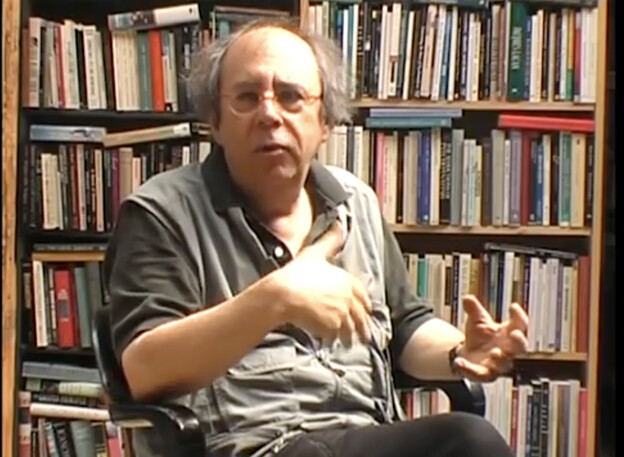
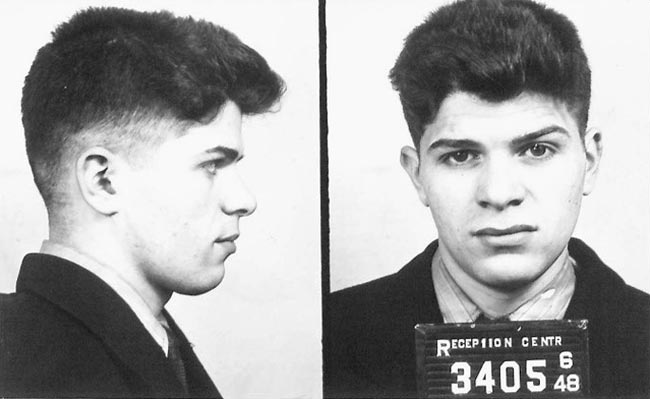
January 17th marks 24 years since resilient Beat bard Gregory Corso passed away at the age of 70. While the last years of his writing — as captured in Gus Reininger's moving documentary Corso: The Last Beat — have finally seen print in The Golden Dot: Last Poems, 1997–2000 (read William Lessard's Jacket2 interview with its editors here), this key poet is still in need of a proper collected poems, and dare one hope for a critical resurgence to go along with it.

We launched our Gregory Corso author page in June 2017, with assistance from Raymond Foye. There, you'll find five full readings plus one individual poem recorded between the 1970s and 1990s. The earliest recording is a April 1971 reading at Duke University, which is followed by an August 1985 appearance at the San Francisco Art Institute as part of their "Art of Poetry" series. Jumping forward to the 90s, there's a March 1991 Brooklyn College reading notable for the appearance of Corso's iconic late poem "The Whole Mess ... Almost" and for the half-hour candid conversation recorded in the car on the way home. From December 1992, there's a stellar reading in New York City also featuring Herbert Huncke, John Wieners, and Allen Ginsberg, and finally, from March 1993, we have a half-hour reading from Rutgers University including "I Met This Guy Who Died," "Earliest Memory," "Youthful Religious Experiences," and "How Not to Die," among other poems. Our most recent addition is a 1969 recording session at Fantasy Records' San Francisco studios on Natoma Street showcasing "In the Fleeting Hand of Time," "Vision of Rotterdam," "The Last Warmth of Arnold," "Mexican Impressions," "Botticelli Spring," "Sun — A Spontaneous Poem," "Ode to Coit Tower," and "I Am 25," among others.

Ginsberg famously offered high praise for his dear friend, calling him "a poet's Poet, his verse pure velvet, close to John Keats for our time, exquisitely delicate in manners of the Muse," who "has been and always will be a popular poet, awakener of youth, puzzlement & pleasure for sophisticated elder bibliophiles." He continues, judging Corso as "'Immortal' as immortal is, Captain Poetry exampling revolution of Spirit, his 'poetry the opposite of hypocrisy,' a loner, laughably unlaurelled by native prizes, divine Poet Maudit, rascal poet Villonesque and Rimbaudian whose wild fame's extended for decades around the world from France to China, World poet." Click here to start listening.

Thursday, January 16, 2025

Congratulations to T. S. Eliot Prize Winner Peter Gizzi

Today we offer our heartiest congratulations to Peter Gizzi, who was recently announced as the winner of the 2024 T. S. Eliot Prize for his 2023 collection Fierce Elegy

Judging committee chair Mimi Khalvati hailed the collection as "a work that is infinitely sad yet resolute, and so fully alive in body and spirit." "Written in the afterlife of grief," she continues, "Fierce Elegy brings us poems that revel in minutiae but also brave the large questions in a lyric sequence of transcendental beauty." Gizzi was announced as one of ten finalists last October, chosen from 187 submitted collections evaluated by judges Khalvati, Anthony Joseph and Hannah Sullivan. 

Dr. Maria del Guadalupe Davidson, a divisional dean Dean at Gizzi's home institution, UMass Amherst, noted that:
The UMass College of Fine Arts and Humanities joins the poetry world in celebrating Prof. Peter Gizzi’s T.S. Eliot Prize. Prof. Gizzi’s poems explore the imagination and the self. They examine love and grief and wrestle with despair, opening for the listener a way into our joys, our sorrows, and our songs of self. We are thrilled to have Prof. Gizzi teaching in the MFA and English department and to offer so many emerging writers the opportunity to work with and learn from him.
You can listen to Gizzi read from Fierce Elegy on his PennSound author page as part of his 2023 visit to Boise State University, one of nearly two dozen recordings spanning more than thirty years housed there. 

Monday, January 13, 2025

"Talking About David Antin," 2018

Antin's "Sky Poem," 1987
Today we're highlighting "Talking About David Antin," an event featuring Eleanor Antin, Charles Bernstein, Julien Bismuth, and Ellen Zweig, which took place at New York's Artists Space on March 27, 2018.

Artists Space Director Jay Sanders provided introductory comments for the two-hour event, which featured individual talks by the aforementioned friends and colleagues, followed by a half-hour collaborative Q&A session.  As the venue's blurb for the event notes, "David Antin's influential work as a poet and artist led him to develop the hybridized format of 'talk poems' in the 1970s, whereby he would compose literary texts in an improvised, conversational manner in a public setting." Those assembled offer up "performances and interventions" that pay tribute to his prodigious, "multidimensional literary and artistic output."

You can enjoy video and audio versions of this event on PennSound's David Antin author page, which is home to forty years' worth of recordings highlighting his singular talents, which are sorely missed.

Saturday, January 11, 2025

In Memoriam: Richard Foreman (1937-2024)

This week the world said farewell to groundbreaking playwright and founder of the Ontological-Hysteric Theater founder Richard Foreman, who passed away at the age of 87 on January 4th. Our own Charles Bernstein broke the news on his Jacket2 commentary page and has used the post to compile links to obituaries and tributes to Foreman.

"We have lost one of the most original and important theater artists of the last century," wrote Oskar Eustis, — artistic director of New York's Public Theater, with which Foreman had a long association — before concluding "He represented, for many, the model of what a committed downtown New York artist could be. He leaves a huge hole in our world." Helen Shaw echoed this sense of loss in The New Yorker, observing that with Foreman's passing, "an era came to an end." "You might define that era as a time of American aesthetic swagger, when artists such as Foreman, Mabou Mines, Meredith Monk, and Robert Wilson enjoyed international attention, helping make late-twentieth-century New York a performance mecca. Or you might think of it as the era of cheap Manhattan housing, gone now, when artists could afford to pour their often unpaid labor into hugely effortful collaborative projects," she continues. "Maybe you’d call it the era of downtown. But to me, and to many others, a whole half century was just . . . the era of Richard Foreman." Finally, Artforum hailed Foreman as one "who lifted up fresh voices as regularly and with as much gusto as he penned wild new plays—more than fifty, in all" and cited his award wins ("seven Obie awards [...] three of them for Best Play of the Year") as "the fruits of his fertile imagination and fearless devotion to plunging into untested waters, dragging his audiences with him." 

PennSound's Richard Foreman author page is a treasure trove spanning nearly fifty years, with a wide variety of materials, including complete recordings of many of his plays along with readings, interviews, talks, panel discussions, supplemental materials, and much more. For those looking for a few potential avenues into such an immense archive, may we make a few suggestions? There's no better starting point than Foreman's three-part appearance on Bernstein's Close Listening radio program, which features the two in conversation for nearly a half hour, then two segments of Foreman reading from his prose works and plays, respectively. Another worthy option is Henry Hills' short film King Richard, described as follows: 

A charming yet revealing interview on the set by pre-teen protagonist Emma Bee Bernstein is interwoven with footage focusing on the periphery of a recent production — the elaborate set design and lighting, the non-speaking supporting cast (the so-called "stage crew") with their frantic movement patterns, typical props and recurrent imagery, all shot & edited in a disruptive manner to mimetically compensate for the loss of actual presence.

Hills said of the film, "Curators don't seem to get this piece. I don't understand because I find it fantastic and endlessly interesting. This is my most misunderstood work in years!" 

Speaking of Hills, surveying the work collected on Foreman's PennSound page in her New Yorker piece, Helen Shaw offers the opinion that "The best one to start with, I think, is Henry Hills's extraordinary 2010 film of Astronome, which feels like a Kabbalistic ritual sped up into a panic attack." Finally, Foreman was also a frequent guest on Leonard Schwartz's long-running radio program Cross Cultural Poetics, appearing on a half-dozen episodes between 2004 and 2009, and one can track his evolution during this period across each visit. You can find all of the aforementioned recordings, along with a great deal more, here.

We'll give the final word to Bernstein, who, announcing the death of his close friend offered this simple summation: "His memory, and the memory of his work, is a blessing for all who had the pleasure to experience it."


Monday, January 6, 2025

William Carlos Williams Burns the Christmas Greens

In Irish culture January 6th is traditionally recognized as Little Christmas, which marks the official end of the holiday season. On a chilly day like today, even a lapsed Catholic such as myself can't help but shudder just a little at the sight of the previous year's Christmas trees stripped bare and piled at the curbside waiting on trash day. Richard Brautigan's portrait of the grim holiday season after JFK's assassination, "'What Are You Going to Do With 390 Photographs of Christmas Trees?'" (from The Tokyo-Montana Express) does a fine job of paying tribute to this strange phenomenon — the sense of loss that haunts the promise of a fresh new year — but even it pales in comparison to the stark beauty of William Carlos Williams' "Burning the Christmas Greens," one of my favorite hidden gems on PennSound's encyclopedic Williams author page.

First published in the January 1944 issue of Poetry, the poem would later appear in The Wedge that same year. Altogether we have four recordings of Williams reading the poem: one from a May 1945 session at the Library of Congress Recording Library, another from a June 1951 home recording by Kenneth Burke, the third from a reading at Harvard in December of that year, and the last from the 92nd Street Y in January 1954; we also have a 1990 rendition of the poem by Robert Creeley.

"At the winter's midnight" — the thick of the dark / the moment of the cold's / deepest plunge" — "we went to the trees, the coarse / holly, the balsam and / the hemlock for their green," Williams tells us, before launching into a litany of the season's decorative delights. "Green is a solace / a promise of peace, a fort / against the cold," something that "seemed gentle and good / to us," and yet now, "their time past," Williams finds a different sort of solace in the "recreant" force of the conflagration, "a living red, / flame red, red as blood wakes / on the ash." Surrendering ourselves to the experience, we find ourselves, like Williams, "breathless to be witnesses, / as if we stood / ourselves refreshed among / the shining fauna of that fire," ready and grateful to be able to begin the cycle once more.

So even though the calendar's turned over, the presents are put away, and the all-too-swift delights of the season are gone, here's one last chance to reflect on what we've experienced and an opportunity to prepare ourselves for what lies ahead. You can listen to our four recordings of Williams reading the poem on his PennSound author page, or click here to hear the earliest.

Friday, January 3, 2025

Paul Buck's Pressed Curtains Tape Project

In the 1970s, Paul Buck edited Curtains, a leading British avant-garde journal, whose amorphous identity was evidenced by its issue-by-issue name changes (Safety CurtainCurtain-RaiserA Range of Curtains, etc.) in the style of Tom Clark's Once and Kenward Elmslie's Z. "Curtains was not a poetry magazine either," Buck notes, "though it contained poetry and was viewed as part of the poetry world. Initially I was intent on researching an area of writing between poetry and prose, a writing that was more likely to be written by poets, though not exclusively." In time, the magazine would expand to become a multimedia endeavor:
Halfway through the 1970s, the notion of performing, whether relating to "performance art" or in terms of the oral tradition of poetry, was another factor that became part of the fabric. I was combining the two courses and exploring the oral in terms of poetry, music, art and ethnic traditions. It seemed natural to extend the boundaries of Curtains into a cassette tape series, even if no sophisticated equipment was available, either at home or nearby. 

In time, Buck would go on to release three cassettes under the series name Pressed Curtains: readings by Eric Mottram and Ulli McCarthy (then known as Ulli Freer) made at his own home, along with a recording of himself reading his piece xxxx7. Other recordings were made for potential release, but never saw the light of day. That ended in 2015, when Test Centre and Blank Editions put out a lavish limited-edition box set including a ten cassettes in total. With that edition of fifty now sold out, Buck has generously shared the complete archives with PennSound. In addition to the three original releases, you'll find recordings by Kathy Ackercris cheekAllen FisherBill GriffithsPierre JorisRobert Kelly, and Jean-Luc Parant. Buck's illuminating liner notes are also included. Click here to start exploring this fascinating time capsule.


Wednesday, January 1, 2025

Bern Porter on PennSound

Today we're highlighting our holdings from the influential author, artist, and publisher Bern Porter, perhaps best known for his pioneering work in the field of Found Poetry.

Our earliest recording is parts one and two of "For Our Friends in Germany," recorded by Mark Melnicove in 1979 at the Eternal Poetry Festival in South Harpswell, Maine. Then there's "Aspects of Modern Poetry," a 1982 WBAI program with Bob Holman that was broadcast live. It's presented in two parts that are roughly a half-hour each.

Next, we have the New Wilderness Audiographics cassette release, Found Sounds, whose two sides consist of two separate sessions, the first made on December 2, 1978 with Dick Higgins and Charlie Morrow; the second from May 9, 1981 and featuring Patricia Burgess (tenor saxophone), Glen Velez (bodhrán, cymbal, tambourine), and Morrow (brass, ocarina, and voice). 

Jumping forward to December 1989, we have a recording from "Williamson Street Night" at the Avant Garde, Museum of Temporary Art in Madison, Wisconsin with contributions by Malok, Elizabeth Was & mIEKAL aND, and our final recording is an interview with Higgins and aND from Woodland Pattern Book Center on March 16, 1990. You can browse all of the aforementioned recordings by visiting our Bern Porter author page.