

Today we're revisiting another classic recording from our PennSound Cinema page: FAT FEET, a groundbreaking short film made by the then-husband-and-wife team of Mimi Gross and Red Grooms.
In addition to the twenty-minute film, we've assembled remembrances from Gross and Yvonne Andersen (who served as photographer, artist and editor, as well as constructing sets and props). Here's Gross describing the film's origins and inspirations:
As I worked with Red at various intervals of time and projects, from 1960-1976, our collaborations became increasingly intense, and often lost the boundaries of ideas, aesthetics, and in the real time of making, craft and painting.FAT FEET (1965-66) was directly inspired by the early animated films of Georges Melies, Emil Kohl, and the marvelous movie, The Invisible Moving Co, all of which we saw from the collections of Joseph Cornell (via Robert Whitman and Rudy Burckhardt). In 1962-3, together with Rudy Burckhardt, we made a 16mm film called Shoot the Moon. It is a direct homage to Georges Melies. There are some brief scenes with stop-action animation. Red and I made little cut outs, and Rudy showed us how he filmed the scene. A few years later, we experimented with animating life-sized props with live actors (long before "green screens").When Yvonne Andersen and Dominic Falcone visited us in New York, we planned to make a film together the following summer where they lived near Boston. Red and I had just moved into lively "Little Italy" (1964), a neighborhood where daily fires, violence, and long term elderly residents lived near the Bowery, filled with bums, and (pre-immigration quota) Chinatown. I was busy drawing in the streets, and making objects based on street life, and Red was obsessively chasing fires, fire engines, street life, he was incorporating into his work.The explosion of making FAT FEET resulted from our excitement living in the new neighborhood. Later, we made an ad, and called FAT FEET: "A day in the life of 'nervous city'!"
And here's Andersen describing the spirit of collaboration among friends that guided the project:
Each morning the four of us along with Dominic and our two children Paul, 7 and Jean, 5 went to the studio to build the sets and props. We painted cartoonish black and white buildings on the paper walls of the set, painted and and constructed 3/4 size flat automobiles with movable wheels from heavy building cardboard. Red built a dog which could be animated to walk in front of a live person.Red was creating a cartoonish atmosphere depicting the types of city people who might be seen walking the street of a big city. For this reason the people wore giant shoes to connect them to the sidewalks. Those shoes were heavy! A normal shoe was screwed into a giant shoe manufactured by Red.In the beginning this was supposed to be a four person project, but people heard about it. Each night people came to be in the winter crowd scenes. Some were friends of Red and Mimi, some were my animation students and neighbors. We got old coats from Morgan Memorial and there was a large make up table. People could come in, put on a coat, do their own make up, and become who they wanted to be for the evening.
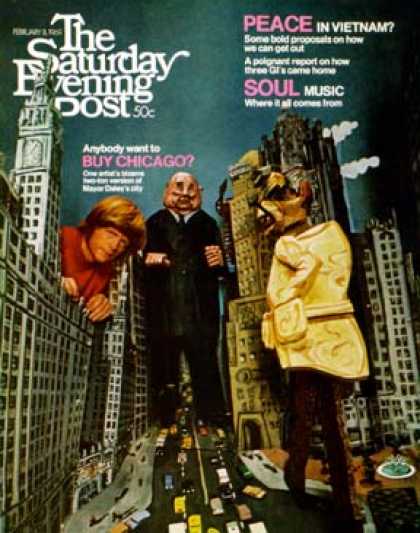
From a personal perspective, it was truly wonderful to finally get to see this charming film when we first announced it a decade ago this month, since I had first heard about (along with its creators) under strange circumstances a very long time ago. My grandfather spent many years working as a printer for the Curtis Publishing Company, and one of the few concrete mementoes from his time there (aside from the missing tip of one finger) was a copy of the February 8, 1969 Saturday Evening Post (shown at right) — the magazine's final weekly edition after seventy-two years of publication, which featured Red Grooms on the cover and a lavish article on Grooms and Gross inside. Their technicolor art and lifestyle was immediately appealing to me, connecting with my kindergartener logic (as did the work of Keith Haring, who I likely discovered around the same time), and I found my first favorite artists.
Jumping forward several decades, I should add that I'm still very fond of the work that Grooms and Gross produced in the 1960s, and, for that matter, I still have that issue of The Saturday Evening Post, stored next to the 2004 Rizzoli retrospective of their art. Seeing FAT FEET for the first time, that childlike awe is certainly rekindled by its Chaplin-esque grace, its engaging bustle, the warmth of its handmade aesthetic and its dizzying juxtapositions (of black-and-white and color, two- and three-dimensional forms, live actors and stop-motion animation). Check out the film on our FAT FEET homepage and perhaps you'll have the same magical experience.
